


COVID-19 forecasting using new viral variants and vaccination effectiveness models
- PMID: 36030722
- PMCID: PMC9381972
- DOI: 10.1016/j.compbiomed.2022.105986
COVID-19 forecasting using new viral variants and vaccination effectiveness models
Abstract
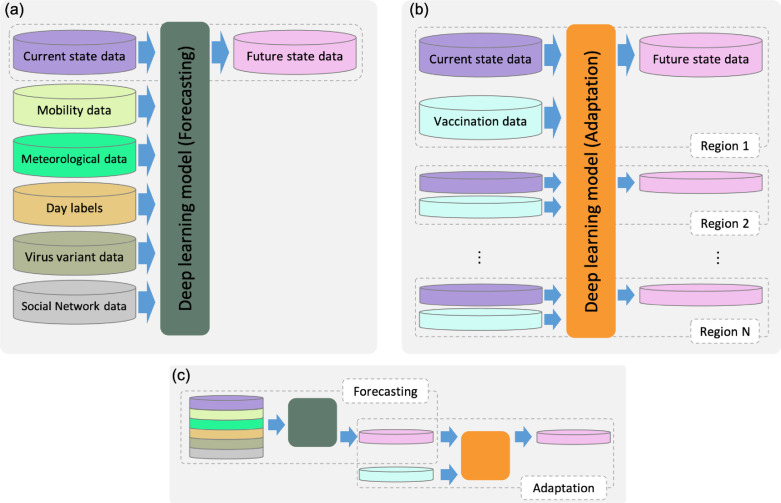
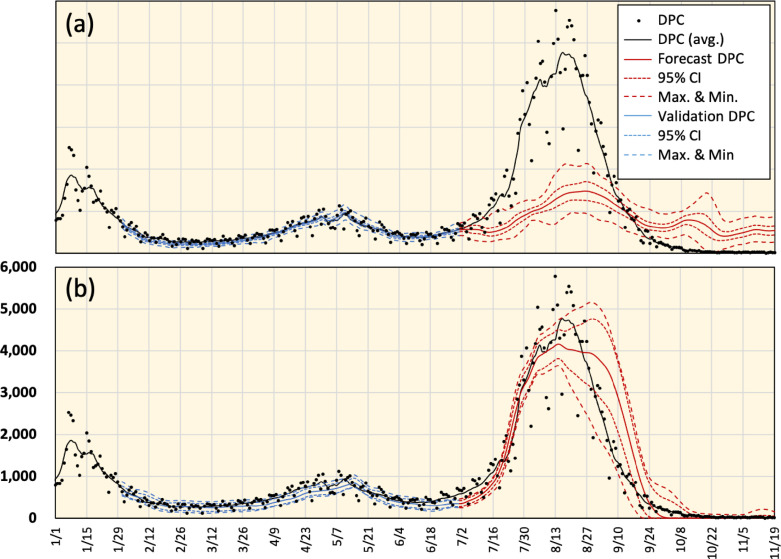
Recently, a high number of daily positive COVID-19 cases have been reported in regions with relatively high vaccination rates; hence, booster vaccination has become necessary. In addition, infections caused by the different variants and correlated factors have not been discussed in depth. With large variabilities and different co-factors, it is difficult to use conventional mathematical models to forecast the incidence of COVID-19. Machine learning based on long short-term memory was applied to forecasting the time series of new daily positive cases (DPC), serious cases, hospitalized cases, and deaths. Data acquired from regions with high rates of vaccination, such as Israel, were blended with the current data of other regions in Japan such that the effect of vaccination was considered in efficient manner. The protection provided by symptomatic infection was also considered in terms of the population effectiveness of vaccination as well as the vaccination protection waning effect and ratio and infectivity of different viral variants. To represent changes in public behavior, public mobility and interactions through social media were also included in the analysis. Comparing the observed and estimated new DPC in Tel Aviv, Israel, the parameters characterizing vaccination effectiveness and the waning protection from infection were well estimated; the vaccination effectiveness of the second dose after 5 months and the third dose after two weeks from infection by the delta variant were 0.24 and 0.95, respectively. Using the extracted parameters regarding vaccination effectiveness, DPC in three major prefectures of Japan were replicated. The key factor influencing the prevention of COVID-19 transmission is the vaccination effectiveness at the population level, which considers the waning protection from vaccination rather than the percentage of fully vaccinated people. The threshold of the efficiency at the population level was estimated as 0.3 in Tel Aviv and 0.4 in Tokyo, Osaka, and Aichi. Moreover, a weighting scheme associated with infectivity results in more accurate forecasting by the infectivity model of viral variants. Results indicate that vaccination effectiveness and infectivity of viral variants are important factors in future forecasting of DPC. Moreover, this study demonstrate a feasible way to project the effect of vaccination using data obtained from other country.
Keywords: COVID-19; Deep learning; Forecasting; Vaccination effectiveness.
Copyright © 2022 Elsevier Ltd. All rights reserved.
Conflict of interest statement
Declaration of Competing Interest The authors declare that they have no known competing financial interests or personal relationships that could have appeared to influence the work reported in this paper.
Figures





References
-
- 2022. WHO. Online https://covid19.who.int (Accessed 5-Mar-2022)
-
- Alamoodi A., Zaidan B., Al-Masawa M., Taresh S.M., Noman S., Ahmaro I.Y., Garfan S., Chen J., Ahmed M., Zaidan A., Albahri O., Aickelin U., Thamir N.N., Fadhil J.A., Salahaldin A. Multi-perspectives systematic review on the applications of sentiment analysis for vaccine hesitancy. Comput. Biol. Med. 2021;139 doi: 10.1016/j.compbiomed.2021.104957. - DOI - PMC - PubMed
MeSH terms
Supplementary concepts
LinkOut - more resources
Full Text Sources
Medical
