


Comparison of patient characteristics and long-term mortality between transferred and non-transferred COVID-19 patients in Dutch intensive care units: A national cohort study
- PMID: 36031794
- PMCID: PMC9539143
- DOI: 10.1111/aas.14129
Comparison of patient characteristics and long-term mortality between transferred and non-transferred COVID-19 patients in Dutch intensive care units: A national cohort study
Abstract
Background: COVID-19 patients were often transferred to other intensive care units (ICUs) to prevent that ICUs would reach their maximum capacity. However, transferring ICU patients is not free of risk. We aim to compare the characteristics and outcomes of transferred versus non-transferred COVID-19 ICU patients in the Netherlands.
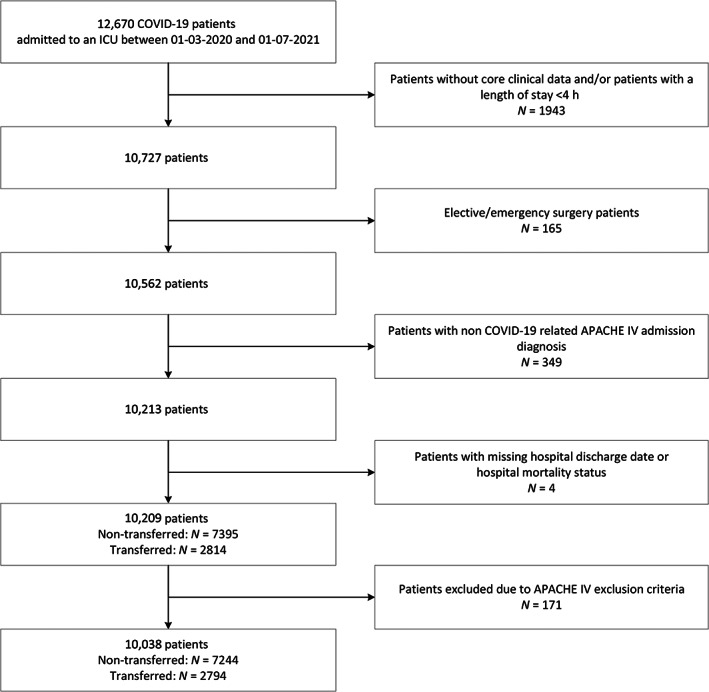
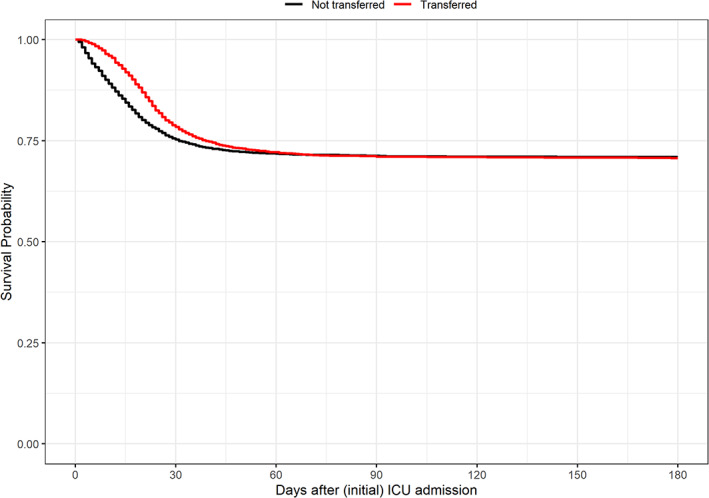
Methods: We included adult COVID-19 patients admitted to Dutch ICUs between March 1, 2020 and July 1, 2021. We compared the patient characteristics and outcomes of non-transferred and transferred patients and used a Directed Acyclic Graph to identify potential confounders in the relationship between transfer and mortality. We used these confounders in a Cox regression model with left truncation at the day of transfer to analyze the effect of transfers on mortality during the 180 days after ICU admission.
Results: We included 10,209 patients: 7395 non-transferred and 2814 (27.6%) transferred patients. In both groups, the median age was 64 years. Transferred patients were mostly ventilated at ICU admission (83.7% vs. 56.2%) and included a larger proportion of low-risk patients (70.3% vs. 66.5% with mortality risk <30%). After adjusting for age, APACHE IV mortality probability, BMI, mechanical ventilation, and vasoactive medication use, the hazard of mortality during the first 180 days was similar for transferred patients compared to non-transferred patients (HR [95% CI] = 0.99 [0.91-1.08]).
Conclusions: Transferred COVID-19 patients are more often mechanically ventilated and are less severely ill compared to non-transferred patients. Furthermore, transferring critically ill COVID-19 patients in the Netherlands is not associated with mortality during the first 180 days after ICU admission.
Keywords: COVID-19; intensive care unit; intrahospital transfer; mortality; severity of illness.
© 2022 The Authors. Acta Anaesthesiologica Scandinavica published by John Wiley & Sons Ltd on behalf of Acta Anaesthesiologica Scandinavica Foundation.
Conflict of interest statement
Nicolette F. de Keizer, Dylan W. de Lange, and Dave A. Dongelmans are members of the board of the Dutch National Intensive Care Evaluation (NICE) foundation. The NICE foundation pays the Department of Medical Informatics, Amsterdam UMC, for processing data of all Dutch ICUs into audit and feedback information. Safira A. Wortel, Nicolette F. de Keizer, Fabian Termorshuizen, and Ferishta Bakhshi‐Raiez are employees of the Department of Medical Informatics and work on the NICE project.
Figures
References
-
- The Dutch COVID‐19 Research Consortium . One year of COVID‐19 in The Netherlands ‐ a Dutch narrative. Neth J Crit Care. 2021;29:78‐84.
-
- Mazzoli CA, Gamberini L, Lupi C, et al. Interhospital transfer of critically ill COVID‐19 patients: preliminary considerations from the Emilia‐Romagna experience. Air Med J. 2020;39(5):423‐426.
MeSH terms
LinkOut - more resources
Full Text Sources
Medical
