


Immunogenicity and toxicity of AAV gene therapy
- PMID: 36032092
- PMCID: PMC9411526
- DOI: 10.3389/fimmu.2022.975803
Immunogenicity and toxicity of AAV gene therapy
Abstract
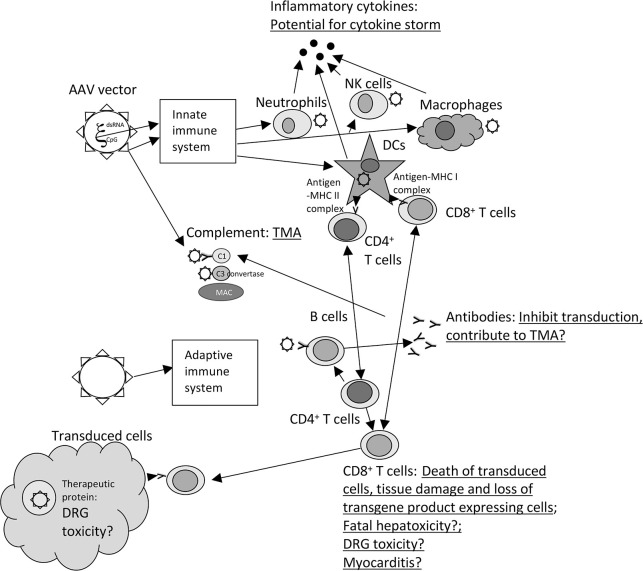
Gene transfer using adeno-associated viral (AAV) vectors has made tremendous progress in the last decade and has achieved cures of debilitating diseases such as hemophilia A and B. Nevertheless, progress is still being hampered by immune responses against the AAV capsid antigens or the transgene products. Immunosuppression designed to blunt T cell responses has shown success in some patients but failed in others especially if they received very high AAV vectors doses. Although it was initially thought that AAV vectors induce only marginal innate responses below the threshold of systemic symptoms recent trials have shown that complement activation can results in serious adverse events. Dorsal root ganglia toxicity has also been identified as a complication of high vector doses as has severe hepatotoxicity. Most of the critical complications occur in patients who are treated with very high vector doses indicating that the use of more efficient AAV vectors to allow for dose sparing or giving smaller doses repeatedly, the latter in conjunction with antibody or B cell depleting measures, should be explored.
Keywords: AAV; B cell responses; T cell responses; innate immune responses; serious adverse events.
Copyright © 2022 Ertl.
Conflict of interest statement
The author consults for several Gene Therapy companies and holds equity in Virion Therapeutics.
Figures
References
-
- Herzog RW, Hagstrom JN, Kung SH, Tai SJ, Wilson JM, Fisher KJ, et al. Stable gene transfer and expression of human blood coagulation factor IX after intramuscular injection of recombinant adeno-associated virus. Proc Natl Acad Sci U S A (1997) 94(11):5804–9. doi: 10.1073/pnas.94.11.5804 - DOI - PMC - PubMed
Publication types
MeSH terms
Substances
LinkOut - more resources
Full Text Sources
Other Literature Sources
Medical
