


Auditory Processing in Children with Specific Language Impairment: A FFR Based Study
- PMID: 36032839
- PMCID: PMC9411455
- DOI: 10.1007/s12070-020-02127-x
Auditory Processing in Children with Specific Language Impairment: A FFR Based Study
Abstract
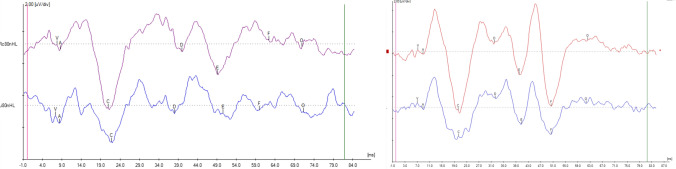
Specific language impairment (SLI) is diagnosed when a child has difficulty in producing or understanding spoken language for no apparent reason. The study attempted to assess the sub-cortical encoding in children with SLI using speech-evoked auditory brainstem response (ABR). The objective of the study was to compare the amplitude and latency of the frequency following response (FFR) parameters between the children with SLI and typically developing children. The frequency following response was recorded using/da/stimuli from ten ears of children diagnosed with SLI. The amplitude and the latencies of the different peaks of FFR in children with SLI were compared with those of typically developing children. The results of the study showed that the latencies of wave C and D were significantly prolonged in children with SLI compared to typically developing children. The waveforms obtained from the typically developing (TD) children were clearer and easily identifiable, with larger negativity observed in the troughs. The waveform morphology was poorer in children with SLI with shallower peaks. Thus, it can be concluded that speech evoked ABR gives an insight into the auditory processing ability of children with SLI. It indicates that signal processing in the auditory pathway of children with SLI is temporally distorted and which might affect the development of language.
Keywords: Auditory evoked potential; Auditory processing; Frequency following response; Specific language impairment.
© Association of Otolaryngologists of India 2020.
Conflict of interest statement
Conflicts of interestThe authors do not have any conflicts of interests to disclose. The authors report no conflicts of interest. The authors alone are responsible for the content and writing of the paper.
Figures


References
LinkOut - more resources
Full Text Sources