


The survival benefit of different lymph node yields in radical prostatectomy for pN1M0 prostate cancer patients: Implications from a population-based study
- PMID: 36033541
- PMCID: PMC9404339
- DOI: 10.3389/fonc.2022.953069
The survival benefit of different lymph node yields in radical prostatectomy for pN1M0 prostate cancer patients: Implications from a population-based study
Abstract
Background and objectives: The extent and survival benefits of lymph node dissection (LND) in radical prostatectomy (RP) for pN1M0 prostate cancer (PCa) patients remained unclear and were controversial. This study aimed to determine the survival benefit of different lymph node yields in RP for pN1M0 PCa patients.
Methods: pN1M0 PCa patients who received RP and LND were identified in Surveillance Epidemiology and End Results (SEER) (2010-2015). Patients were divided into two groups in SEER based on the removal of one to three regional lymph nodes (LND1 group) or four or more regional lymph nodes (LND4 group). Kaplan-Meier methods were used to calculate cancer-specific survival (CSS) and overall survival (OS).
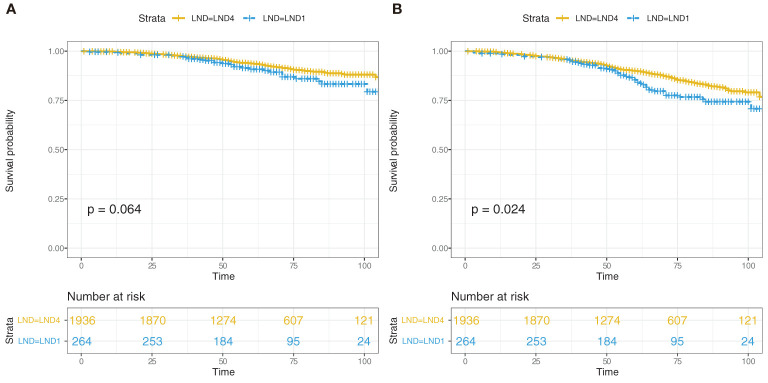
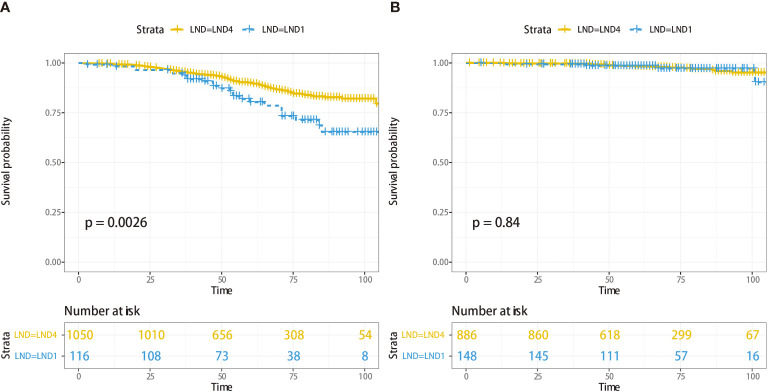
Results: In total, 2,200 patients were identified; 264 patients received LND1 and 1,936 patients received LND4. CSS had no significant difference between the LND4 and LND1 groups (101mon vs. 98mon, p = 0.064), and OS was higher in LND4 patients compared with LND1 patients (97mon vs. 93mon, p = 0.024); for patients with Gleason score = 9 or 10 and T3b or T4, 5-year OS was higher in patients undergoing LND4 (80.9%; 95% CI, 79.0-82.8) compared with those undergoing LND1 (67.5%; 95% CI, 60.8-74.2) (p = 0.009).
Conclusion: More lymph node yield provided better survival for patients with Gleason score = 9 or 10 and T3b or T4, but not for other pN1M0 PCa patients. The extent of LND would be determined after a comprehensive evaluation including Gleason score, tumor stage, and the general condition of the patient.
Keywords: Gleason score; lymph node dissection; prognosis (carcinoma); radical prostatectomy; tumor stage.
Copyright © 2022 Hu, Yu, Liu, Zhong, Zhou and Xi.
Conflict of interest statement
The authors declare that the research was conducted in the absence of any commercial or financial relationships that could be construed as a potential conflict of interest.
Figures
References
-
- Mottet N, van den Bergh R, Briers E, Van den Broeck T, Cumberbatch MG, De Santis M, et al. EAU-EANM-ESTRO-ESUR-SIOG guidelines on prostate cancer-2020 update. part 1: Screening, diagnosis, and local treatment with curative intent. Eur Urol (2021) 79(2):243–62. doi: 10.1016/j.eururo.2020.09.042 - DOI - PubMed
-
- Gandaglia G, Martini A, Ploussard G, Fossati N, Stabile A, De Visschere P, et al. External validation of the 2019 briganti nomogram for the identification of prostate cancer patients who should be considered for an extended pelvic lymph node dissection. Eur Urol (2020) 78(2):138–42. doi: 10.1016/j.eururo.2020.03.023 - DOI - PubMed
-
- D'Amico AV, Whittington R, Malkowicz SB, Schultz D, Blank K, Broderick GA, et al. Biochemical outcome after radical prostatectomy, external beam radiation therapy, or interstitial radiation therapy for clinically localized prostate cancer. Jama (1998) 280(11):969–74. doi: 10.1001/jama.280.11.969 - DOI - PubMed
-
- Seyedin SN, Mitchell DL, Mott SL, Russo JK, Tracy CR, Snow AN, et al. Is more always better? an assessment of the impact of lymph node yield on outcome for clinically localized prostate cancer with Low/Intermediate risk pathology (pT2-3a/pN0) managed with prostatectomy alone. Pathol Oncol Res (2019) 25(1):209–15. doi: 10.1007/s12253-017-0349-5 - DOI - PMC - PubMed
-
- Laine C, Gandaglia G, Valerio M, Heidegger I, Tsaur I, Olivier J, et al. Features and management of men with pN1 cM0 prostate cancer after radical prostatectomy and lymphadenectomy: a systematic review of population-based evidence. Curr Opin Urol (2022) 32(1):69–84. doi: 10.1097/MOU.0000000000000946 - DOI - PubMed
LinkOut - more resources
Full Text Sources
