


Chronotype, circadian rhythm, and psychiatric disorders: Recent evidence and potential mechanisms
- PMID: 36033630
- PMCID: PMC9399511
- DOI: 10.3389/fnins.2022.811771
Chronotype, circadian rhythm, and psychiatric disorders: Recent evidence and potential mechanisms
Abstract
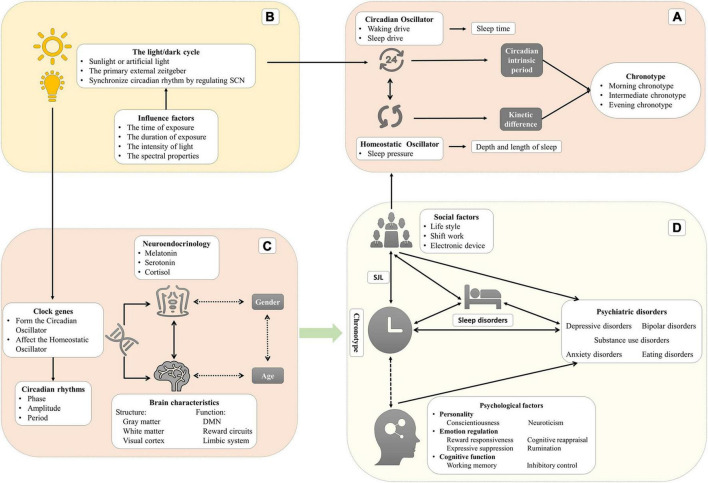
The circadian rhythm is crucial for physiological and behavioral functions. Chronotype, which represents individual preferences for activity and performance, is associated with human health issues, particularly psychiatric disorders. This narrative review, which focuses on the relationship between chronotype and mental disorders, provides an insight into the potential mechanism. Recent evidence indicates that (1) the evening chronotype is a risk factor for depressive disorders and substance use disorders, whereas the morning chronotype is a protective factor. (2) Evening chronotype individuals with bipolar disorder tend to have more severe symptoms and comorbidities. (3) The evening chronotype is only related to anxiety symptoms. (4) The relationship between chronotype and schizophrenia remains unclear, despite increasing evidence on their link. (5) The evening chronotype is significantly associated with eating disorders, with the majority of studies have focused on binge eating disorders. Furthermore, the underlying mechanisms or influence factors are described in detail, including clock genes, brain characteristics, neuroendocrinology, the light/dark cycle, social factors, psychological factors, and sleep disorders. These findings provide the latest evidence on chronotypes and psychiatric disorders and serve as a valuable reference for researchers.
Keywords: chronotype; circadian rhythm; depression; psychiatric disorders; sleep disorder.
Copyright © 2022 Zou, Zhou, Yan, Yao and Lu.
Conflict of interest statement
The authors declare that the research was conducted in the absence of any commercial or financial relationships that could be construed as a potential conflict of interest.
Figures
Comment in
-
Commentary: Chronotype, circadian rhythm, and psychiatric disorders: recent evidence and potential mechanisms.Front Neurosci. 2024 Nov 1;18:1470026. doi: 10.3389/fnins.2024.1470026. eCollection 2024. Front Neurosci. 2024. PMID: 39559719 Free PMC article. No abstract available.
References
Publication types
LinkOut - more resources
Full Text Sources
