. 2022 Aug 11:13:923585.
doi: 10.3389/fphar.2022.923585. eCollection 2022.

Oxaliplatin Eluting CalliSpheres Microspheres for the Treatment of Unresectable or Recurrent Hepatocellular Carcinoma

Affiliations

Oxaliplatin Eluting CalliSpheres Microspheres for the Treatment of Unresectable or Recurrent Hepatocellular Carcinoma

Yonghua Bi et al. Front Pharmacol. .

Abstract

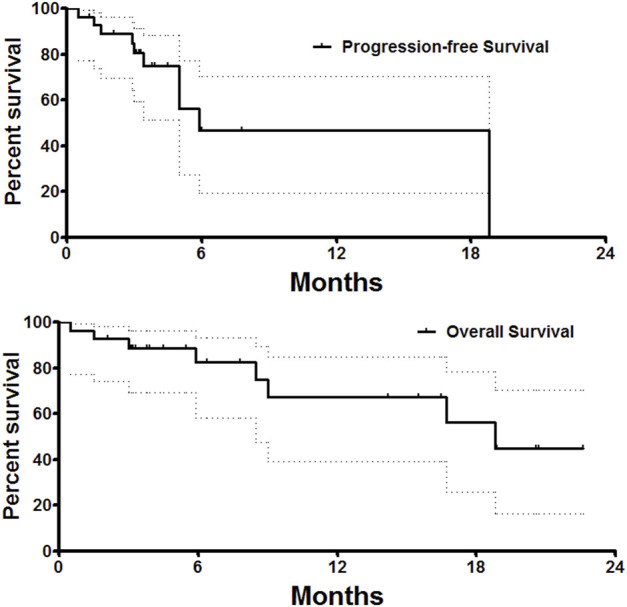
Aim: Drug-eluting beads-transarterial chemoembolization (DEB-TACE) has been widely used in unresectable and advanced hepatocellular carcinoma (HCC). However, no study reported the clinical outcomes of drug-eluting beads TACE (DEB-TACE) with oxaliplatin-eluting CalliSpheres microspheres in the treatment of HCC. This study reports the preliminary outcomes of DEB-TACE loaded with oxaliplatin for the treatment of patients with unresectable or recurrent HCC. Methods: From November 2019 to November 2021, 29 patients with unresectable or recurrent HCC were recruited from our department and treated by DEB-TACE loaded with oxaliplatin. The primary endpoint was progression-free survival (PFS), and the secondary endpoints were disease control rate and safety. Tumor response was investigated at 1, 3, and 6 months after DEB-TACE according to the criteria of the response evaluation in solid tumor (RECIST) criteria and the modified RECIST criteria (mRECIST). Survival curve was generated with the Kaplan-Meier method. Results: A total of 49 DEB-TACE sessions were performed, with a technical success rate of 100%. The overall response rate and disease control rate were 52.4 and 95.2%, 64.7 and 76.5%, and 54.5 and 63.3%, respectively, at 1, 3, and 6 months after DEB-TACE (mRECIST). The PFS was 5.9 months, and the median overall survival was 18.8 months. The 6- and 12-month overall survival rate was 82.5% and 67.5%, respectively, No treatment-related mortality or severe adverse events were observed. Minor complications were observed in 21 patients (72.4%), and abdominal pain (41.4%) was the most common treatment-related complication. Conclusion: DEB-TACE loaded with oxaliplatin-eluting CalliSpheres microspheres could be a safe, feasible, and efficacious palliative regimen in unresectable or recurrent HCC patients.

Keywords: CalliSpheres beads; TACE; drug-eluting beads transarterial chemoembolization (DEB-TACE); hepatocellular carcinoma (HCC); oxaliplatin.


Conflict of interest statement

The authors declare that the research was conducted in the absence of any commercial or financial relationships that could be construed as a potential conflict of interest.

Figures
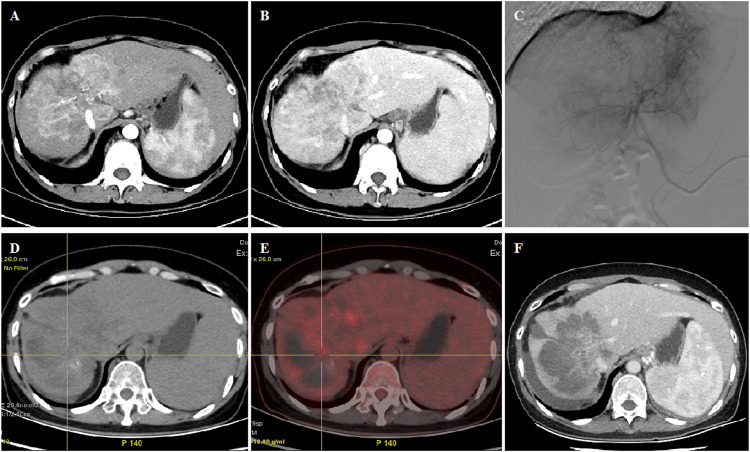
FIGURE 1
FIGURE 1
45 year old female patient treated with CalliSpheres beads for advanced primary HCC. (A–B) CT examination on admission revealed HCC in the right lobe. (C) Huge tumor staining was shown and was embolized by 300–500 μm oxaliplatin-loaded beads. (D–E) PET-CT showed significant reduction of the tumor and no residual tumor at 2.2 months’ follow-up. (F) Complete response was shown by mRECIST criteria at 5.0 months’ follow-up and still alive 15.5 months later.
FIGURE 2
FIGURE 2
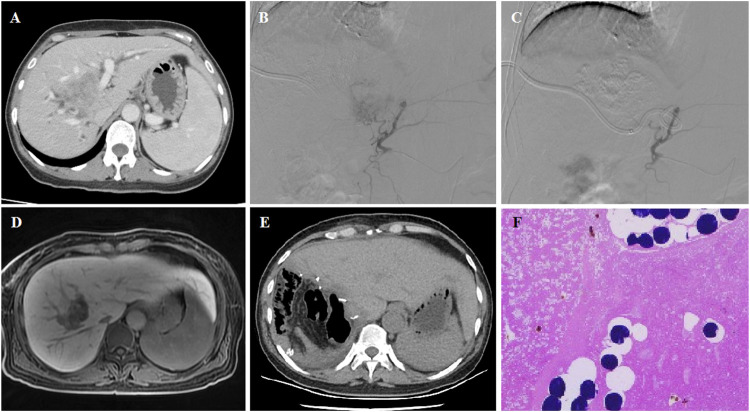
54 years female patient treated with CalliSpheres beads for advanced primary HCC. (A) CT revealed a tumor in the right lobe and the obstructed bile duct. (B–C) Tumor artery was super selectively incubated and embolized by 100–300 μm oxaliplatin-loaded beads. (D) MR revealed a shrunk tumor 4.6 months after DEB-TACE. (E–F) Tumor was resected 4.9 months after DEB-TACE, and no residual tumor was shown by pathological examination.
FIGURE 3
FIGURE 3
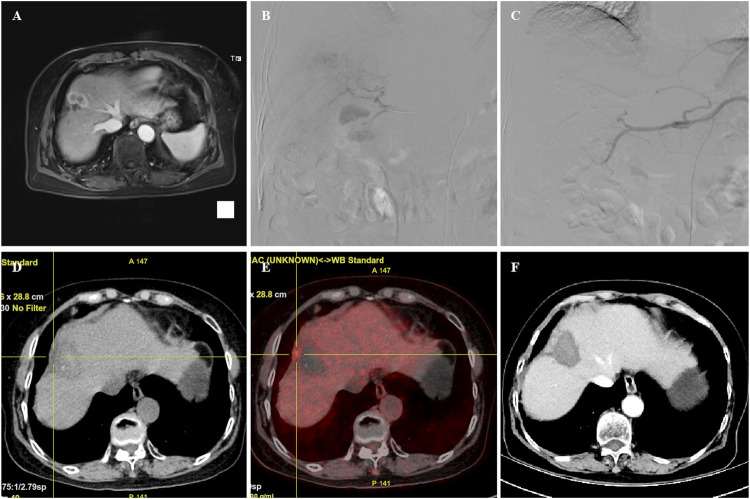
70 years female patient treated with CalliSpheres beads for advanced primary HCC. (A) MR revealed HCC in the right lobe. (B–C) Tumor staining was shown, and the right hepatic artery was embolized by 100–300 μm oxaliplatin-loaded beads. (D–E) PET-CT revealed a shrunk tumor with a small residual node 4.8 months later. (F) Tumor was found to shrink with no enhancement after 6.5 month follow-up. The patient passed away with tumor progression after 18.8 months.
FIGURE 4
FIGURE 4
Survival follow-up. The PFS was 5.9 months, and the median overall survival was 18.8 months.

References

    1. Bi Y., Shi X., Ren J., Yi M., Han X., Song M. (2021a). Clinical Outcomes of Doxorubicin-Eluting CalliSpheres(R) Beads-Transarterial Chemoembolization for Unresectable or Recurrent Esophageal Carcinoma. BMC Gastroenterol. 21 (1), 231. 10.1186/s12876-021-01816-3 - DOI - PMC - PubMed
    1. Bi Y., Shi X., Yi M., Han X., Ren J. (2021b). Pirarubicin-loaded CalliSpheres(R) Drug-Eluting Beads for the Treatment of Patients with Stage III-IV Lung Cancer. Acta Radiol. 63(3), 311–318. 10.1177/0284185121994298 - DOI - PubMed
    1. Bi Y., Wang Y., Zhang J., Shi X., Wang Y., Xu M., et al. (2021c). Clinical Outcomes of Uterine Arterial Chemoembolization with Drug-Eluting Beads or Advanced-Stage or Recurrent Cervical Cancer. Abdom. Radiol. (NY) 46 (12), 5715–5722. 10.1007/s00261-021-03267-6 - DOI - PubMed
    1. Bruix J., Llovet J. M. (2002). Prognostic Prediction and Treatment Strategy in Hepatocellular Carcinoma. Hepatology 35 (3), 519–524. 10.1053/jhep.2002.32089 - DOI - PubMed
    1. Bruix J., Sherman M. (2011). Management of Hepatocellular Carcinoma: an Update. Hepatology 53 (3), 1020–1022. 10.1002/hep.24199 - DOI - PMC - PubMed