


Postharvest dormancy-related changes of endogenous hormones in relation to different dormancy-breaking methods of potato (Solanum tuberosum L.) tubers
- PMID: 36035674
- PMCID: PMC9399798
- DOI: 10.3389/fpls.2022.945256
Postharvest dormancy-related changes of endogenous hormones in relation to different dormancy-breaking methods of potato (Solanum tuberosum L.) tubers
Abstract
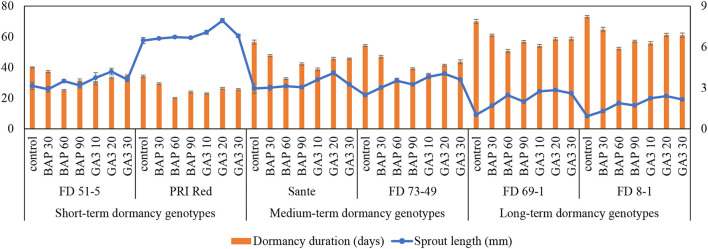
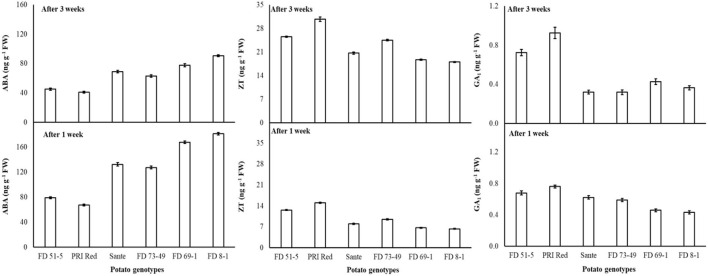
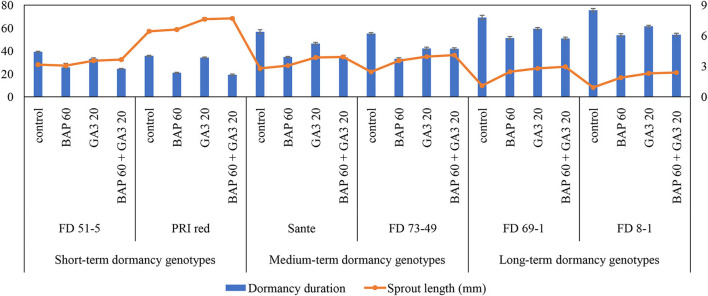
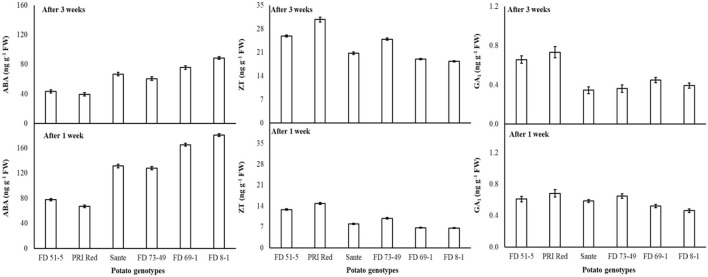
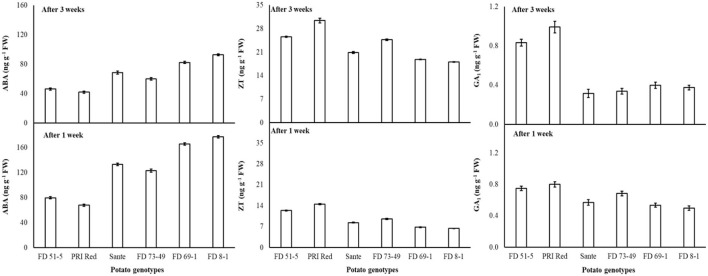
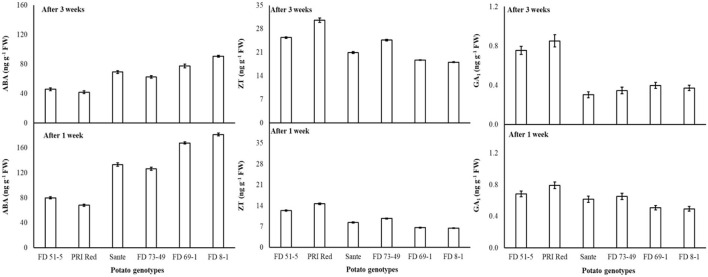
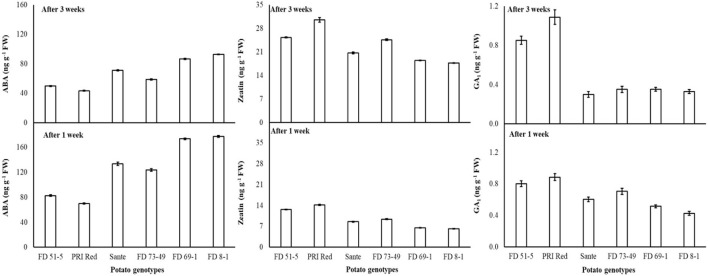
Development of an efficient and eco-friendly technique to break tuber dormancy in potato (Solanum tuberosum L.) is highly demanded due to the production of two or more crops annually. Several physiological and hormonal changes have been found to be related to the breaking of tuber dormancy; however, their consistency with genotypes and different protocols have not been well clarified. This study aims to evaluate the effectiveness of four dormancy-breaking methods, that is, plant growth regulator (PGR) dipping in 30, 60, or 90 mgL-1 benzyl amino purine (BAP) and 10, 20, or 30 mgL-1 gibberellic acids (GA3) alone and in the combination of optimized concentrations; electric current application at 20, 40, 60, or 80 Vs; cold pre-treatment at 2, 4, or 6 °C; irradiation at 1, 1.5, 2, 2.5, 3, or 3.5 kGy. In addition, changes in endogenous levels of abscisic acid (ABA), zeatin (ZT), and gibberellin A1 (GA1) in six potato genotypes after subjecting to these methods were investigated. Overall, the highest effective method for dormancy duration was the PGR application which shortened the duration by 18 days, followed by electric current (13 days), cold pre-treatment (9 days), and then irradiation (7 days). The solution of 60 mgL-1 BAP significantly reduced the dormancy duration in all genotypes but did not have a significant effect on the sprout length. While 20 mgL-1 GA3 produced maximum sprout length with a non-significant effect on dormancy duration. The genotype × PGR interaction for dormancy duration was more pronounced in short- and medium-term dormancy genotypes than in long-term dormancy genotypes. The genotypes displayed a significant positive correlation between dormancy duration and ABA levels but exhibited a negative correlation between dormancy duration and ZT as well as GA1 levels. From the first to the third week of storage, ABA was decreased in tubers while, however, ZT and GA1 were increased. The obtained results could be useful for the postharvest storage of potato tuber and the related field of physiological investigation in future.
Keywords: Solanum tuberosum L.; cold-treatment; dormancy; electric current; g-radiation; plant growth regulators; sprouting; zeatin.
Copyright © 2022 Haider, Nafees, Ahmad, Ali, Maryam, Iqbal, Vodnar, Marc, Kamran, Saleem, Al-Ghamdi, Al-Hemaid and Elshikh.
Conflict of interest statement
The authors declare that the research was conducted in the absence of any commercial or financial relationships that could be construed as a potential conflict of interest.
Figures
References
-
- Alexopoulos A. A., Aivalakis G., Akoumianakis K. A., Passam H. C. (2008). Effect of gibberellic acid on the duration of dormancy of potato tubers produced by plants derived from true potato seed. Postharvest Biol. Technol. 49, 424–430. 10.1016/j.postharvbio.2008.02.009 - DOI
-
- Alexopoulos A. A., Aivalakis G., Akoumianakis K. A., Passam H. C. (2009). Bromoethane induces dormancy breakage and metabolic changes in tubers derived from true potato seed. Postharvest Biol. Technol. 54, 165–171. 10.1016/j.postharvbio.2009.07.004 - DOI
-
- Alexopoulos A. A., Akoumianakis K. A., Passam H. C. (2006). The effect of the time and mode of application of gibberellic acid on the growth and yield of potato plants derived from true potato seed. J. Sci. Food Agric. 86, 2189–2195. 10.1002/jsfa.2595 - DOI
-
- Alexopoulos A. A., Akoumianakis K. A., Vemmos S. N., Passam H. C. (2007). The effect of postharvest application of gibberellic acid and benzyl adenine on the duration of dormancy of potatoes produced by plants grown from TPS. Postharvest Biol. Technol. 46, 54–62. 10.1016/j.postharvbio.2007.03.016 - DOI
-
- Bashir K. M., Ali A., Farrukh M. U., Alam M. (2021). Estimation of economic and production efficiency of potato production in Central Punjab. Pakistan. p. 17.
LinkOut - more resources
Full Text Sources
Research Materials
