


Effectiveness and safety of mexiletine in patients at risk for (recurrent) ventricular arrhythmias: a systematic review
- PMID: 36036670
- PMCID: PMC9681134
- DOI: 10.1093/europace/euac087
Effectiveness and safety of mexiletine in patients at risk for (recurrent) ventricular arrhythmias: a systematic review
Abstract
Aims: While mexiletine has been used for over 40 years for prevention of (recurrent) ventricular arrhythmias and for myotonia, patient access has recently been critically endangered. Here we aim to demonstrate the effectiveness and safety of mexiletine in the treatment of patients with (recurrent) ventricular arrhythmias, emphasizing the absolute necessity of its accessibility.
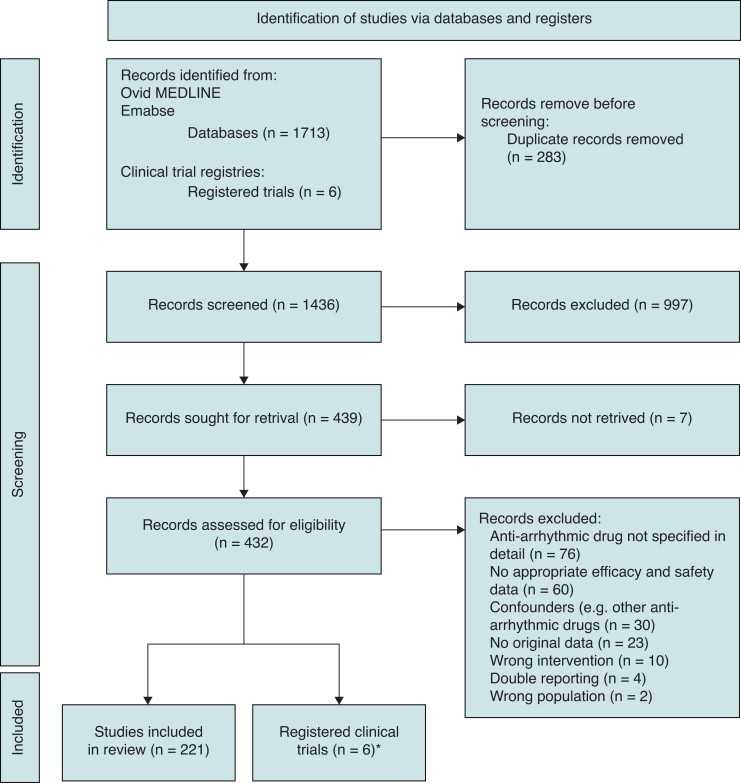
Methods and results: Studies were included in this systematic review (PROSPERO, CRD42020213434) if the efficacy or safety of mexiletine in any dose was evaluated in patients at risk for (recurrent) ventricular arrhythmias with or without comparison with alternative treatments (e.g. placebo). A systematic search was performed in Ovid MEDLINE, Embase, and in the clinical trial registry databases ClinicalTrials.gov and ICTRP. Risk of bias were assessed and tailored to the different study designs. Large heterogeneity in study designs and outcome measures prompted a narrative synthesis approach. In total, 221 studies were included reporting on 8970 patients treated with mexiletine. Age ranged from 0 to 88 years. A decrease in ventricular arrhythmias of >50% was observed in 72% of the studies for pre-mature ventricular complexes, 64% for ventricular tachycardia, and 33% for ventricular fibrillation. Electrocardiographic effects of mexiletine were small; only in a subset of patients with primary arrhythmia syndromes, a relative (desired) QTc decrease was reproducibly observed. As for adverse events, gastrointestinal complaints were most frequently observed (33% of the patients).
Conclusions: In this systematic review, we present all the currently available knowledge of mexiletine in patients at risk for (recurrent) ventricular arrhythmias and show that mexiletine is both effective and safe.
Keywords: Mexiletine; Systematic review; Ventricular arrhythmias.
© The Author(s) 2022. Published by Oxford University Press on behalf of the European Society of Cardiology.
Conflict of interest statement
Conflict of interest: P.G.P. is a member of the Scientific Advisory Group on Cardiovascular Issues (SAG-CVS) of the EMA since 2021. C.E.M.H. is involved in pre-marketing research with Sanofi, Protalix, and Idorsia, outside the submitted work. N.R., N.S., S.B., V.W., B.J., and C.E.M.H. are members of the platform ‘Medicijn voor de Maatschappij’. This is an academic initiative that aims to support sustainable access to medicines for rare diseases, including mexiletine. V.W. reports personal fees from Fair Medicine Foundation, personal fees from Patient One, outside the submitted work.
References
-
- Priori SG, Blomström-Lundqvist C, Mazzanti A, Blom N, Borggrefe M, Camm Jet al. . 2015 ESC Guidelines for the management of patients with ventricular arrhythmias and the prevention of sudden cardiac death: The Task Force for the Management of Patients with Ventricular Arrhythmias and the Prevention of Sudden Cardiac Death of the Europe. Eur Heart J 2015;36:2793–867. - PubMed
-
- Sénac J-B, Orléans P, Orléans L, Potier J, Robert J. Traité de la structure du coeur, de son action, et de ses maladies 1749.
-
- Withering W. An account of the foxglove and some of its medical uses: with practical remarks on dropsy and other diseases. London 1785.
-
- Lei M, Wu L, Terrar DA, Huang CL. Modernized classification of cardiac antiarrhythmic drugs. Circulation 2018;138:1879–96. - PubMed
Publication types
MeSH terms
Substances
LinkOut - more resources
Full Text Sources
Medical
Research Materials
