


Evaluation of accuracy and performance of self-reported HIV and antiretroviral therapy status in the Nigeria AIDS Indicator and Impact Survey (2018)
- PMID: 36037201
- PMCID: PMC9423665
- DOI: 10.1371/journal.pone.0273748
Evaluation of accuracy and performance of self-reported HIV and antiretroviral therapy status in the Nigeria AIDS Indicator and Impact Survey (2018)
Abstract
Background: Data on awareness of HIV status among people living with HIV (PLHIV) are critical to estimating progress toward epidemic control. To ascertain the accuracy of self-reported HIV status and antiretroviral drug (ARV) use in the Nigeria HIV/AIDS Indicator and Impact Survey (NAIIS), we compared self-reported HIV status with HIV rapid diagnostic test (RDT) results and self-reported ARV use with detectable blood ARV levels.
Methods: On the basis of responses and test results, participants were categorized by HIV status and ARV use. Self-reported HIV status and ARV use performance characteristics were determined by estimating sensitivity, specificity, positive predictive value (PPV), and negative predictive value (NPV). Proportions and other analyses were weighted to account for complex survey design.
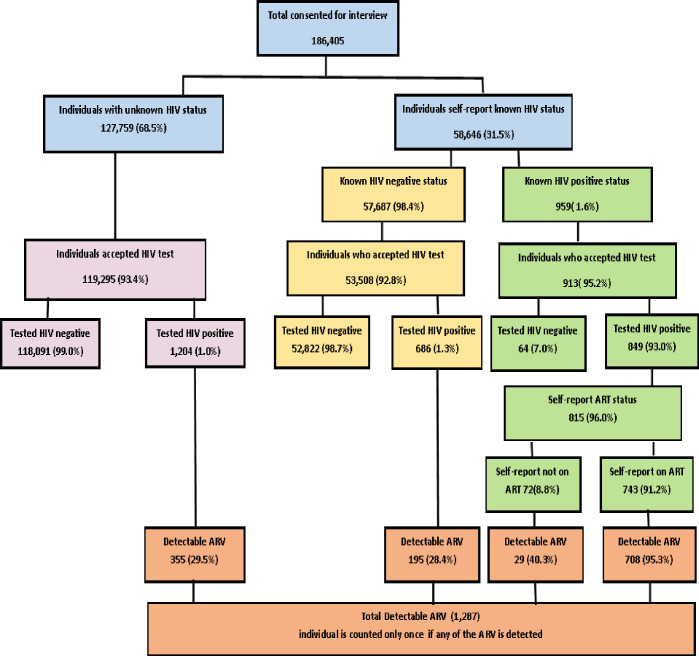
Results: During NAIIS, 186,405 participants consented for interview out of which 58,646 reported knowing their HIV status. Of the 959 (weighted, 1.5%) who self-reported being HIV-positive, 849 (92.1%) tested HIV positive and 64 (7.9%) tested HIV negative via RDT and polymerase chain reaction test for discordant positive results. Of the 849 who tested HIV positive, 743 (89.8%) reported using ARV and 72 (10.2%) reported not using ARV. Of 57,687 who self-reported being HIV negative, 686 (1.2%) tested HIV positive via RDT, with ARV biomarkers detected among 195 (25.1%). ARV was detected among 94.5% of those who self-reported using ARV and among 42.0% of those who self-reported not using ARV. Overall, self-reported HIV status had sensitivity of 52.7% (95% confidence interval [CI]: 49.4%-56.0%) with specificity of 99.9% (95% CI: 99.8%-99.9%). Self-reported ARV use had sensitivity of 95.2% (95% CI: 93.6%-96.7%) and specificity of 54.5% (95% CI: 48.8%-70.7%).
Conclusions: Self-reported HIV status and ARV use screening tests were found to be low-validity measures during NAIIS. Laboratory tests to confirm self-reported information may be necessary to determine accurate HIV and clinical status for HIV studies in Nigeria.
Conflict of interest statement
The authors have no conflicts of interest to disclose.
Figures
References
-
- 90-90-90. An ambitious treatment target to help end the AIDS epidemic. Geneva: Joint United Nations Program on HIV/AIDS; 2014. Available from: http://www.unaids.org/sites/default/files/media_asset/90-90-90_en_0.pdf [cited 2020 Aug 15]
-
- PHIA Project: From arm to freezer: PHIA Project laboratory network supports ambitious HIV testing targets. Available from: https://phia.icap.columbia.edu/from-arm-to-freezer-phia-project-laborato...
-
- Huerga H, Van Cutsem G, Ben Farhat J, Reid M, Bouhenia M, Maman D, et al. Who needs to be targeted for HIV testing and treatment in KwaZulu-Natal? Results from a population-based survey. J Acquir Immune Defic Syndr. [Internet]. 2016. [cited 2016 Jun 30]; Available from: http://www.ncbi.nlm.nih.gov/pubmed/27243903. - PMC - PubMed
-
- Cherutich P, Kim AA, Kellogg TA, Sherr K, Waruru A, De Cock KM, et al. Detectable HIV viral load in Kenya: data from a population-based survey. PLoS One. 2016. [cited 2016 Jun 30];11: e0154318. Available from: http://www.ncbi.nlm.nih.gov/pubmed/27192052. doi: 10.1371/journal.pone.0154318 - DOI - PMC - PubMed
Publication types
MeSH terms
Substances
Grants and funding
LinkOut - more resources
Full Text Sources
Medical
