


Nephrostomy tube versus double J ureteral stent in patients with malignant ureteric obstruction. A systematic review and meta-analysis of comparative studies
- PMID: 36037256
- PMCID: PMC9747026
- DOI: 10.1590/S1677-5538.IBJU.2022.0225
Nephrostomy tube versus double J ureteral stent in patients with malignant ureteric obstruction. A systematic review and meta-analysis of comparative studies
Abstract
Purpose: We aimed to perform a systematic review to assess perioperative outcomes, complications, and survival in studies comparing ureteral stent and percutaneous nephrostomy in malignant ureteral obstruction.
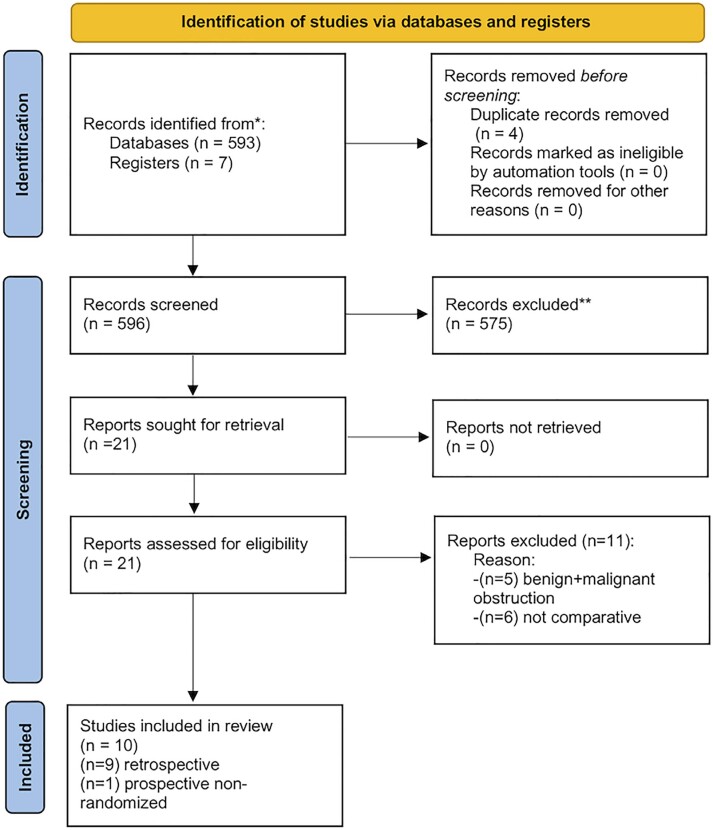
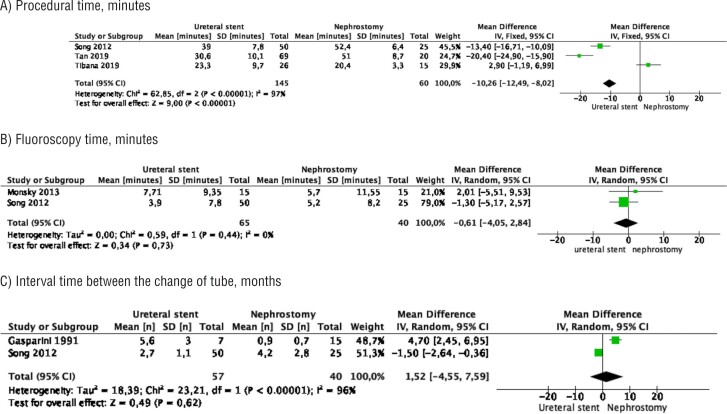
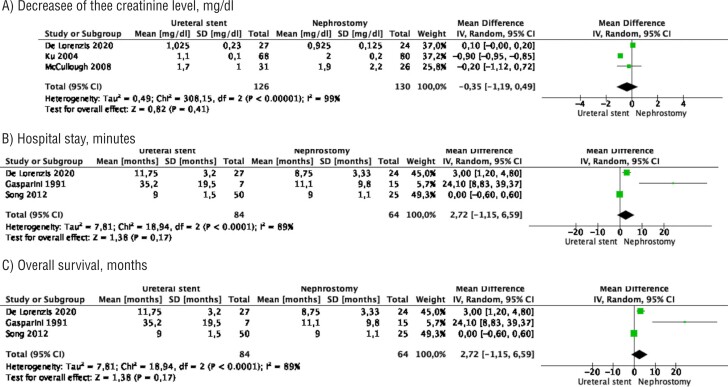
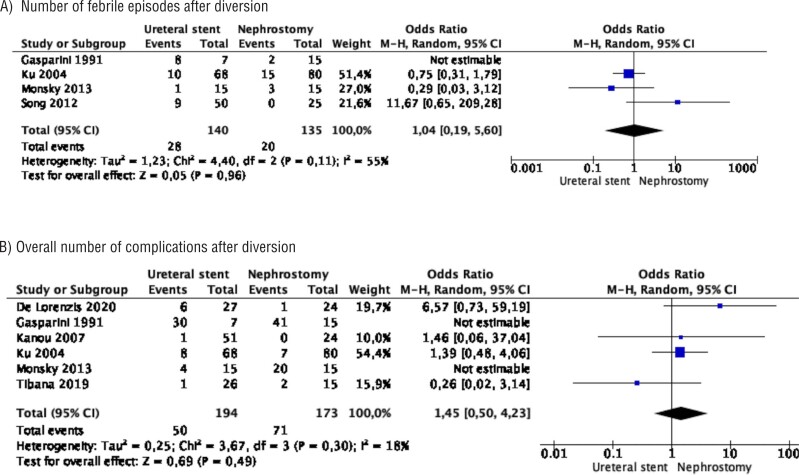
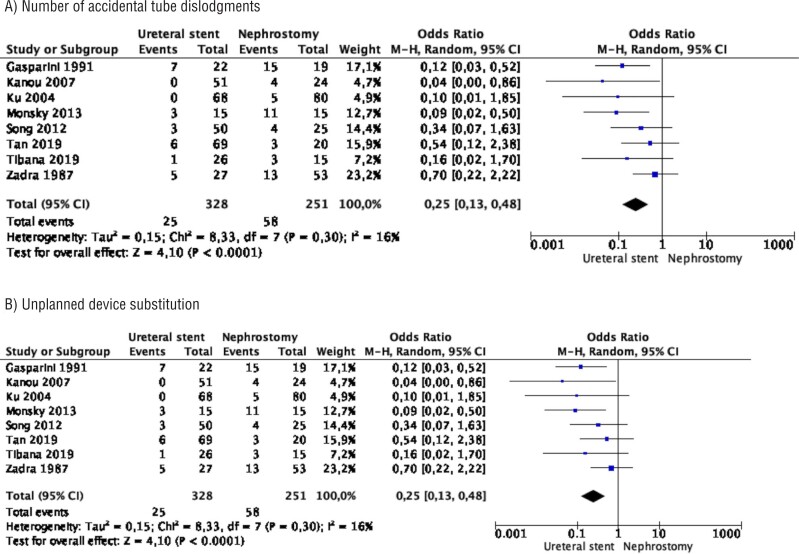
Materials and methods: This review was performed according to the Preferred Reporting Items for Systematic Reviews and Meta-Analyses framework. Meta-analyses were performed on procedural data; outcomes; complications (device-related, accidental dislodgement, febrile episodes, unplanned device replacement), dislodgment, and overall survival. Continuous variables were pooled using the inverse variance of the mean difference (MD) with a fixed effect, and 95% confidence interval (CI). The incidences of complications were pooled using the Cochran-Mantel-Haenszel method with the random effect model and reported as Odds Ratio (OR), and 95% CI. Statistical significance was set two-tail p-value < 0.05 Results: Ten studies were included. Procedure time (MD -10.26 minutes 95%CI -12.40-8.02, p< 0.00001), hospital stay (MD -1.30 days 95%CI -1.69 - -0.92, p< 0.0001), number of accidental tube dislodgments (OR 0.25 95% CI 0.13 - 0.48, p< 0.0001) were significantly lower in the stent group. No difference was found in mean fluoroscopy time, decrease in creatinine level post procedure, overall number of complications, interval time between the change of tubes, number of febrile episodes after diversion, unplanned device substitution, and overall survival.
Conclusion: Our meta-analysis favors stents as the preferred choice as these are easier to maintain and ureteral stent placement should be recommended whenever feasible. If the malignant obstruction precludes a stent placement, then PCN is a safe alternative.
Keywords: Nephrostomy, Percutaneous; Ureteral Obstruction; Urinary Diversion.
Copyright® by the International Brazilian Journal of Urology.
Conflict of interest statement
None declared.
Figures
References
-
- Holden S, McPhee M, Grabstald H. The rationale of urinary diversion in cancer patients. J Urol. 1979;121:19–21. - PubMed
-
- Liberman D, McCormack M. Renal and urologic problems: management of ureteric obstruction. Curr Opin Support Palliat Care. 2012;6:316–321. - PubMed
-
- Kouba E, Wallen EM, Pruthi RS. Management of ureteral obstruction due to advanced malignancy: optimizing therapeutic and palliative outcomes. J Urol. 2008;180:444–450. - PubMed
-
- Danilovic A, Antonopoulos IM, Mesquita JL, Lucon AM. Likelihood of retrograde double-J stenting according to ureteral obstructing pathology. Int Braz J Urol. 2005;31:431–436. discussion 436. - PubMed
-
- Misra S, Coker C, Richenberg J. Percutaneous nephrostomy for ureteric obstruction due to advanced pelvic malignancy: have we got the balance right? Int Urol Nephrol. 2013;45:627–632. - PubMed
Publication types
MeSH terms
Substances
LinkOut - more resources
Full Text Sources
