


Comparative genomics of mortal and immortal cnidarians unveils novel keys behind rejuvenation
- PMID: 36037356
- PMCID: PMC9459311
- DOI: 10.1073/pnas.2118763119
Comparative genomics of mortal and immortal cnidarians unveils novel keys behind rejuvenation
Erratum in
-
Correction for Pascual-Torner et al., Comparative genomics of mortal and immortal cnidarians unveils novel keys behind rejuvenation.Proc Natl Acad Sci U S A. 2023 Apr 4;120(14):e2303228120. doi: 10.1073/pnas.2303228120. Epub 2023 Mar 27. Proc Natl Acad Sci U S A. 2023. PMID: 36972462 Free PMC article. No abstract available.
-
Correction for Pascual-Torner et al., Comparative genomics of mortal and immortal cnidarians unveils novel keys behind rejuvenation.Proc Natl Acad Sci U S A. 2023 Sep 26;120(39):e2314776120. doi: 10.1073/pnas.2314776120. Epub 2023 Sep 21. Proc Natl Acad Sci U S A. 2023. PMID: 37733745 Free PMC article. No abstract available.
Abstract
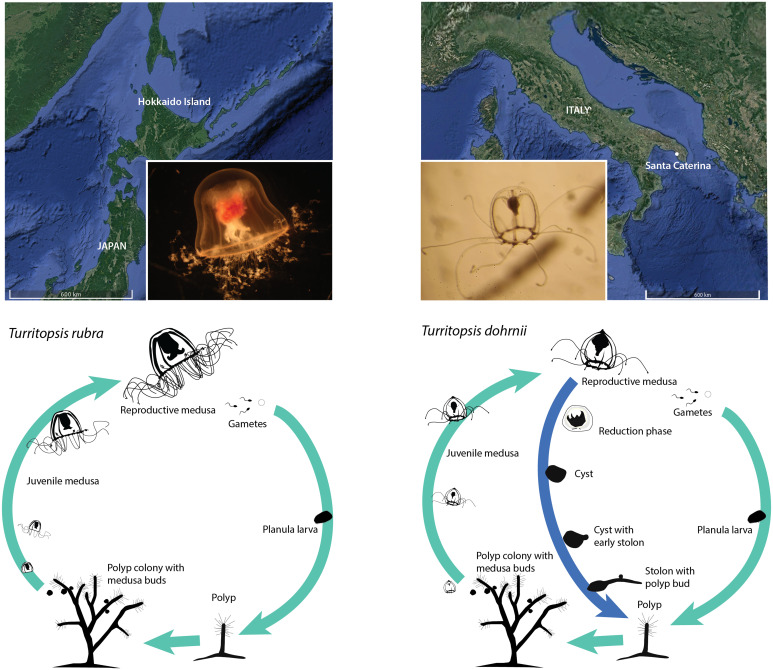
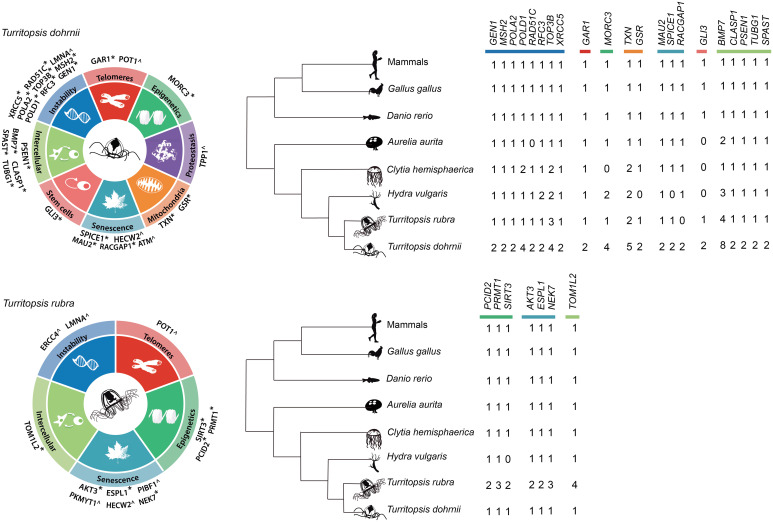
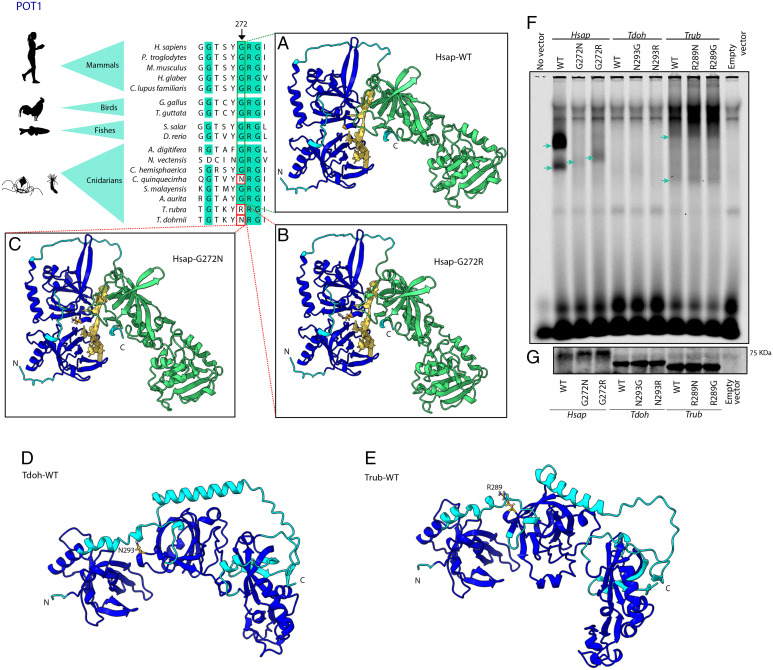
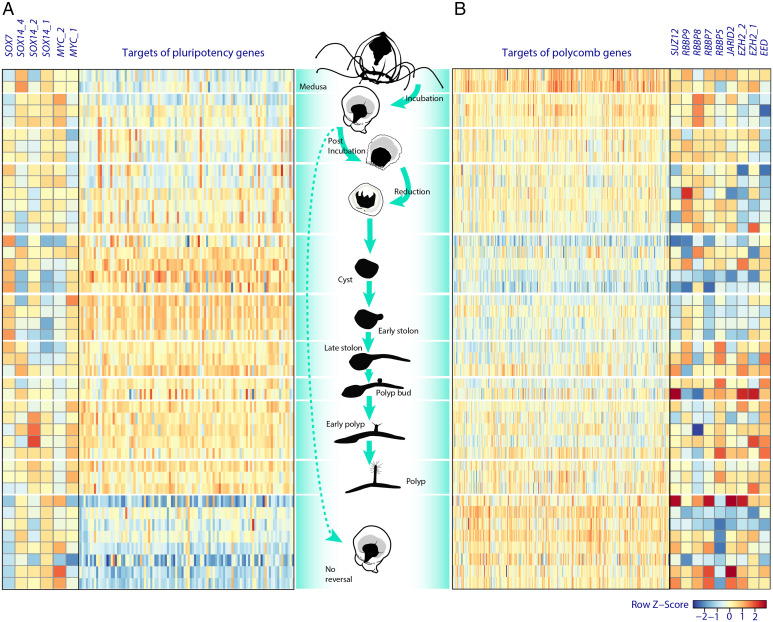
Turritopsis dohrnii is the only metazoan able to rejuvenate repeatedly after its medusae reproduce, hinting at biological immortality and challenging our understanding of aging. We present and compare whole-genome assemblies of T. dohrnii and the nonimmortal Turritopsis rubra using automatic and manual annotations, together with the transcriptome of life cycle reversal (LCR) process of T. dohrnii. We have identified variants and expansions of genes associated with replication, DNA repair, telomere maintenance, redox environment, stem cell population, and intercellular communication. Moreover, we have found silencing of polycomb repressive complex 2 targets and activation of pluripotency targets during LCR, which points to these transcription factors as pluripotency inducers in T. dohrnii. Accordingly, we propose these factors as key elements in the ability of T. dohrnii to undergo rejuvenation.
Keywords: Turritopsis; aging; pluripotency; polycomb; reprogramming.
Conflict of interest statement
The authors declare no competing interest.
Figures
Comment in
-
On the perils of working on nonmodel organisms.Proc Natl Acad Sci U S A. 2023 Mar 14;120(11):e2216683120. doi: 10.1073/pnas.2216683120. Epub 2023 Mar 9. Proc Natl Acad Sci U S A. 2023. PMID: 36893273 Free PMC article. No abstract available.
-
Reply to Miglietta: Toward doing rigorous and innovative science with nonmodel organisms.Proc Natl Acad Sci U S A. 2023 Mar 14;120(11):e2217389120. doi: 10.1073/pnas.2217389120. Epub 2023 Mar 9. Proc Natl Acad Sci U S A. 2023. PMID: 36893278 Free PMC article. No abstract available.
References
Publication types
MeSH terms
LinkOut - more resources
Full Text Sources
Other Literature Sources
