. 2022 Sep 6;119(36):e2205420119.
doi: 10.1073/pnas.2205420119. Epub 2022 Aug 29.

Cholesterol inhibits human voltage-gated proton channel hHv1

Affiliations

Cholesterol inhibits human voltage-gated proton channel hHv1

Shuo Han et al. Proc Natl Acad Sci U S A. .

Abstract

Although human sperm is morphologically mature in the epididymis, it cannot fertilize eggs before capacitation. Cholesterol efflux from the sperm plasma membrane is a key molecular event essential for cytoplasmic alkalinization and hyperactivation, but the underlying mechanism remains unclear. The human voltage-gated proton (hHv1) channel functions as an acid extruder to regulate intracellular pHs of many cell types, including sperm. Aside from voltage and pH, Hv channels are also regulated by distinct ligands, such as Zn2+ and albumin. In the present work, we identified cholesterol as an inhibitory ligand of the hHv1 channel and further investigated the underlying mechanism using the single-molecule fluorescence resonance energy transfer (smFRET) approach. Our results indicated that cholesterol inhibits the hHv1 channel by stabilizing the voltage-sensing S4 segment at resting conformations, a similar mechanism also utilized by Zn2+. Our results suggested that the S4 segment is the central gating machinery in the hHv1 channel, on which voltage and distinct ligands are converged to regulate channel function. Identification of membrane cholesterol as an inhibitory ligand provides a mechanism by which the hHv1 channel regulates fertilization by linking the cholesterol efflux with cytoplasmic alkalinization, a change that triggers calcium influx through the CatSper channel. These events finally lead to hyperactivation, a remarkable change in the mobility pattern indicating fertilization competence of human sperm.

Keywords: cholesterol; ion channel; ligand gating; structural dynamics; voltage gating.


Conflict of interest statement

The authors declare no competing interest.

Figures
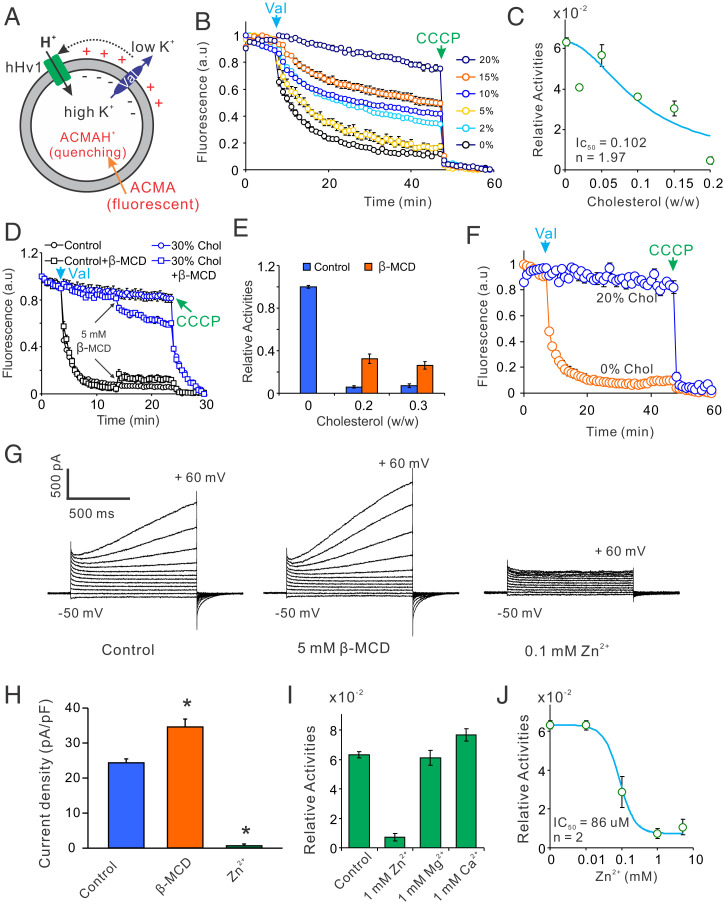
FIG. 1.
FIG. 1.
Cholesterol inhibits the hHv1 channel. (A) Liposome flux assay to determine activities of hHv1 channels in liposomes. The electrical potential was generated by the K+ gradient across liposomes, which drove proton uptake into liposomes, then protonated and quenched the ACMA fluorescence. (B and C) Dose-dependent inhibition of the hHv1 channel by cholesterol, fitted with the Hill equation. (D and E) Cholesterol extraction by 5 mM β-MCD attenuated cholesterol inhibition of hHv1 channels. The relative activities of hHv1 channels after adding valinomycin and β-MCD were calculated separately. For the hHv1 liposomes without cholesterol (control), fluorescence quenching reached steady states before adding β-MCD. Therefore, the activities of hHv1 channels in control liposomes after adding β-MCD were not calculated. All data were presented as mean ± SE, n = 6. (F) Inhibition of the voltage-sensor-only hHv1 channel by 20% cholesterol (wt/wt, to total lipids). Fluorescence intensities were presented as arbitrary unit (a.u). (G) The representative whole-cell currents from HEK293 cells transfected with hHv1-EGFP channels. The currents were recorded before and after 5 mM β-MCD treatment, then further validated by exposing to bath solution containing 0.1 mM Zn2+ (extracellular side). (H) Extraction of membrane cholesterol enhances proton currents through hHv1-EGFP channels expressed in HEK293 cells. All data were presented as mean ± SE, n = 3. (I) The activities of hHv1 channels in the presence of 1 mM Zn2+, Mg2+, and Ca2+, added to both intra- and extraliposomal sides, were determined by liposome flux assay. (J) Dose-dependent inhibition of the hHv1 channel by Zn2+, fitted with the Hill equation. All data were presented as mean ± SE, n = 3.
FIG. 2.
FIG. 2.
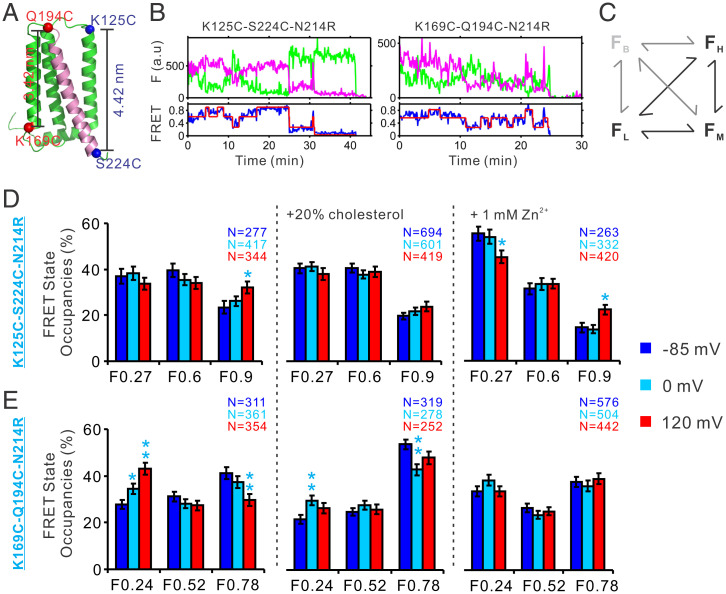
Cholesterol and Zn2+ stabilize the S4 segment at resting conformation. (A) Cartoon representation of the hHv1 structure with the S4 segment colored pink, the α-carbons of the K125C-S224C and K169C-Q194C labeling sites were highlighted as blue and red spheres, respectively. For both labeling sites, the N214R background mutation was introduced to abolish proton uptake into liposomes that will alter the voltage dependence of the hHv1 channel (29, 37, 38). (B) Representative smFRET traces from the K125C-S224C and K169-Q194C labeling sites. The green and pink lines in the Upper Panels are the donor and acceptor intensities, and the blue and red lines in the Lower Panels are the measured and idealized FRET. The time resolution of smFRET imaging was 100 ms. (C) The kinetic model for analyzing the smFRET traces from the K125-S224C and K169C-Q194C labeling sites. The model was established in our previous work, containing four FRET states, i.e., low (FL), medium (FM), high (FH), and bleaching (FB) FRET states. The FB state was introduced to minimize the impact of some FRET events when the donor or acceptor fluorophores were bleached or blinked. (D and E) FRET state occupancies calculated from the smFRET data at the K125C-S224C (D) and K169C-S194C (E) labeling sites. The smFRET traces were idealized based on the four-FRET-state kinetic model using the maximum point likelihood algorithm. The state occupancy data were presented as mean ± SE. Significance levels of FRET state occupancy changes induced by voltage, cholesterol, or Zn2+ were examined by unpaired t tests, with *P < 0.05 and **P < 0.01.
FIG. 3.
FIG. 3.
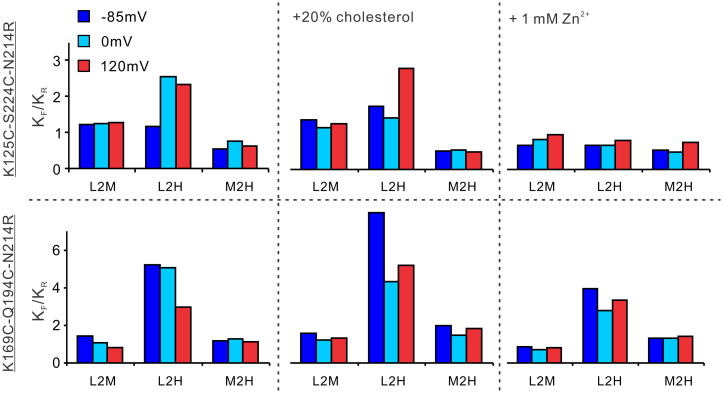
Effects of voltage, cholesterol, and Zn2+ on the conformational dynamics of the S4 segment revealed by equilibrium constants. The transitions among the FL, FM, and FH states were classified into FL to FM (L2M), FL to FH (L2H), and FM to FH (M2H) transitions. The equilibrium constants of the three different transition types were calculated as the ratios of its forward to reverse transition rates for our smFRET data were collected from the K125C-S224C and K169C-Q194C labeling sites at equilibrium voltage/ligand conditions. Among the three different transitions, only the equilibrium constants between the FL and FH states, i.e., L2H, are highly responsive to voltage, Zn2+, and cholesterol, which reflect the transitions of the S4 segment between the inward resting and outward activating conformations.
FIG. 4.
FIG. 4.
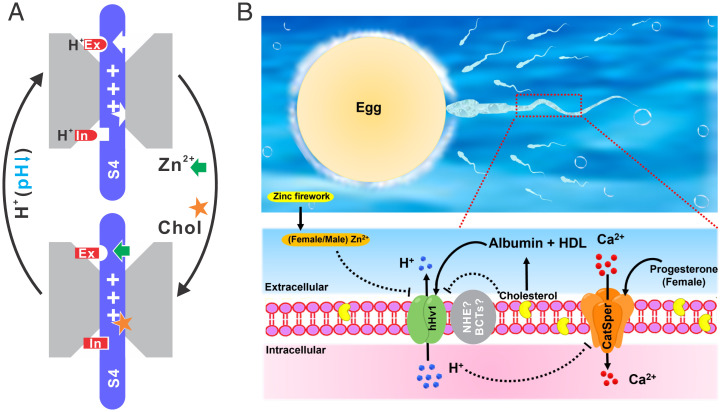
The structural basis underlying ligand regulation of hHv1 channels and its potential roles in fertilization. (A) The structural basis underlying ligand regulation of hHv1 channels. The protonation states of the pH-sensing residues at the intra- (In) or extracellular (Ex) sides change their interactions with the resting state S4 segment to which Zn2+ (green arrow) and cholesterol (orange star) also bind. (B) The potential role of the hHv1 channel in human fertilization. The cholesterol efflux is facilitated by HDL and albumin in the oviductal fluid. Removal of membrane cholesterol and the presence of albumin collectively activate the sperm hHv1 channel, leading to efflux of protons and thus elevation of intracellular pH. Progesterone and high intracellular pH activate the CatSper channel to facilitate calcium influx, which leads to hyperactivation of sperm for fertilization. The fertilized egg generates Zn2+ fireworks, which inhibit hHv1 channels of the surrounding unfertilized sperm to prevent polyspermy. However, cholesterol efflux may impact sperm cell pH through other pathways, like Na+/H+ exchanger (NHE) and HCO3 transporters (bicarbonate transporters [BCTs]) in other species, especially for mouse sperm that does not express Hv1 channels.

References

    1. Cross N. L., Role of cholesterol in sperm capacitation. Biol. Reprod. 59, 7–11 (1998). - PubMed
    1. Puga Molina L. C., et al. , Molecular basis of human sperm capacitation. Front. Cell Dev. Biol. 6, 72 (2018). - PMC - PubMed
    1. Leahy T., Gadella B. M., New insights into the regulation of cholesterol efflux from the sperm membrane. Asian J. Androl. 17, 561–567 (2015). - PMC - PubMed
    1. Davis B. K., Interaction of lipids with the plasma membrane of sperm cells. I. The antifertilization action of cholesterol. Arch. Androl. 5, 249–254 (1980). - PubMed
    1. Davis B. K., Byrne R., Bedigian K., Studies on the mechanism of capacitation: Albumin-mediated changes in plasma membrane lipids during in vitro incubation of rat sperm cells. Proc. Natl. Acad. Sci. U.S.A. 77, 1546–1550 (1980). - PMC - PubMed

Publication types