


Theoretically derived interventions aimed at improving appropriate polypharmacy in primary care: A systematic review
- PMID: 36039374
- PMCID: PMC9418988
- DOI: 10.1016/j.rcsop.2022.100166
Theoretically derived interventions aimed at improving appropriate polypharmacy in primary care: A systematic review
Abstract
Background: Polypharmacy (the use of multiple medications) is common in older patients and achieving a balance between appropriate and inappropriate polypharmacy is a challenge routinely faced by prescribers. It is recommended to incorporate the use of theory when developing complex interventions, but it is not known if theoretically derived interventions aimed at improving appropriate polypharmacy are effective.
Objective: This systematic review aimed to establish the overall effectiveness of theoretically derived interventions on improving appropriate polypharmacy and to investigate the degree to which theory informed intervention design.
Methods: Seven electronic databases were searched from inception to August 2021 including hand-searching of reference lists. Interventions developed using a theory, involving the use of a validated tool to assess prescribing, delivered in primary care to participants with a mean age of ≥65 years and prescribed ≥four medications, were included. Data was extracted independently by two reviewers. The Theory Coding Scheme (TCS) was applied to evaluate the use of theory; Risk of Bias (RoB) was assessed using the Cochrane RoB 2.0 tool.
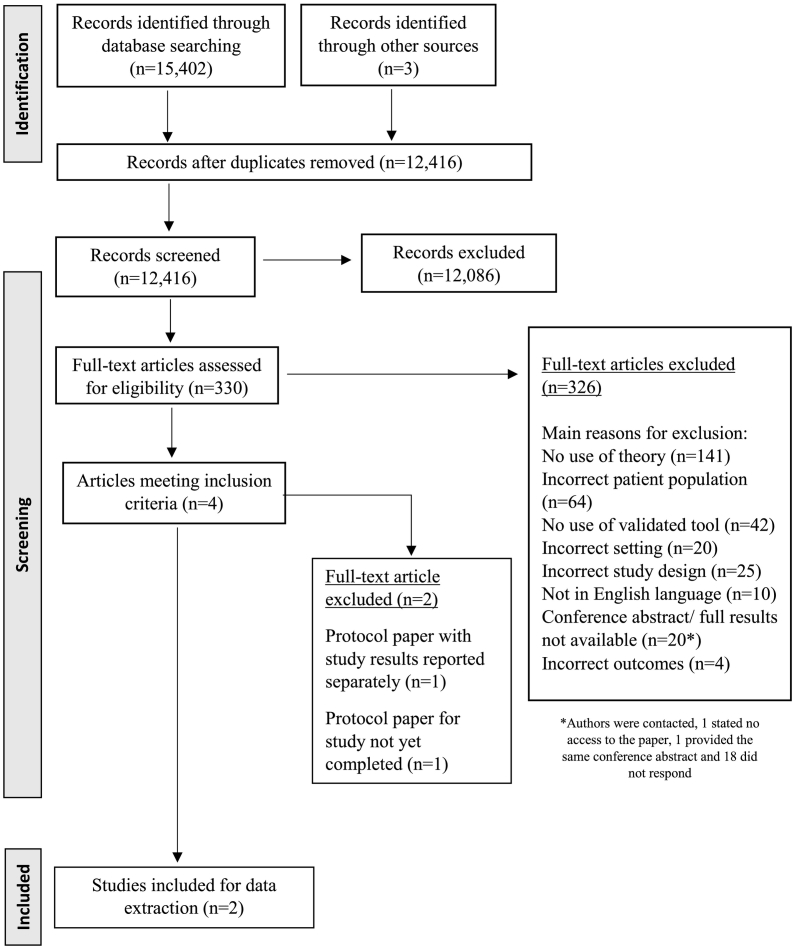
Results: Two studies, one feasibility study and one randomised controlled trial (RCT) were included, and therefore overall effectiveness of the theoretically derived intervention could not be assessed. Theory used in development included the Theoretical Domains Framework and Reason's system-based risk management theory. The RCT was rated to have a high RoB. Based on the TCS, neither study used theory completely.
Conclusion: The effectiveness of theoretically derived interventions to improve appropriate polypharmacy in primary care could not be determined due to the small number of studies and their heterogeneity. Further incorporation of theory into intervention development is required to understand the effectiveness of this approach.Prospero registration: CRD42020157175.
Keywords: Older adults; Polypharmacy; Primary care; Theory.
© 2022 Published by Elsevier Inc.
Conflict of interest statement
The authors declare that they have no known competing financial interests or personal relationships that could have appeared to influence the work reported in this paper.
Figures

References
-
- United Nations, Department of Economic and Social Affairs World Population Prospects 2019, Highlights. 2019. https://population.un.org/wpp/Publications/Files/WPP2019_Highlights.pdf Accessed 10.07.22.
-
- OECD . Health at a Glance 2019: OECD Indicators. OECD Publishing; Paris: 2019. Projections of health expenditure. - DOI
-
- Department of Finance, Irish Government Population Ageing and the Public Finances in Ireland. 2018. https://assets.gov.ie/4147/101218131007-cdad7ec478c4467290c52008da8f536d... Accessed 10.07.22.
-
- Salive M.E. Multimorbidity in older adults. Epidemiol Rev. 2013;35:75–83. - PubMed
Publication types
LinkOut - more resources
Full Text Sources
