


Nafamostat Mesylate for Treatment of COVID-19 in Hospitalised Patients: A Structured, Narrative Review
- PMID: 36040613
- PMCID: PMC9425784
- DOI: 10.1007/s40262-022-01170-x
Nafamostat Mesylate for Treatment of COVID-19 in Hospitalised Patients: A Structured, Narrative Review
Abstract
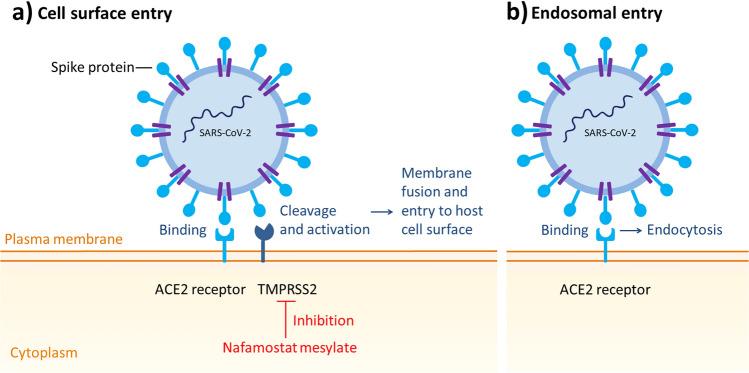
The search for clinically effective antivirals against the severe acute respiratory syndrome coronavirus-2 (SARS-CoV-2) is ongoing. Repurposing of drugs licensed for non-coronavirus disease 2019 (COVID-19) indications has been extensively investigated in laboratory models and in clinical studies with mixed results. Nafamostat mesylate (nafamostat) is a drug licensed in Japan and Korea for indications including acute pancreatitis and disseminated intravascular coagulation. It is available only for continuous intravenous infusion. In vitro human lung cell line studies with nafamostat demonstrate high antiviral potency against SARS-CoV-2 (half maximal inhibitory concentration [IC50] of 0.0022 µM [compared to remdesivir 1.3 µM]), ostensibly via inhibition of the cellular enzyme transmembrane protease serine 2 (TMPRSS2) preventing viral entry into human cells. In addition, the established antithrombotic activity is hypothesised to be advantageous given thrombosis-associated sequelae of COVID-19. Clinical reports to date are limited, but indicate a potential benefit of nafamostat in patients with moderate to severe COVID-19. In this review, we will explore the pre-clinical, pharmacokinetic and clinical outcome data presently available for nafamostat as a treatment for COVID-19. The recruitment to ongoing clinical trials is a priority to provide more robust data on the safety and efficacy of nafamostat as a treatment for COVID-19.
© 2022. The Author(s).
Conflict of interest statement
The following authors Steven Y.C. Tong, Justin T. Denholm, Gregory J. Dore, Asha C. Bowen, Sharon R. Lewin, Balasubramanian Venkatesh, Thomas E. Hills, Zoe McQuilten, David L. Paterson, Susan C. Morpeth and Jason A. Roberts are members of the Australasian COVID-19 Trial (ASCOT), which is studying nafamostat as an antiviral treatment for non-critically ill, hospitalised COVID-19 patients. ASCOT has received nafamostat drug and an unrestricted investigator-initiated grant from manufacturer Chong Kun Dang Pharmaceuticals (Seoul, Korea) and Institute Pasteur Korea. ASCOT is supported by the Australian Partnership for Preparedness Research on Infectious Disease Emergencies (APPRISE), The BHP Foundation, Health Research Council of New Zealand, Hospital Research Foundation, The Macquarie Group Foundation, The Minderoo Foundation, The Pratt Foundation, Royal Brisbane and Women’s Hospital Foundation, The Common Good (The Prince Charles Hospital Foundation), Wesley Medical Research, Chong Kun Dang Pharmaceutical Corporation, NSW Office for Health and Medical Research, Medical Research Future Fund (grant MRF2002132) and the Russell and Womersley Foundation.
Figures
References
-
- Fehr AR, Perlman S. Coronaviruses: methods and protocols. In: Maier HJ (ed) Methods Mol Biol. Springer Science; 2015. p. 1–282.
-
- Yamamoto M, Matsuyama S, Li X, Takeda M, Kawaguchi Y, Inoue JI, et al. Identification of Nafamostat as a potent inhibitor of middle east respiratory syndrome coronavirus S protein-mediated membrane fusion using the split-protein-based cell-cell fusion assay. Antimicrob Agents Chemother. 2016;60:6532–6539. doi: 10.1128/AAC.01043-16. - DOI - PMC - PubMed
Publication types
MeSH terms
Substances
LinkOut - more resources
Full Text Sources
Medical
Miscellaneous
