


Using PrEP and Doing it for Ourselves (UPDOs Protective Styles), a Web-Based Salon Intervention to Improve Uptake of Pre-exposure Prophylaxis Among Black Women: Protocol for a Pilot Feasibility Study
- PMID: 36040785
- PMCID: PMC9472057
- DOI: 10.2196/34556
Using PrEP and Doing it for Ourselves (UPDOs Protective Styles), a Web-Based Salon Intervention to Improve Uptake of Pre-exposure Prophylaxis Among Black Women: Protocol for a Pilot Feasibility Study
Abstract
Background: Multilevel interventions are necessary to address the complex social contributors to health that limit pre-exposure prophylaxis use among Black women, including medical distrust, pre-exposure prophylaxis stigma, and access to equitable health care. Strategies to improve knowledge, awareness, and uptake of pre-exposure prophylaxis among Black women will be more successful if information-sharing and implementation take place within trusted environments. Providing women with information through trusted cultural and social channels can effectively support informed decision-making about pre-exposure prophylaxis for themselves and members of their social networks who are eligible for pre-exposure prophylaxis.
Objective: The goal of this project is to improve knowledge, awareness, uptake, and trust of pre-exposure prophylaxis, as well as reduce pre-exposure prophylaxis stigma, among Black women living in the US South.
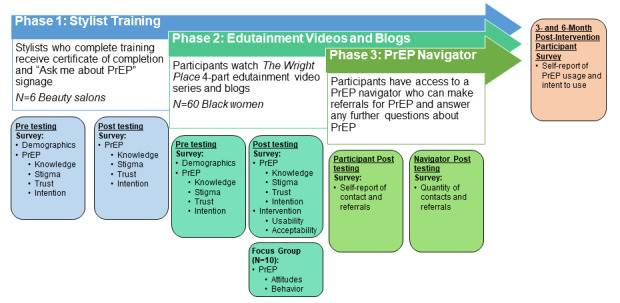
Methods: This multilevel, mixed methods study uses a community-engagement approach to develop and pilot test a salon-based intervention. There are three components of this intervention: (1) stylist training, (2) women-focused entertainment videos and modules, and (3) engagement of a pre-exposure prophylaxis navigator. First, stylist training will be provided through two 2-hour training sessions delivered over 2 consecutive weeks. We will use a pre- and posttest design to examine knowledge and awareness improvement of pre-exposure prophylaxis among the stylists. Upon full completion of training, the stylists will receive a certificate of completion and "Ask Me about PrEP" signage for their beauty salons. Second, together with the community, we have codeveloped a 4-part entertainment series (The Wright Place) that uses culturally and socially relevant stories to highlight key messages about (1) HIV, (2) pre-exposure prophylaxis, and (3) Black women's social contributors to health. Quantitative and qualitative measures will be used in a pre- and posttest design to examine pre-exposure prophylaxis knowledge, awareness, risk, stigma, trust, intentions, and women's perceptions of the usability and acceptability of the overall intervention and its implementation strategies. A video blog will be provided after each video. Third, participants will have access through an email or text message link to a pre-exposure prophylaxis navigator, who will respond to them privately to answer questions or make referrals for pre-exposure prophylaxis as requested.
Results: This project was funded in October 2020 by Gilead Sciences and was approved by the Duke University School of Nursing institutional review board in April 2021 (Pro00106307). Intervention components were developed in partnership with community partners in the first year. Data collection for phase 1 began in April 2022. Data collection for phase 2 began in May 2022. The study will be complete by October 2022.
Conclusions: Multilevel interventions that consider the assets of the community have promise for promoting health among Black women who have influence within their social networks. The findings of this study have the potential to be generalizable to other populations.
International registered report identifier (irrid): PRR1-10.2196/34556.
Keywords: HIV; HIV prevention; PrEP uptake; application; community engagement; mixed-method; pilot test; pre-exposure prophylaxis; prophylaxis; web-based; web-based application; women.
©Schenita D Randolph, Ragan Johnson, Allison Johnson, Lana Keusch. Originally published in JMIR Research Protocols (https://www.researchprotocols.org), 30.08.2022.
Conflict of interest statement
Conflicts of Interest: None declared.
Figures

References
-
- HIV in the southern United States strengthening prevention and care in the nation's most-affected region state of the HIV epidemic in the south. Centers for Disease Control and Prevention. [2022-08-06]. https://www.cdc.gov/hiv/pdf/policies/cdc-hiv-in-the-south-issue-brief.pdf .
-
- HIV Surveillance Reports. Centers for Disease Control and Prevention. [2022-08-06]. http://www.cdc.gov/hiv/library/reports/hiv-surveillance.html .
-
- HIV/AIDS Prevention Research Synthesis Project Compendium of Evidence-Based Interventions and Best Practices for HIV Prevention. Centers for Disease Control and Prevention. [2022-08-06]. https://www.cdc.gov/hiv/research/interventionresearch/compendium/index.html .
-
- Chapman Lambert Crystal, Marrazzo J, Amico RK, Mugavero MJ, Elopre L. PrEParing Women to Prevent HIV: An Integrated Theoretical Framework to PrEP Black Women in the United States. J Assoc Nurses AIDS Care. 2018;29(6):835–848. doi: 10.1016/j.jana.2018.03.005. https://europepmc.org/abstract/MED/29685648 S1055-3290(18)30073-6 - DOI - PMC - PubMed
Grants and funding
LinkOut - more resources
Full Text Sources
Miscellaneous
