Review
. 2022 Nov 7;43(42):4458-4468.
doi: 10.1093/eurheartj/ehac456.

Cardiovascular complications of immune checkpoint inhibitors for cancer

Affiliations
Review

Cardiovascular complications of immune checkpoint inhibitors for cancer

Franck Thuny et al. Eur Heart J. .

Abstract

Over the last decade or so, there has been a paradigm shift in the oncologic care of patients with a range of solid tumour and haematologic malignancies, away from traditional cytotoxic chemotherapy and towards personalized cancer treatments, using both targeted therapy and immunotherapy. This shift has contributed to the remarkable and sustained increase in the number of cancer survivors and the longevity of patients with a cancer diagnosis. This review will focus on the cardiovascular effects of immune checkpoint inhibitors and will present a background on immune checkpoint inhibition for cancer, the epidemiology, potential mechanisms, the potential insights into cardiovascular biology, and a diagnostic and therapeutic approach to potential cases. Our understanding of the cardiovascular effects of immune checkpoint inhibitors needs to improve. However, the evolution necessarily needs to be rapid. Initial observations noted that immune checkpoint inhibitor therapy can lead to a fulminant myocarditis. Recent reports have expanded the effect of immune checkpoint inhibitor therapy on the cardiovascular system to include an increase in cardiac dysfunction without myocarditis, arrhythmias, venous thromboembolic disease, accelerated atherosclerosis, and atherosclerosis-related cardiovascular events. The association between immune checkpoint inhibitor therapy and an increase in these cardiovascular events is not only limited to events occurring within the first few weeks after starting therapy but can also include events that occur months to years after therapy. The latter observation is especially of relevance in those treated with adjuvant or neoadjuvant therapy. There needs to be a shift from recognition of an increase in cardiovascular events to currently approved immune checkpoint inhibitor therapies to understanding the mechanisms that lead to adverse cardiovascular effects, understanding who is at risk, and understanding what we can do about it.

Keywords: Atherosclerosis; Cancer; Immune checkpoint inhibitors; Myocarditis.


Conflict of interest statement

Conflict of interest: T.G.N. has received advisory fees from AbbVie, Amgen, C4 Therapeutics, H3-Biomedicine, Genentech, Sanofi, Roche, BMS, and Intrinsic Imaging. T.G.N. has received grant funding from AstraZeneca and BMS. J.N. has received advisory fees from AstraZeneca, Bristol Myers Squibb, Merck, Roche/Genentech, Amgen, Takeda, Pfizer, Daiichi Sankyo, NGM Pharmaceuticals, Kaleido Biosciences, and institutional research grant funding from Merck, AstraZeneca, Bristol Myers Squibb, and Mirati. J.N. is the principal investigator on grant funding from Merck, AstraZeneca, and Bristol Myers Squibb.

Figures
Graphical Abstract
Graphical Abstract
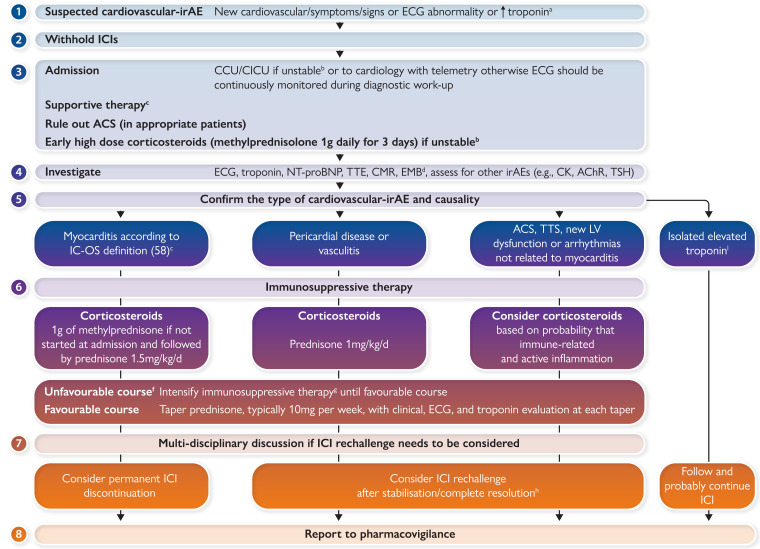
Proposed eight-point-based management of patients with a suspicion for a cardiovascular immune-related adverse event. aTroponin testing may be positive if Troponin I or T is >99th percentile of the upper reference limit. Concomitant myositis may result in significant elevations of CK, CK isoforms, and even Troponin T. In patients with pre-therapeutic troponin elevation, a 50% increase of the level may be used as a cut-off, but no evidence currently supports this recommendation. bHaemodynamic instability, heart failure requiring non-invasive or invasive ventilation, complete or high-grade heart block, and/or significant ventricular arrhythmia. cArrhythmias, conduction abnormalities, acute coronary syndromes, stroke, thromboembolic events, and heart failure should be managed urgently according to the international guidelines. dEndomyocardial biopsy should be performed especially in unstable patients who cannot undergo urgent CMR and in patients with uncertain diagnosis. eSee Table 2. fDefined as hemodynamic instability or electrical instability or increasing troponin or decreasing left ventricular ejection fraction. gThere are no data to recommend a standardized initial treatment strategy for the intensification of immunosuppressive therapy. For now, case series and case reports have shown the potential efficacy of anti-thymocyte globulin, intravenous immunoglobulin, plasma exchange, mycophenolate mofetil, tacrolimus, tocilizumab, abatacept, alemtuzumab, and tofacitinib. The decision regarding optimal therapy must be multidisciplinary, involving specialists in immunology and organ rejection. Infliximab was also proposed but was not incorporated into the algorithm because of its contraindication in acute heart failure. iTroponin elevation without cardiovascular signs/symptoms and negative investigations including EMB. ACS, acute coronary syndrome; CCU, coronary care unit; CK, creatine kinase; AchR, acetylcholine receptor antibodies; CMR, cardiac magnetic resonance; EMB, endomyocardial biopsy; irAE, immune-related adverse event; ICI, immune checkpoint inhibitor; NT-proBNP, N-terminal-pro-brain-natriuretic-peptide; SMB, skeletal muscle biopsy; TSH, thyroid-stimulating hormone; TTE, transthoracic echocardiography; TTS, takotsubo syndrome.
Figure 1
Figure 1
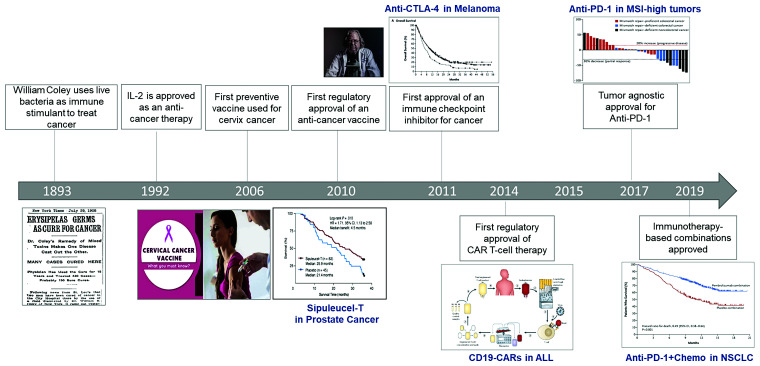
Timeline for immunotherapy in cancer.
Figure 2
Figure 2
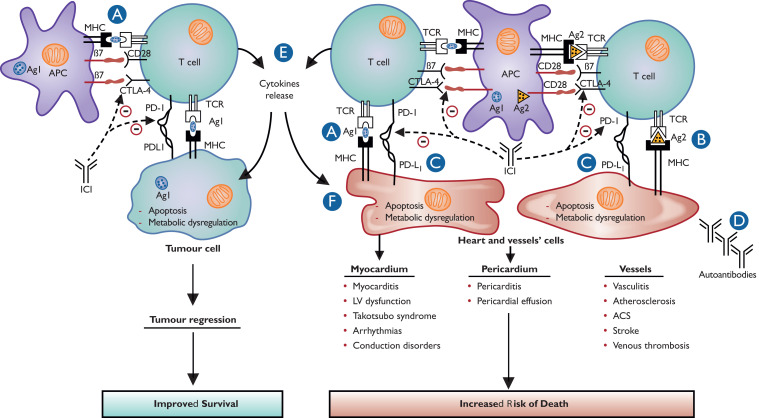
Proposed pathophysiology and mechanisms of cardiovascular immune-related adverse events. (A) T-cell targeting cardiovascular cells might result from cross-reactivity of tumour and cardiovascular tissues antigens. Tumour and cardiovascular antigens might be similar or with common epitopes. (B) T-cell targeting cardiovascular cells might result from important immune reaction and decrease in cell self-tolerance, which can lead to self-antigen recognition, especially if they had been modified by previous cardiovascular injury. (C) The use of immune checkpoint inhibitor in the context of programmed death ligand 1 overexpression on cardiovascular cells might also contribute to T-cell mediated myocardial, vascular, and pericardial injury related to T-cell infiltration. This overexpression of programmed death ligand 1 is protective in processes such as myocardial ischaemia reperfusion or atherosclerosis. (D) Though autoantibodies targeting cardiac troponin were only detected in pre-clinical models, the hypothesis that activation of the immune system might upregulate pre-existing autoantibodies, especially in predisposed patients, is not completely excluded. (E) The release of pro-inflammatory cytokines secondary to an immune response dysregulated by immune checkpoint inhibitors may cause cytokine release syndrome resulting in myocardial injury. However, cytokine release syndrome is rarely observed with immune checkpoint inhibitor therapy and is more frequent with CAR T-cell therapy. (F) Dysregulation of myocardial metabolism induced by smouldering inflammation is a possible mechanism of myocardial dysfunction after immune checkpoint inhibitor administration.

Comment in

References

    1. Dobosz P, Dzieciatkowski T. The intriguing history of cancer immunotherapy. Front Immunol 2019;10:2965. - PMC - PubMed
    1. Leach DR, Krummel MF, Allison JP. Enhancement of antitumor immunity by CTLA-4 blockade. Science 1996;271:1734–1736. - PubMed
    1. Topalian SL, Hodi FS, Brahmer JR, Gettinger SN, Smith DC, McDermott DF, et al. Safety, activity, and immune correlates of anti-PD-1 antibody in cancer. N Engl J Med 2012;366:2443–2454. - PMC - PubMed
    1. Hodi FS, O'Day SJ, McDermott DF, Weber RW, Sosman JA, Haanen JB, et al. Improved survival with ipilimumab in patients with metastatic melanoma. N Engl J Med 2010;363:711–723. - PMC - PubMed
    1. Ansell SM, Hurvitz SA, Koenig PA, LaPlant BR, Kabat BF, Fernando D, et al. Phase I study of ipilimumab, an anti-CTLA-4 monoclonal antibody, in patients with relapsed and refractory B-cell non-Hodgkin lymphoma. Clin Cancer Res 2009;15:6446–6453. - PMC - PubMed

Publication types

MeSH terms

Substances