


Pattern recognition receptor ligand-induced differentiation of human transitional B cells
- PMID: 36040923
- PMCID: PMC9426890
- DOI: 10.1371/journal.pone.0273810
Pattern recognition receptor ligand-induced differentiation of human transitional B cells
Abstract
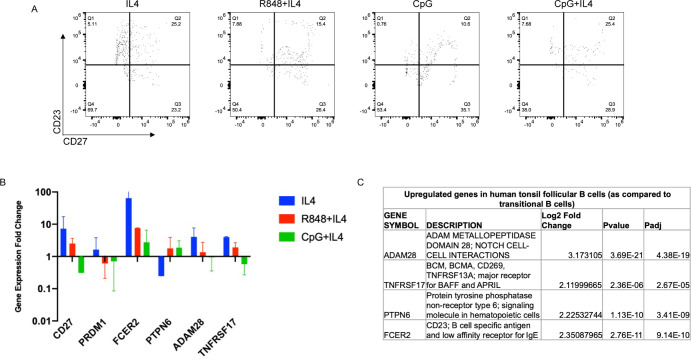
B cells represent a critical component of the adaptive immune response whose development and differentiation are determined by antigen-dependent and antigen-independent interactions. In this study, we explored the effects of IL-4 and pattern-recognition receptor (PRR) ligands on B cell development and differentiation by investigating their capacity to drive the in vitro maturation of human transitional B cells. In the presence of IL-4, ligands for TLR7/8, TLR9, and NOD1 were effective in driving the in vitro maturation of cord blood transitional B cells into mature, naïve B cells as measured by CD23 expression, ABCB1 transporter activation and upregulation of sIgM and sIgD. In addition, several stimulation conditions, including TLR9 ligand alone, favored an expansion of CD27+ IgM memory B cells. Transitional B cells stimulated with TLR7/8 ligand + IL-4 or TLR9 ligand, with or without IL-4, induced a significant subpopulation of CD23+CD27+ B cells expressing high levels of sIgM and sIgD, a minor B cell subpopulation found in human peripheral blood. These studies illustrate the heterogeneity of the B cell populations induced by cytokine and PRR ligand stimulation. A comparison of transitional and mature, naïve B cells transcriptomes to identify novel genes involved in B cell maturation revealed that mature, naïve B cells were less transcriptionally active than transitional B cells. Nevertheless, a subset of differentially expressed genes in mature, naïve B cells was identified including genes associated with the IL-4 signaling pathway, PI3K signaling in B lymphocytes, the NF-κB signaling pathway, and the TNFR superfamily. When transitional B cells were stimulated in vitro with IL-4 and PRR ligands, gene expression was found to be dependent on the nature of the stimulants, suggesting that exposure to these stimulants may alter the developmental fate of transitional B cells. The influence of IL-4 and PRR signaling on transitional B cell maturation illustrates the potential synergy that may be achieved when certain PRR ligands are incorporated as adjuvants in vaccine formulations and presented to developing B cells in the context of an inflammatory cytokine environment. These studies demonstrate the potential of the PRR ligands to drive transitional B cell differentiation in the periphery during infection or vaccination independently of antigen mediated BCR signaling.
Conflict of interest statement
The authors have declared that no competing interests exist.
Figures
References
-
- Didierlaurent AM, Morel S, Lockman L, Giannini SL, Bisteau M, Carlsen H, et al.. AS04, an aluminum salt- and TLR4 agonist-based adjuvant system, induces a transient localized innate immune response leading to enhanced adaptive immunity. J Immunol. 2009;183(10):6186–97. Epub 2009/10/30. doi: 10.4049/jimmunol.0901474 . - DOI - PubMed
Publication types
MeSH terms
Substances
Grants and funding
LinkOut - more resources
Full Text Sources
Research Materials
