. 2022 Jul 21;25(9):104816.
doi: 10.1016/j.isci.2022.104816. eCollection 2022 Sep 16.

Exosomal MicroRNA signature acts as an efficient biomarker for non-invasive diagnosis of gallbladder carcinoma

Affiliations

Exosomal MicroRNA signature acts as an efficient biomarker for non-invasive diagnosis of gallbladder carcinoma

Pinghua Yang et al. iScience. .

Abstract

Through a three-step study that relies on biomarker discovery, training, and validation, we identified a set of five exosomal microRNAs (miRNAs) that can be used to evaluate the risk of gallbladder carcinoma (GBC), including miR-552-3p, miR-581, miR-4433a-3p, miR-496, and miR-203b-3p. When validated in 102 GBC patients and 112 chronic cholecystitis patients from multiple medical centers, the AUC of this combinatorial biomarker was 0.905, with a sensitivity of 81.37% and a specificity of 86.61%. The performance of this biomarker is superior to that of the standard biomarkers CA199 and CEA and is suited for GBC early diagnosis. The multi-clinicopathological features and prognosis of GBC patients were significantly associated with this biomarker. After building a miRNA-target gene regulation network, cell functions and signaling pathways regulated by these five miRNAs were examined. This biomarker signature can be used in the development of a noninvasive tool for GBC diagnosis, screening and prognosis prediction.

Keywords: Cancer; Cancer systems biology; Health sciences.


Conflict of interest statement

The authors declare no competing interests.

Figures

None
Graphical abstract
Figure 1
Figure 1
Study design The experimental procedure and number of patients included. GBC: gallbladder carcinoma, CC: chronic cholecystitis, RT–PCR: reverse transcriptase polymerase chain reaction, ROC, receiver operating characteristics.
Figure 2
Figure 2
Plasma exosomal miRNA profiles of GBC and CC patients (A) Display of the proportions of various small RNAs in plasma exosomes from GBC and CC patients. (B) The percentage of exosomal miRNAs and Y RNAs in GBC and CC patients. Data are represented as mean ± SD. (C) In the discovery cohort, unique miRNAs that were either upregulated or downregulated in GBC patients relative to CC patients (fold-change≥2 and p ≤ 0.01) are shown in the volcano plot graph. (D) Hierarchical clustering analysis of exosomal miRNAs that were differentially expressed with fold-change≥2 and p ≤ 0.01 between the GBC and CC groups.
Figure 3
Figure 3
A set of five exosomal miRNAs acted as an effective diagnostic biomarker for GBC in the training cohort (A and B) Differentially expressed exosomal miRNAs in the training cohort. miRNA expression was measured by RT–PCR. Data are represented as mean ± SD. (C) CA199 and CEA levels in GBC patients in the training cohort. Data are represented as mean ± SD. (D–F) ROC curve analysis was performed for GBC (n = 30) and CC (n = 30) patients in the training cohort. AUC: area under the curve.
Figure 4
Figure 4
Outcomes of the use of exosomal miRNAs in the diagnosis of GBC patients in the validation cohort (A) Differentially expressed exosomal miRNAs in the validation cohort, n = 102 for GBC patients, n = 112 for CC patients, n = 25 for HCC patients. miRNA expression was measured by RT–PCR. Data are represented as mean ± SD. (B) CA199 and CEA levels in GBC patients in the validation cohort. Data are represented as mean ± SD. (C) The logistic regression equation and parameters created in the training cohort were used to construct the ROC curve in the validation cohort. (D) ROC curve analysis was performed to analyze the performance of CA199 and CEA in the validation cohort. (E) Patients with TNM stage I or II were classified as having early GBC. Patients with TNM stage III or IV were classified as having advanced GBC.
Figure 5
Figure 5
The five exosomal miRNAs-set is a significant prognostic factor of GBC (A) Associations between exosomal miRNA grade and the clinicopathological characteristics of GBC patients. GBC patients were stratified into low-grade or high-grade groups with the median cutoff based on the calculated exosomal miRNA levels. (B) Kaplan–Meier analysis of the correlation between exosomal miRNA grade and overall survival (OS) or disease-free survival (DFS) in patients with GBC. (C) Multivariate analysis of HRs for overall survival and tumor recurrence. HR: hazard ratio, CI: confidence interval.
Figure 6
Figure 6
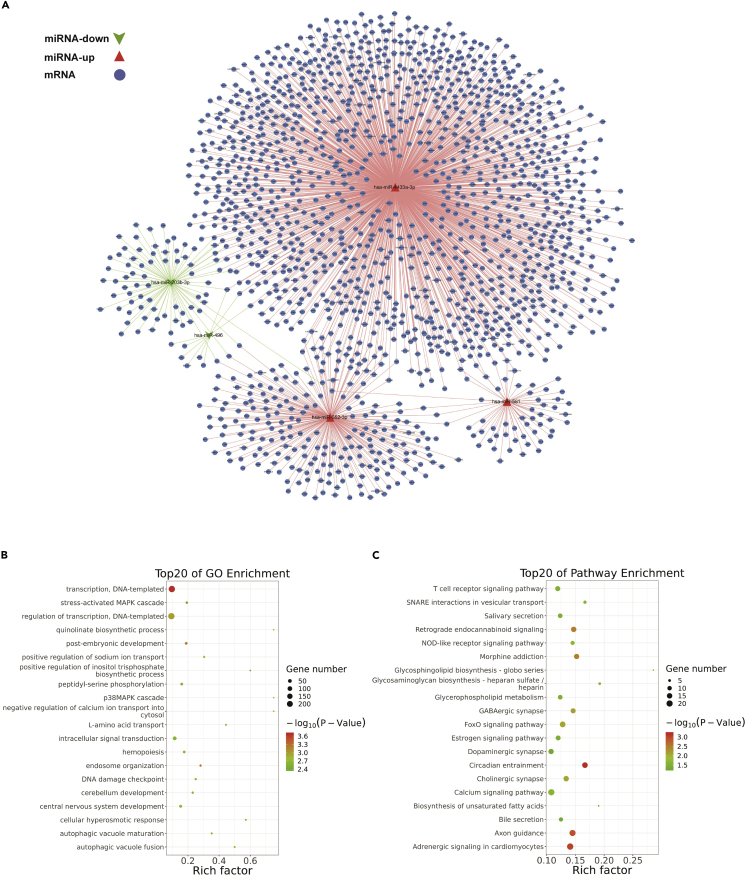
Analysis of the potential function of the five exosomal miRNAs in GBC patients (A) miRNA-target gene regulation network consisting of the five exosomal miRNAs. (B and C) GO and KEGG analyses of the functions of the potential target genes of differentially expressed exosomal miRNAs. The X axis represents the rich factor. The Y axis represents the top 20 functions or signaling pathways associated with each term.

References

    1. Barile L., Vassalli G. Exosomes: therapy delivery tools and biomarkers of diseases. Pharmacol. Ther. 2017;174:63–78. doi: 10.1016/j.pharmthera.2017.02.020. - DOI - PubMed
    1. Bray F., Ferlay J., Soerjomataram I., Siegel R.L., Torre L.A., Jemal A. Global cancer statistics 2018: GLOBOCAN estimates of incidence and mortality worldwide for 36 cancers in 185 countries. CA Cancer J. Clin. 2018;68:394–424. doi: 10.3322/caac.21492. - DOI - PubMed
    1. Brock G., Castellanos-Rizaldos E., Hu L., Coticchia C., Skog J. Liquid biopsy for cancer screening, patient stratification and monitoring. Transl. Cancer Res. 2015;4:280–290. doi: 10.3978/j.issn.2218-676X.2015.06.05. - DOI
    1. Chung I.M., Rajakumar G., Venkidasamy B., Subramanian U., Thiruvengadam M. Exosomes: current use and future applications. Clin. Chim. Acta. 2020;500:226–232. doi: 10.1016/j.cca.2019.10.022. - DOI - PubMed
    1. Dasari B.V.M., Ionescu M.I., Pawlik T.M., Hodson J., Sutcliffe R.P., Roberts K.J., Muiesan P., Isaac J., Marudanayagam R., Mirza D.F. Outcomes of surgical resection of gallbladder cancer in patients presenting with jaundice: a systematic review and meta-analysis. J. Surg. Oncol. 2018;118:477–485. doi: 10.1002/jso.25186. - DOI - PubMed