


A Conceptual Model for Sources of Differential Selection in Lung Transplant Allocation
- PMID: 36044711
- PMCID: PMC9989866
- DOI: 10.1513/AnnalsATS.202202-105OC
A Conceptual Model for Sources of Differential Selection in Lung Transplant Allocation
Abstract
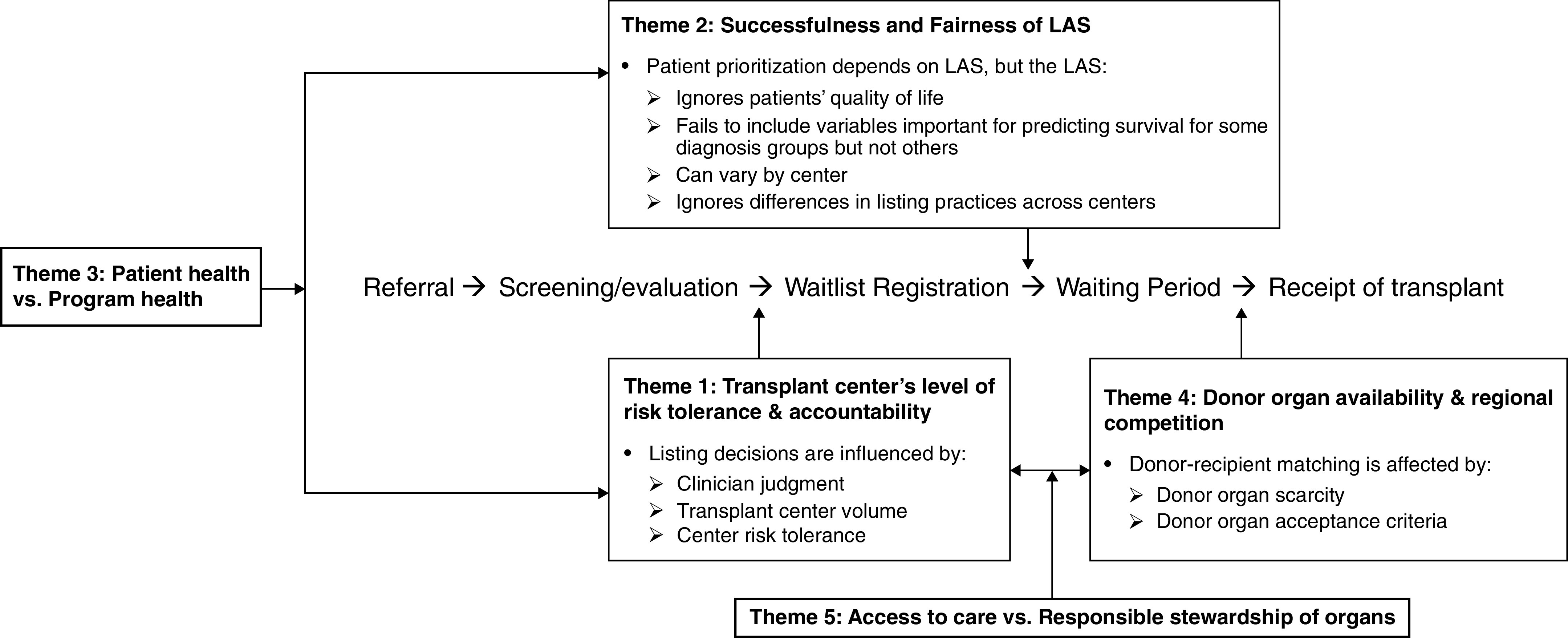
Rationale: In the United States, donor lungs are allocated to transplant candidates on the basis of lung allocation scores (LAS). However, additional factors beyond the LAS can impact who is transplanted, including listing and donor-organ acceptance practices. These factors can result in differential selection, undermining the objectivity of lung allocation. Yet their impact on the lung transplant pathway has been underexplored. Objectives: We sought to systematically examine sources of differential selection in lung transplantation via qualitative methods. Methods: We conducted semistructured qualitative interviews with lung transplant surgeons and pulmonologists in the United States between June 2019 and June 2020 to understand clinician perspectives on differential selection in lung transplantation and the LAS. Results: A total of 51 respondents (30 surgeons and 21 pulmonologists) identified many sources of differential selection arising throughout the pathway from referral to transplantation. We synthesized these sources into a conceptual model with five themes: 1) transplant center's degree of risk tolerance and accountability; 2) successfulness and fairness of the LAS; 3) donor-organ availability and regional competition; 4) patient health versus program health; and 5) access to care versus responsible stewardship of organs. Conclusions: Our conceptual model demonstrates how differential selection can arise throughout lung transplantation and facilitates the further study of such selection. As new organ allocation models are developed, differential selection should be considered carefully to ensure that these models are more equitable.
Keywords: allocation of healthcare resources; lung transplantation; patient selection for treatment.
Figures
Comment in
-
What's to Lose When We Choose: Decision-making in Lung Transplantation.Ann Am Thorac Soc. 2023 Feb;20(2):200-201. doi: 10.1513/AnnalsATS.202211-962ED. Ann Am Thorac Soc. 2023. PMID: 36723479 Free PMC article. No abstract available.
References
-
- Egan TM, Murray S, Bustami RT, Shearon TH, McCullough KP, Edwards LB, et al. Development of the new lung allocation system in the United States. Am J Transplant . 2006;6:1212–1227. - PubMed
-
- U.S. Department of Health & Human Services. 42 CFR part 121: organ procurement and transplantation network final rule, 56649-56661;1999 [accessed 2022 Sep 11]. Available from: https://www.govinfo.gov/content/pkg/FR-1999-10-20/pdf/FR-1999-10-20.pdf.
-
- A guide to calculating the lung allocation score. United Network for Organ Sharing https://unos.org/wp-content/uploads/unos/lung-allocation-score.pdf.
-
- Veatch RM, Ross LF. Transplantation ethics. Washington, DC: Georgetown University Press; 2015.
Publication types
MeSH terms
Grants and funding
LinkOut - more resources
Full Text Sources
Medical
Research Materials
