


An investigation into the causes of abnormal waste of Ortho-K lenses
- PMID: 36045728
- PMCID: PMC9421076
- DOI: 10.3389/fpubh.2022.981573
An investigation into the causes of abnormal waste of Ortho-K lenses
Abstract
Purpose: To investigate the reasons for wasting orthokeratology (OK) lenses due to breakage or loss, provide more comprehensive guidelines for the clinical care of lenses and minimize time and costs for patients due to excessive broken and lost lenses.
Methods: A survey was administered to clinic outpatients who had broken or lost their OK lenses before the regularly scheduled replacement cycle (1-1.5 years). The association between the frequency of OK lens breakage and daily care was assessed using Fisher's exact test and multivariable ordered logistic regression analysis.
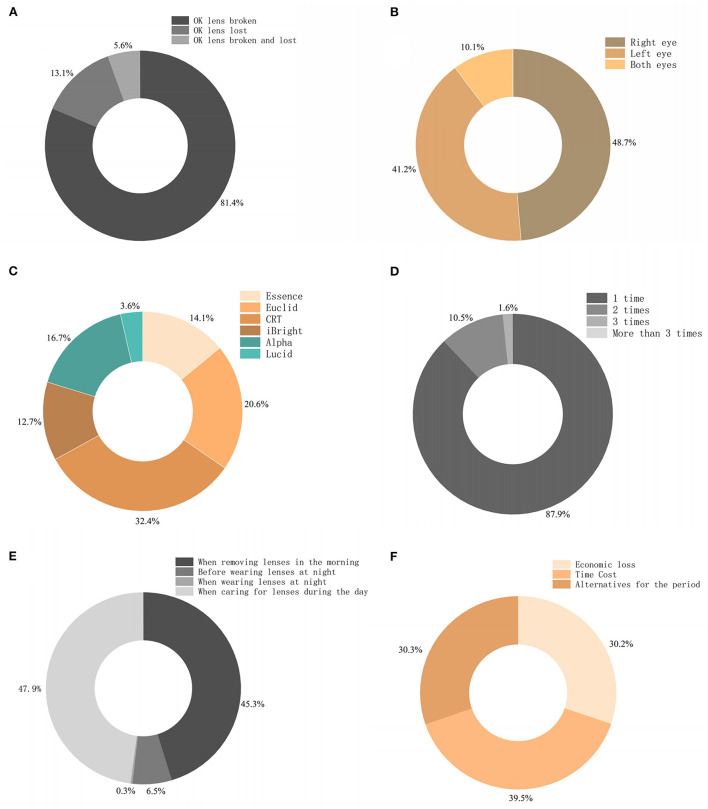
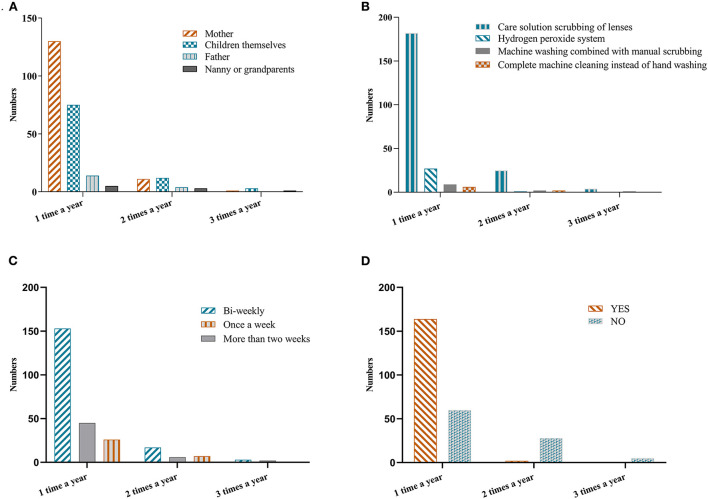
Results: A total of 306 valid questionnaires were collected. Among the subjects, 141 were male, and 165 were female, with a mean age of 10.57 ± 2.00 years (range: 6-18 years). In the investigation of the causes of OK lens waste, 81.4% of the patients reported lens breakage, 13.1% lost their lenses, and 5.6% of patients experienced both fragmentation and lens loss. More than half of the patients (52.90%) used incorrect lens cleaning techniques. In further analysis of the relationship between the frequency of OK lens fragmentation within a year and daily care habits, a significant difference was observed between the caregiver (P = 0.03) and whether the lenses were cleaned promptly after removal (P < 0.001). Mothers as daily caregivers of OK lenses had a lower frequency of fragmentation in a year compared to nanny or grandparents (P = 0.014, OR = 0.33, 95% CI = 0.13, 0.80). The failure to clean the lenses according to eye care practitioners' guidance was a risk factor for the frequent breakage of OK lenses (P < 0.001. OR = 5.29, 95% CI = 3.15, 8.89).
Conclusions: The causes of OK lens waste were mainly attributed to caregivers, care practices and some unexpected situations that can be avoided through optometrists' reminders. Regardless of the reasons for noncompliant behavior leading to breakage or loss of OK lenses, all of the complications can probably be addressed by better and more frequent reinforcement of care procedures by practitioners. Better clinical guidance measures and more frequent reminders could prevent a large proportion of abnormal waste of OK lenses.
Keywords: clinical guideline; myopia; orthokeratology; questionnaire; rigid contact lens.
Copyright © 2022 Fan, Zuo, Ma, Peng, Li, Wang and Zhao.
Conflict of interest statement
The authors declare that the research was conducted in the absence of any commercial or financial relationships that could be construed as a potential conflict of interest.
Figures
References
Publication types
MeSH terms
LinkOut - more resources
Full Text Sources
Medical
