


Assessing the Quality of YouTube Videos on Adhesive Capsulitis
- PMID: 36046306
- PMCID: PMC9419844
- DOI: 10.7759/cureus.27406
Assessing the Quality of YouTube Videos on Adhesive Capsulitis
Abstract
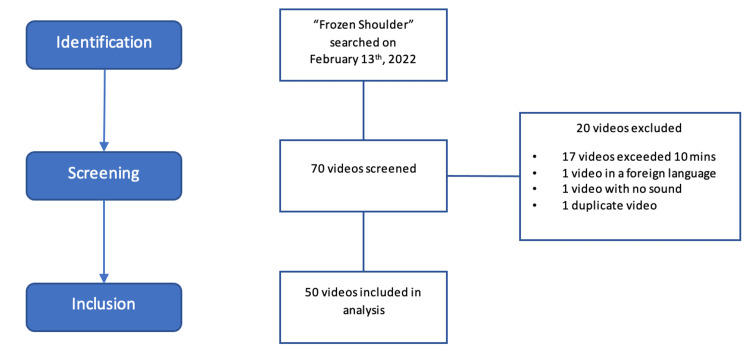
Introduction YouTube is the most popular video-based source of information on the Internet. It is accessed by over 1 billion users, which approximates to almost one-third of all Internet users. Orthopaedic video content published on YouTube is not screened and does not go through an editorial process, and most videos do not have information about authorship or appropriate references. Users who do not have the knowledge to assess the accuracy and reliability of the source may be misinformed about their medical condition. Previous studies have evaluated the quality of YouTube content for information in orthopaedics such as meniscus,kyphosis, and anterior cruciate ligament (ACL), but the quality of frozen shoulder videos on YouTube has not been investigated. The purpose of this study is to evaluate the quality and educational value of YouTube videos concerning adhesive capsulitis. Methods A YouTube search was performed using the term "frozen shoulder." Videos were excluded if they had no audio, were in a language other than English, or were longer than 10 minutes. A total of 70 videos were screened, and the first 50 videos that met the inclusion criteria were evaluated by three observers. Six video characteristics were extracted, and videos were categorized by source and content. Quality and educational value were assessed using the DISCERN (score range, 0-5), Global Quality score (GQS; score range, 0-4), and a Frozen Shoulder-Specific Score (FSSS; score range, 0-16). Results The mean video duration was 242.46 ± 164.32 seconds. The mean number of views was 137,494 ± 262,756 and the total view count across 50 videos was 6,874,706. The mean DISCERN, GQS, and FSSS scores were 2.72 ± 0.85, 2.37 ± 0.895, and 4.42 ± 3.15, respectively. The video sources were primarily from non-physician healthcare professionals (32%), and most of the video content was focused on disease-specific information (50%). Significant between-group effects were observed for the DISCERN score and video source (P = .005), with videos from academic sources having the highest mean DISCERN score. DISCERN scores also differed significantly based on video content (P = .007), with disease content having the highest DISCERN score. Both GQS and FSSS scores differed significantly based on video content (both P < .001) but did not differ significantly based on the video source. Conclusions Information about frozen shoulder on YouTube is low quality and has limited educational value. Thus, providers for orthopaedic conditions should warn their patients and provide better alternatives for education.
Keywords: adhesive capsulitis; frozen shoulder; patient education; quality; social media; videos; youtube.
Copyright © 2022, Tang et al.
Conflict of interest statement
The authors have declared that no competing interests exist.
References
-
- Statista: Worldwide digital population as of January 2021. [ Mar; 2022 ];https://www.statista.com/statistics/617136/digital-population-worldwide/ 2021
-
- Quality of online video resources concerning patient education for the meniscus: a YouTube-based quality-control study. Kunze KN, Krivicich LM, Verma NN, Chahla J. Arthroscopy. 2020;36:233–238. - PubMed
-
- Evaluating the accuracy and quality of the information in kyphosis videos shared on YouTube. Erdem MN, Karaca S. Spine (Phila Pa 1976) 2018;43:0–9. - PubMed
-
- YouTube provides poor information regarding anterior cruciate ligament injury and reconstruction. Cassidy JT, Fitzgerald E, Cassidy ES, Cleary M, Byrne DP, Devitt BM, Baker JF. Knee Surg Sports Traumatol Arthrosc. 2018;26:840–845. - PubMed
LinkOut - more resources
Full Text Sources
Miscellaneous