


Behavior without beliefs: Profiles of heteronormativity and well-being among heterosexual and non-heterosexual university students in Chile
- PMID: 36046402
- PMCID: PMC9421161
- DOI: 10.3389/fpsyg.2022.988054
Behavior without beliefs: Profiles of heteronormativity and well-being among heterosexual and non-heterosexual university students in Chile
Abstract
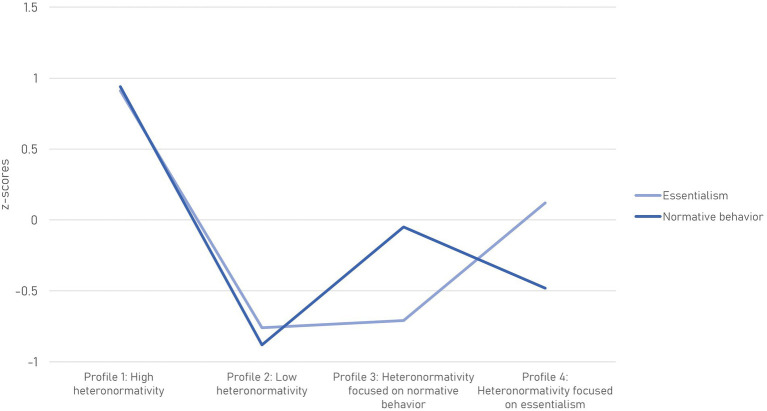
Heteronormativity comprises essentialist, binary beliefs about sex and gender, and normative behaviors derived from those beliefs. There is scarce literature on how heteronormative attitudes and well-being variables are concurrent among individuals who are heterosexual or gay, lesbian, bisexual, and of other queer sexual identities (LGBQ). The objective of this study was to distinguish profiles of university students based on essentialism and normative behavior, two dimensions of heteronormativity, and to characterize these groups by sexual orientation and gender, perceived social support, physical and mental health, and life satisfaction. A sample of 552 university students in Temuco, Chile, responded to an online questionnaire consisting of sociodemographic questions, the Scale of Heteronormative Attitudes and Beliefs, the Life Satisfaction Scale, the Health-Related Quality of Life Index, and the Multidimensional Scale of Perceived Social Support. We used Latent profile analysis to distinguish profiles based on significant score differences in Essentialism and Normative behavior. We identified four heteronormativity profiles: High heteronormativity (34.85%), with a significant proportion of heterosexuals and men; Low heteronormativity (25.59%), comprising a significant proportion of students who were non-binary, and LGBQ; Heteronormativity focused on normative behavior (20.42%), with a significant proportion students who were men or non-binary, and who were lesbian, gay or bisexual or preferred not to disclose their sexual orientation; and Heteronormativity focused on essentialism (19.14%), with a significant proportion of heterosexuals and women, and individuals who preferred not to disclose their sexual orientation. The four profiles differed in the proportions of students by faculty and area of residence (urban/rural), and by life satisfaction, self-perceived mental health, and perceived social support. These results show that patterns of association between heteronormativity and subjective well-being are heterogeneous among heterosexual and non-heterosexual individuals. Some of these patterns may respond to the COVID-19 pandemic, which has disrupted daily life and social dynamics. These findings expand our understanding of advantageous and disadvantageous conditions associated with maintaining heteronormativity attitudes, particularly among non-heterosexual individuals.
Keywords: Heteronormativity; LGBTQI+; latent profile analysis; subjective well-being; university students.
Copyright © 2022 Orellana, Alarcón and Schnettler.
Conflict of interest statement
The authors declare that the research was conducted in the absence of any commercial or financial relationships that could be construed as a potential conflict of interest.
Figures
References
-
- Arnett J. (2007). Emerging adulthood: what is it, and what is it good for? Child Dev. Perspect. 1, 68–73. doi: 10.1111/j.1750-8606.2007.00016.x - DOI
-
- Arnett J. J. (2014). Presidential address: the emergence of emerging adulthood: a personal history. Emerg. Adulthood 2, 155–162. doi: 10.1177/2167696814541096 - DOI
-
- Barrera-Herrera A., Vinet E. (2017). Adultez Emergente y características culturales de la etapa en universitarios chilenos. Ter. Psicol. 35, 47–56. doi: 10.4067/S0718-48082017000100005 - DOI
LinkOut - more resources
Full Text Sources
