Male Attitudes towards Infertility: Results from a Global Questionnaire
- PMID: 36047077
- PMCID: PMC9826912
- DOI: 10.5534/wjmh.220099
Male Attitudes towards Infertility: Results from a Global Questionnaire
Abstract
Purpose: In general, men are less likely to seek health care than women. Infertility is a global disease that afflicts approximately 15% of reproductive age couples and the male contributes to 40% of the diagnosable cause. Remarkably, no large or multi-national population data exist regarding men's perceptions about their infertility. The purpose of this study was to advance our knowledge about the infertile male's social experience regarding: (1) how they feel about their infertility, (2) what motivated them to seek health care, (3) how likely are they to talk with others about their infertility, (4) their awareness of male infertility support groups, and (5) what their primary source for information is regarding male infertility? Based on the results from this study, these simple questions now have clearer definition.
Materials and methods: An Institutional Review Board-approved, male-directed, anonymous questionnaire translated into 20 languages was made globally available through the Fertility Europe website (https://fertilityeurope.eu). Males (n=1,171) age 20-49 years were invited to complete the online survey after informed consent.
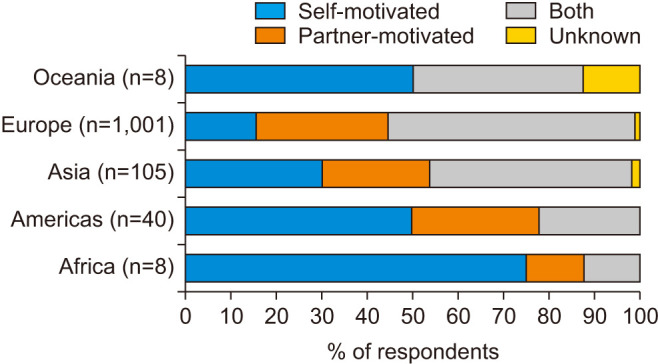
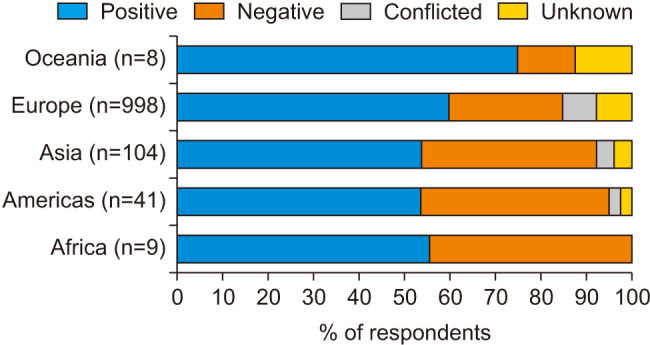
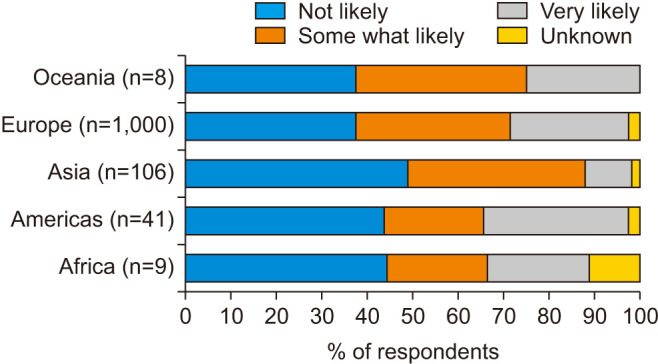
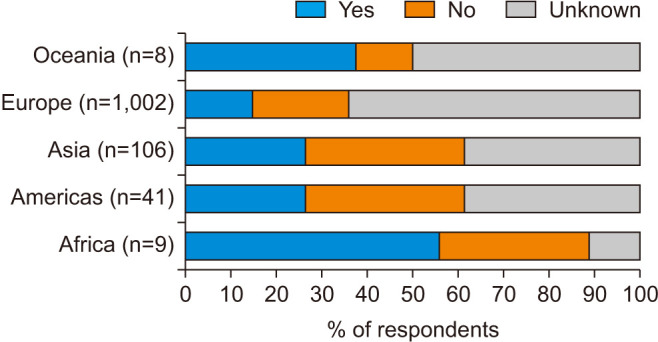
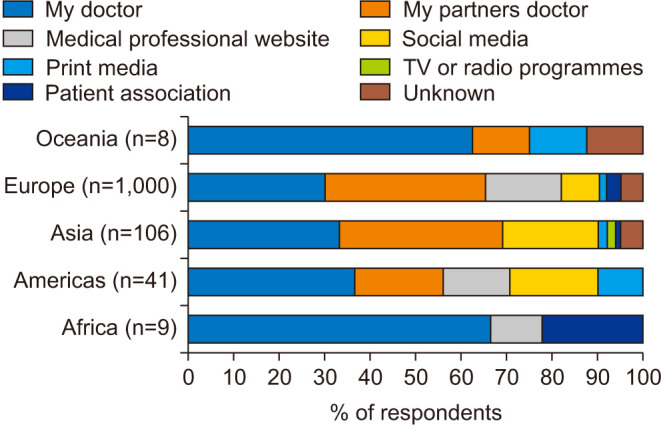
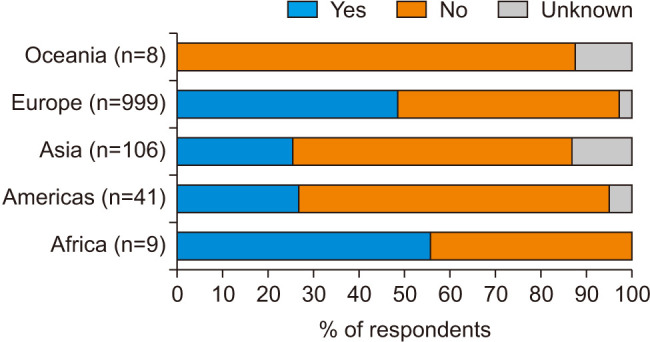
Results: Most respondents were European (86%). Of European men, <15.8% were self-motivated to seek medical help. Further, their physician was not the primary source of information regarding their infertility. While most men (59%) viewed their infertility positively, a large majority were not very likely (73%) to talk about it. Most respondents indicated a lack of awareness or absence of male infertility support groups.
Conclusions: These are the first multi-national population data revealing men's feelings about their infertility, what motivates them to seek help and their awareness of resources for peer support and information. These findings also serve to highlight significant gaps that exist in the provision of male reproductive health care and in supportive resources for men suffering from infertility. We offer recommendations on how to address the problem(s).
Keywords: Attitiude to health; Feelings; Infertility, male; Reproductive health.
Copyright © 2023 Korean Society for Sexual Medicine and Andrology.
Conflict of interest statement
Christopher J. De Jonge is Associate Editor, Frontiers in Molecular and Cellular Reproduction. Steven A. Gellatly: no conflicts to disclose. Mónica H. Vazquez-Levin (MHVL) is Editor for Fertility & Sterility and for F&S Science, and Associate Editor for Human Reproduction. Christopher L.R. Barratt (CLRB), as an employee of the University of Dundee, serves on the Scientific Advisory board of ExSeed Health (from October 2021, financial compensation to the University of Dundee) and is a scientific consultant for Exscientia (from September 2021-Feb 2022, financial compensation to the University of Dundee). CLRB has previously received a fee from Cooper Surgical for lectures on scientific research methods outside the submitted work (2020) and Ferring for a lecture on male reproductive health (2021). CLRB is Editor for RBMO. Satu Rautakallio-Hokkanen: no conflicts to disclose.
Figures
References
-
- Vander Borght M, Wyns C. Fertility and infertility: definition and epidemiology. Clin Biochem. 2018;62:2–10. - PubMed
-
- Schlegel PN, Sigman M, Collura B, De Jonge CJ, Eisenberg ML, Lamb DJ, et al. Diagnosis and treatment of infertility in men: AUA/ASRM guideline part I. J Urol. 2021;205:36–43. - PubMed
-
- Mahalik JR, Burns SM, Syzdek M. Masculinity and perceived normative health behaviors as predictors of men's health behaviors. Soc Sci Med. 2007;64:2201–2209. - PubMed
-
- Miner MM, Heidelbaugh J, Paulos M, Seftel AD, Jameson J, Kaplan SA. The intersection of medicine and urology: an emerging paradigm of sexual function, cardiometabolic risk, bone health, and men's health centers. Med Clin North Am. 2018;102:399–415. - PubMed