


Real-Time Telerehabilitation in Older Adults With Musculoskeletal Conditions: Systematic Review and Meta-analysis
- PMID: 36048520
- PMCID: PMC9478822
- DOI: 10.2196/36028
Real-Time Telerehabilitation in Older Adults With Musculoskeletal Conditions: Systematic Review and Meta-analysis
Abstract
Background: Real-time telerehabilitation (TR) is a new strategy for delivering rehabilitation interventions to older adults with musculoskeletal conditions, to provide continuity to conventional services and mitigate travel-related barriers.
Objective: We aimed to examine the effectiveness of treatment delivered via real-time TR services compared to conventional services among older adults with musculoskeletal conditions, in terms of physical performance, treatment adherence, and cost-effectiveness.
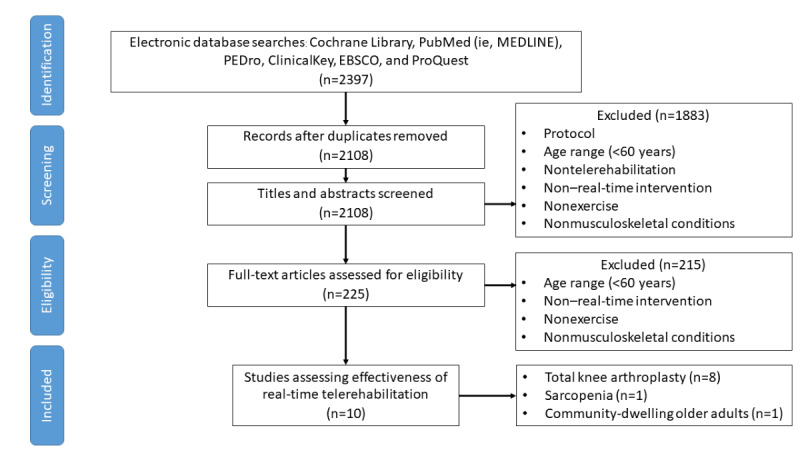
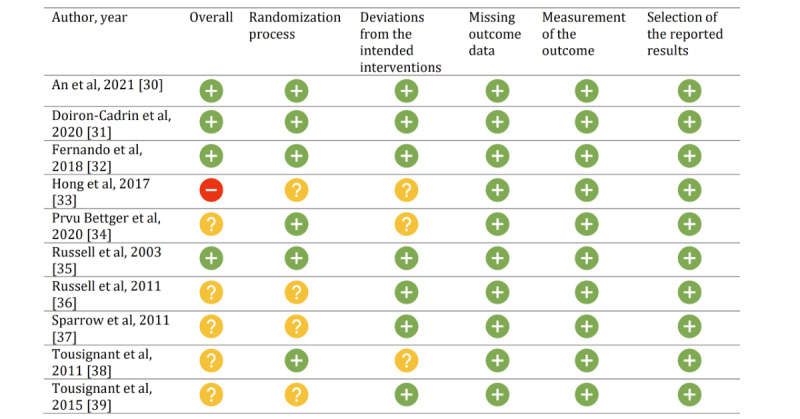
Methods: A literature search of randomized controlled trials (RCTs) published from January 2000 to April 2022 was conducted in six online databases: Cochrane Library, PubMed (ie, MEDLINE), PEDro, ClinicalKey, EBSCO, and ProQuest. The main eligibility criterion for articles was the use of real-time TR among older adults with musculoskeletal conditions to improve physical performance. Two reviewers screened 2108 abstracts and found 10 studies (n=851) that met the eligibility criteria. Quality assessment was based on version 2 of Cochrane's risk-of-bias tool for RCTs, in order to assess the methodological quality of the selected articles. Results were pooled for meta-analyses, based on the primary outcome measures, and were reported as standardized mean differences (SMDs) with 95% CIs. A fixed model was used, and subgroup analysis was performed to check for possible factors influencing TR's effectiveness based on different treatments, controls, and outcome measures.
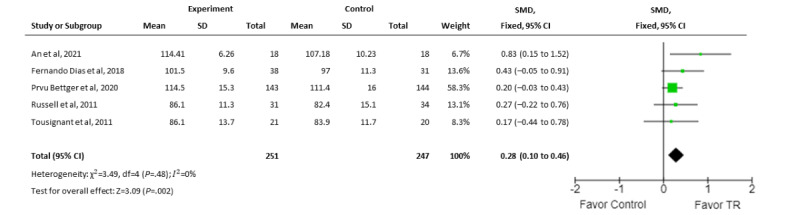
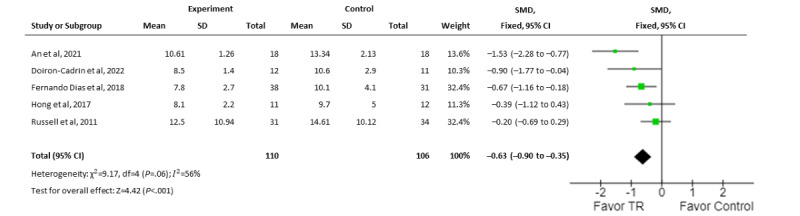
Results: The search and screening process identified 10 papers that collectively reported on three musculoskeletal conditions in older adults and three types of TR programs. Aggregate results suggested that real-time TR, compared to conventional treatment, was more effective at improving physical performance regarding balance (SMD 0.63, 95% CI 0.36-0.9; I2=58.5%). TR was slightly better than usual care at improving range of motion (SMD 0.28, 95% CI 0.1-0.46; I2=0%) and muscle strength (SMD 0.76, 95% CI 0.32-1.2; I2=59.60%), with moderate to large effects. Subgroup analyses suggested that real-time TR had medium to large effects favoring the use of smartphones or tablets (SMD 0.92, 95% CI 0.56-1.29; I2=45.8%), whereas the use of personal computers (SMD 0.25, 95% CI -0.16 to 0.66; I2=0%) had no effect on improving balance and was comparable to conventional treatment.
Conclusions: We found that real-time TR improved physical performance in older adults with musculoskeletal conditions, with an effectiveness level equal to that of conventional face-to-face treatment. Therefore, real-time TR services may constitute an alternative strategy for the delivery of rehabilitation services to older adults with musculoskeletal conditions to improve their physical performance. We also observed that the ideal device for delivering TR is the smartphone. Results suggested that the use of smartphones for TR is driven by ease of use among older adults. We encourage future studies in areas related to rehabilitation in older adults, in addition to examination of physical performance outcomes, to gain additional knowledge about comprehensive care.
Trial registration: PROSPERO CRD42021287289; https://www.crd.york.ac.uk/prospero/display_record.php?RecordID=287289.
Keywords: internet-based intervention; older adults; physical performance; physical therapy; telerehabilitation.
©Nathaphon Jirasakulsuk, Pattaridaporn Saengpromma, Santhanee Khruakhorn. Originally published in JMIR Rehabilitation and Assistive Technology (https://rehab.jmir.org), 01.09.2022.
Conflict of interest statement
Conflicts of Interest: None declared.
Figures
References
-
- Bae J, Woo S, Lee J, Park S, Kwon SW, Choi SH, Yoon G, Kim M, Hwang S, Lee WK. mHealth interventions for lifestyle and risk factor modification in coronary heart disease: Randomized controlled trial. JMIR Mhealth Uhealth. 2021 Sep 24;9(9):e29928. doi: 10.2196/29928. https://mhealth.jmir.org/2021/9/e29928/ v9i9e29928 - DOI - PMC - PubMed
-
- Bentley CL, Powell L, Potter S, Parker J, Mountain GA, Bartlett YK, Farwer J, O'Connor C, Burns J, Cresswell RL, Dunn HD, Hawley MS. The use of a smartphone app and an activity tracker to promote physical activity in the management of chronic obstructive pulmonary disease: Randomized controlled feasibility study. JMIR Mhealth Uhealth. 2020 Jun 03;8(6):e16203. doi: 10.2196/16203. https://mhealth.jmir.org/2020/6/e16203/ v8i6e16203 - DOI - PMC - PubMed
-
- Block VAJ, Pitsch E, Tahir P, Cree BAC, Allen DD, Gelfand JM. Remote physical activity monitoring in neurological disease: A systematic review. PLoS One. 2016;11(4):e0154335. doi: 10.1371/journal.pone.0154335. https://dx.plos.org/10.1371/journal.pone.0154335 PONE-D-15-55629 - DOI - DOI - PMC - PubMed
Publication types
LinkOut - more resources
Full Text Sources
Miscellaneous
