


Disparities in chemical exposures among pregnant women and neonates by socioeconomic and demographic characteristics: A nontargeted approach
- PMID: 36049512
- PMCID: PMC10016233
- DOI: 10.1016/j.envres.2022.114158
Disparities in chemical exposures among pregnant women and neonates by socioeconomic and demographic characteristics: A nontargeted approach
Abstract
Background: Exposure to environmental chemicals during pregnancy adversely affects maternal and infant health, and identifying socio-demographic differences in exposures can inform contributions to health inequities.
Methods: We recruited 294 demographically diverse pregnant participants in San Francisco from the Mission Bay/Moffit Long (MB/ML) hospitals, which serve a primarily higher income population, and Zuckerberg San Francisco General Hospital (ZSFGH), which serves a lower income population. We collected maternal and cord sera, which we screened for 2420 unique formulas and their isomers using high-resolution mass spectrometry using LC-QTOF/MS. We assessed differences in chemical abundances across socioeconomic and demographic groups using linear regression adjusting for false discovery rate.
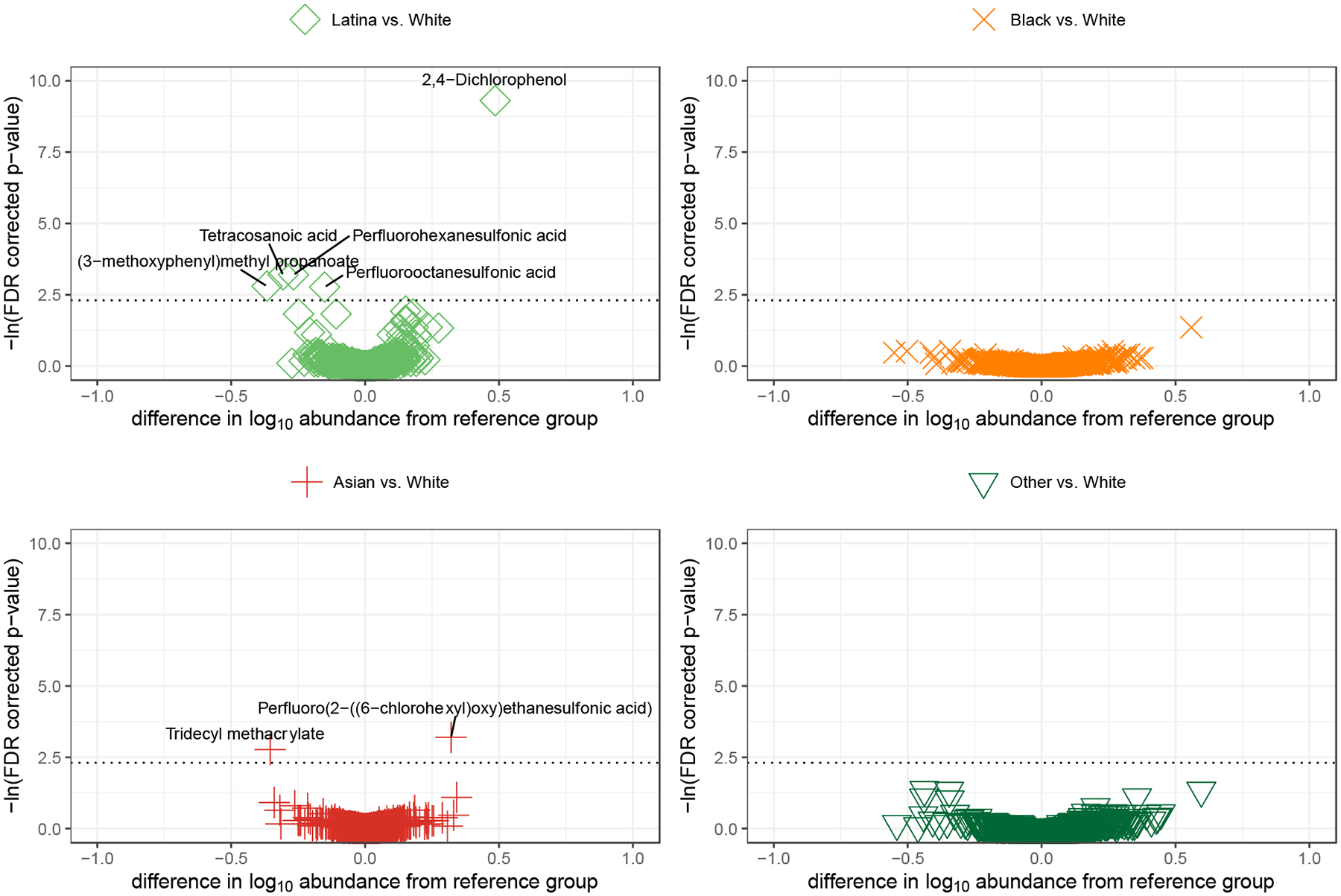
Results: Our participants were racially diverse (31% Latinx, 16% Asian/Pacific Islander, 5% Black, 5% other or multi-race, and 43% white). A substantial portion experienced financial strain (28%) and food insecurity (20%) during pregnancy. We observed significant abundance differences in maternal (9 chemicals) and cord sera (39 chemicals) between participants who delivered at the MB/ML hospitals versus ZSFGH. Of the 39 chemical features differentially detected in cord blood, 18 were present in pesticides, one per- or poly-fluoroalkyl substance (PFAS), 21 in plasticizers, 24 in cosmetics, and 17 in pharmaceuticals; 4 chemical features had unknown sources. A chemical feature annotated as 2,4-dichlorophenol had higher abundances among Latinx compared to white participants, those delivering at ZSFGH compared to MB/ML, those with food insecurity, and those with financial strain. Post-hoc QTOF analyses indicated the chemical feature was either 2,4-dichlorophenol or 2,5-dichlorophenol, both of which have potential endocrine-disrupting effects.
Conclusions: Chemical exposures differed between delivery hospitals, likely due to underlying social conditions faced by populations served. Differential exposures to 2,4-dichlorophenol or 2,5-dichlorophenol may contribute to disparities in adverse outcomes.
Copyright © 2022. Published by Elsevier Inc.
Conflict of interest statement
Declaration of competing interest The authors declare that they have no known competing financial interests or personal relationships that could have appeared to influence the work reported in this paper.
Figures




References
-
- Sapbamrer R, Hongsibsong S. Effects of prenatal and postnatal exposure to organophosphate pesticides on child neurodevelopment in different age groups: a systematic review. Environmental Science and Pollution Research. 2019;26(18):18267–90. - PubMed
-
- Ejaredar M, Nyanza EC, Ten Eycke K, Dewey D. Phthalate exposure and childrens neurodevelopment: a systematic review. Environmental research. 2015;142:51–60. - PubMed
