


Ischemic Heart Disease in Young Women: JACC Review Topic of the Week
- PMID: 36049799
- PMCID: PMC9847245
- DOI: 10.1016/j.jacc.2022.01.057
Ischemic Heart Disease in Young Women: JACC Review Topic of the Week
Abstract
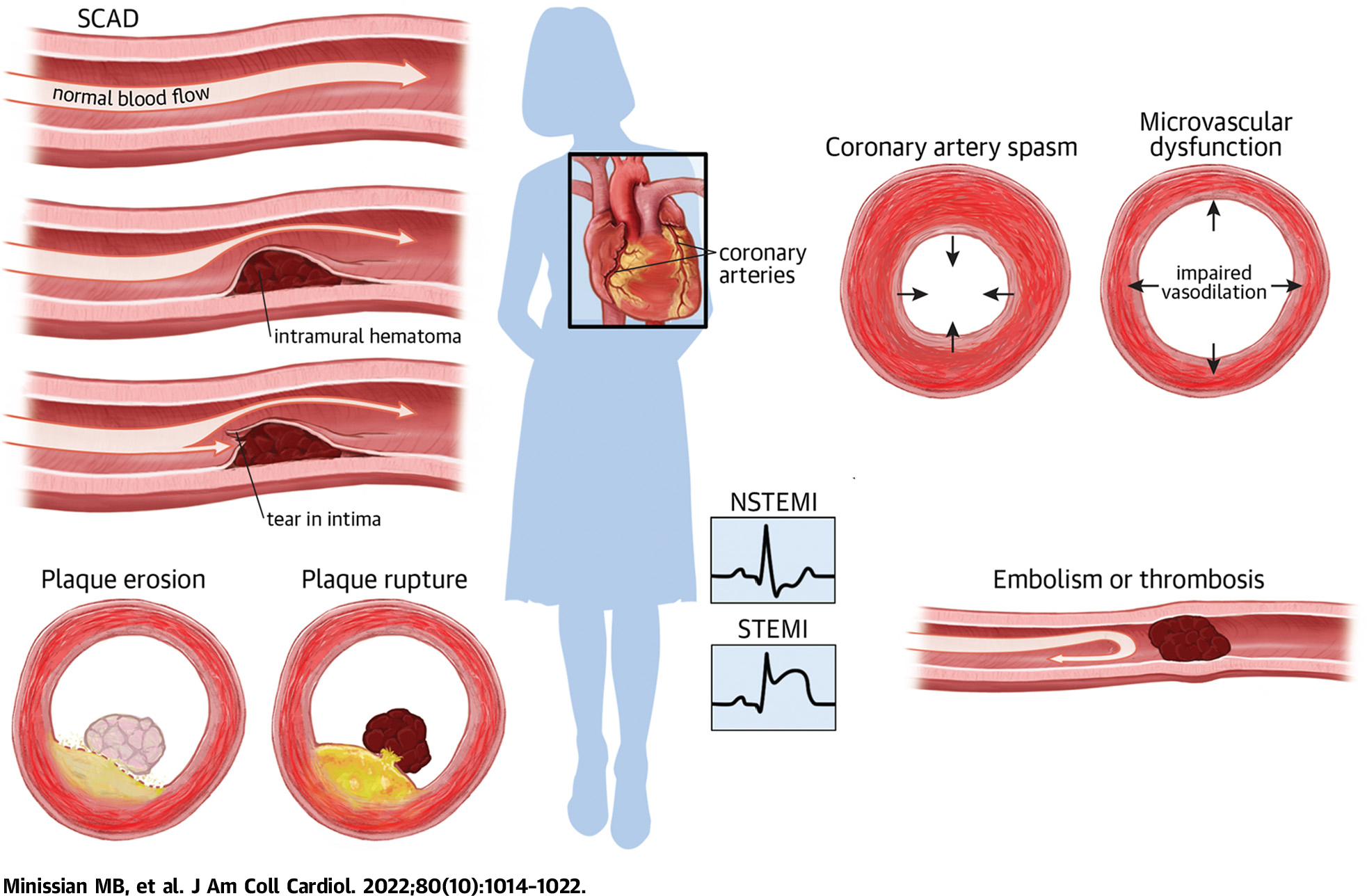
The Cardiovascular Disease in Women Committee of the American College of Cardiology convened a working group to develop a consensus regarding the continuing rise of mortality rates in young women aged 35 to 54 years. Heart disease mortality rates in young women continue to increase. Young women have increased mortality secondary to ischemic heart disease (IHD) compared with comparably aged men and similar mortality to that observed among older women. The authors reviewed the published evidence, including observational and mechanistic/translational data, and identified knowledge gaps pertaining to young women. This paper provides clinicians with pragmatic, evidence-based management strategies for young women at risk for IHD. Next-step research opportunities are outlined. This report presents highlights of the working group review and a summary of suggested research directions to advance the IHD field in the next decade.
Keywords: disease; heart; ischemic; mortality; women.
Crown Copyright © 2022. Published by Elsevier Inc. All rights reserved.
Conflict of interest statement
Funding Support and Author Disclosures This study was funded by National Institute for Nursing Research grants 1K99NR018679-01 and F31NR015725, UCLA Clinical and Translational Science Institutes grants UL1TR000124 and UL1TR001881-01, and the Preventive Cardiovascular Nurses Association grant #5362 through the American Nurses Foundation (Dr Minissian). Additional support was provided by the Cedars-Sinai Department of Obstetrics and Gynecology, the Cedars-Sinai Brawerman Nursing Institute, Department of Nursing Research, and the Cedars-Sinai Barbra Streisand Women’s Heart Center, Beta Chi Chapter, and Cedars-Sinai Precision Health Institute grant #42254 (Dr Minissian). Dr Wei is supported by National Institutes of Health (NIH) grants K23HL125941 and R01HL146158. Dr Bairey Merz is supported by NIH grants R01HL124649 and U54 AG065141, the Barbra Streisand Women’s Cardiovascular Research and Education Program, Cedars-Sinai Medical Center Los Angeles, the Linda Joy Pollin Women’s Heart Health Program, the Erika Glazer Women’s Heart Health Project, and the Adelson Family Foundation, Cedars-Sinai Medical Center, Los Angeles, California. Dr Reynolds is supported by American Heart Association grant SFRN 20-A0-00-1005066. Dr Quesada is supported by NIH grants T32HL116273 and K23HL151867. Dr Minissian has received honoraria from the National Lipid Association, North American Menopause Society, MJH Life Sciences, Vox Media, Medtelligence, Minneapolis Heart Institute, Primed, Good Samaritan Hospital Los Angeles, California, Cardiometabolic Health Congress, American Heart Association, Preventive Cardiovascular Nurses Association, and the American College of Cardiology; has been a consultant for and served on a medical advisory board for Amgen; and has served as a co-chair for CME for the North American Center for Continuing Medical Education honorarium. Dr Wei has received institutional fees for serving on an advisory board for Abbott Vascular. Dr Bairey Merz has received consulting fees from Abbott Diagnostics, Caladrius, and Sanofi Vascular; and receives consulting fees, is on the board of directors and owns stock in iRhythm. Dr Volgman has served as a consultant and on advisory boards for Merck, Bristol Myers Squibb Foundation, Novo Nordisk, and Janssen; has received research funding from Novartis; and hold stocks in Apple, Inc. Dr Elgendy has received research grants from Caladrius Biosciences, Inc, unrelated to this paper. Dr Mamas has been a speaker for Daiichi-Sankyo. Dr Reynolds has received in-kind donations for research from Abbott Vascular, Siemens, and BioTelemetry, Inc. Dr Piazza has received research grants from BMS/Pfizer, Janssen, Alexion, Bayer, Amgen, and BSC; and has an advisory role in BSC, Amgen, BCRI, PERC, Syntactx, BMS, and Janssen. The content is solely the responsibility of the authors and does not necessarily represent the official views of the National Institutes of Health. All other authors have reported that they have no relationships relevant to the contents of this paper to disclose.
Figures
References
-
- Benjamin EJ, Muntner P, Alonso A, et al. Heart disease and stroke statistics-2019 update: a report from the American Heart Association. Circulation. 2019;139:e56–e528. - PubMed
-
- Ananth CV, Duzyj CM, Yadava S, Schwebel M, Tita ATN, Joseph KS. Changes in the prevalence of chronic hypertension in pregnancy, United States, 1970 to 2010. Hypertension. 2019;74:1089–1095. - PubMed
-
- Virani SS, Alonso A, Aparicio HJ, et al. Heart disease and stroke statistics-2021 update: a report from the American Heart Association. Circulation. 2021;143:e254–e743. - PubMed
Publication types
MeSH terms
Grants and funding
- T32 HL116273/HL/NHLBI NIH HHS/United States
- R01 HL146158/HL/NHLBI NIH HHS/United States
- UL1 TR000064/TR/NCATS NIH HHS/United States
- U54 AG065141/AG/NIA NIH HHS/United States
- K23 HL125941/HL/NHLBI NIH HHS/United States
- UL1 TR000124/TR/NCATS NIH HHS/United States
- K23 HL151867/HL/NHLBI NIH HHS/United States
- K99 NR018679/NR/NINR NIH HHS/United States
- R01 HL153500/HL/NHLBI NIH HHS/United States
- UL1 TR001881/TR/NCATS NIH HHS/United States
- R01 HL090957/HL/NHLBI NIH HHS/United States
- R01 HL124649/HL/NHLBI NIH HHS/United States
- F31 NR015725/NR/NINR NIH HHS/United States
LinkOut - more resources
Full Text Sources
