. 2023 Feb;47(1):170-180.
doi: 10.1007/s00266-022-02996-3. Epub 2022 Sep 1.

The Surgical Anatomy of the Jowl and the Mandibular Ligament Reassessed

Affiliations

The Surgical Anatomy of the Jowl and the Mandibular Ligament Reassessed

Lennert Minelli et al. Aesthetic Plast Surg. 2023 Feb.

Abstract

Introduction: A visible jowl is a reason patients consider lower facial rejuvenation surgery. The anatomical changes that lead to formation of the jowl remain unclear. The aim of this study was to elucidate the anatomy of the jowl, the mandibular ligament and the labiomandibular crease, and their relationship with the marginal mandibular branch of the facial nerve.

Materials and methods: Forty-nine cadaver heads were studied (16 embalmed, 33 fresh, mean age 75 years). Following preliminary dissections and macro-sectioning, a series of standardized layered dissections were performed, complemented by histology, sheet plastination and micro-CT.

Results: The jowl forms in the subcutaneous layer where it overlies the posterior part of the mandibular ligament. The mandibular ligament proper exists only in the deep, sub-platysma plane, formed by the combined muscular attachment to the mandible of the specific lower lip depressor muscles and the platysma. The mandibular ligament does not have a definitive subcutaneous component. The labiomandibular crease inferior to the oral commissure marks the posterior extent of the fixed dermal attachment of depressor anguli oris.

Conclusion: Jowls develop as a consequence of aging changes on the functional adaptions of the mouth in humans. To accommodate wide jaw opening with a narrowed commissure requires hypermobility of the tissues overlying the mandible immediately lateral to the level of the oral commissure. This hypermobility over the mandibular attachment of the lower lip depressor muscles occurs entirely in the subcutaneous layer to allow the mandible to move largely independent from the skin. The short, elastic subcutaneous connective tissue, which allows this exceptional mobility without laxity in youth, lengthens with aging, resulting in laxity. The development of subcutaneous and dermal redundancy constitutes the jowl in this location.

Level of evidence iv: "This journal requires that authors assign a level of evidence to each article. For a full description of these Evidence-Based Medicine ratings, please refer to the Table of Contents or the online Instructions to Authors www.springer.com/00266 ."

Keywords: Aging; Facial retaining ligaments; Jowl; Labiomandibular fold; Mandible; Platysma.


Conflict of interest statement

The authors declare that they have no conflicts of interest to disclose.

Figures
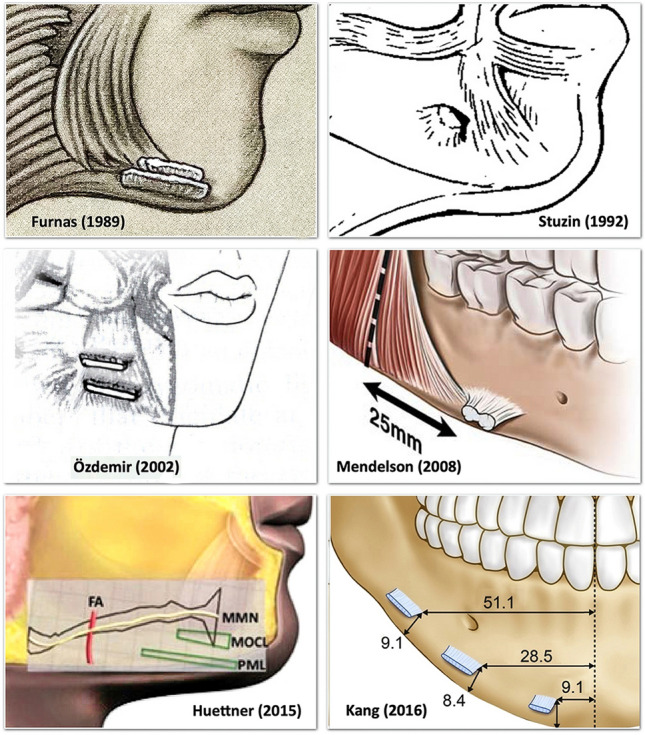
Fig. 1
Fig. 1
This illustration combines the different historical descriptions of the mandibular ligament. Furnas [3] introduced the mandibular ligament as “a linear series of parallel fibres along the anterior third of the mandible which interdigitate among the muscle fibres of the platysma and triangularis along their line of attachment to the mandible”. Stuzin et al. [4] described the mandibular ligaments as osteocutaneous which “securely fix the parasymphysial dermis to the underlying mandible” and illustrated it as a smaller stout ligament. Özdemir et al. [5] reported two mandibular ligaments with mean widths of 22−32 mm. Mendelson et al. [1] reported it in the sub-platysmal plane: “the mandibular ligament is located immediately in front of the masseter’s anterior border”. Huettner et al. [7] described two ligaments in the subcutaneous plane: the mandibular osteocutaneous ligament (MOCL) with a mean width of 13 mm, and the platysma mandibular ligament (PML) with a mean width of 22 mm. Kang et al. [8] described two mandibular ligaments and one mental ligament in the sub-platysmal plane. The platysma, DLI and DAO mandibular attachments were not mentioned, nor a subcutaneous extension of these ligaments Reproduced with permission from Wolters Kluwer Health, Springer Nature, Oxford University Press and Elsevier
Fig. 2
Fig. 2
The deep part of the mandibular ligament is the combined mandibular attachment of the platysma, depressor labii inferioris (DLI) and the depressor anguli oris (DAO). It has a specific organization with the platysma attaching most caudal, the DLI attaching most cephalad and the DAO attaching in the middle. The posterior part of the platysma also inserts directly into the buccinator and the modiolus. The middle part of the platysma “disappears” deep to the DAO to “reappear” at its medial border and insert into the lower lip dermis and orbicularis oris muscle. This part was previously called the “depressor labii lateralis” by Le Louarn.[23] The fixed anterior part of the platysma inserts into the mandible as part of the mandibular ligament but then continues further to the lower lip under the name “depressor labii inferioris”, which is embryologically and evolutionary part of the platysma muscle. When dissecting in the deep plane, it is the posterior end of the platysma attachment which can be felt as the ligament when palpating the flap anteriorly
Fig. 3
Fig. 3
This right side of a fresh cadaver demonstrates the lower lip depressors. Removal of the depressor anguli oris (DAO) demonstrates the continuity of the platysma as the depressor labii inferioris (DLI), being a continuation of the same muscle
Fig. 4
Fig. 4
Fresh cadaver dissections of the right mandible. A The mean distance from the posterior end of the platysma attachment to the masseter is 5.2 mm (SD = 5.0 mm), but in some cases, such as the one seen here, the two muscle attachments “overlap”, with the platysma, DLI and DAO taking origin superior and the masseter taking origin inferior on the mandible. B Repositioning the deep fascia over the mandible demonstrates there is a wafer of fat overlying the mandible and masseter posterior to the mandibular ligament (also clear in C.). Coursing vertically through this fat are the facial vein posteriorly and the facial artery anteriorly with the marginal mandibular nerve (MMN) crossing both vessels superficially. The fat over the nerve has been removed to enhance visualization. The main branch of the MMN is always in close relationship with the mandibular ligament, passing it at only 1 - 2 mm to then continue forward, cephalad to the ligament towards the mentalis, still deep to the platysma, DLI and DAO. C With the upper part of the platysma, DLI and DAO flipped over to reveal what is behind, the continuation of the main branch of the MMN is visualized passing towards the mentalis muscle. The mental nerve is seen exiting the mental foramen at approximately 22 mm from the end of the mandibular ligament
Fig. 5
Fig. 5
Overview of the subcutaneous soft tissue organization at the level of the jowl approximately at the most posterior end of the mandibular ligament. Typical (A) histology with the mouth closed and (B) micro-CT with the mouth open, of the jowl demonstrates the enormous mobility of the skin and subcutaneous fat in this area. Instead of a stout ligament in the subcutaneous layer, the retinacula cutis connecting the skin to the muscles over the mandibular ligament are longer than in the other supra-platysmal areas. This allows the skin to glide over the mandibular ligament when opening the mouth. Note how the retinacula cutis are oriented downwards with the mouth closed, but upwards with the mouth open, allowing the gliding of the mandible and muscle attachment underneath. When dissecting in the deep subcutaneous plane, the length of these retinacula cutis cannot be perceived as they are cut at their base (trunk), and they can be perceived as subcutaneous “mandibular ligaments”
Fig. 6
Fig. 6
Sheet plastination sections through three planes of the chin region demonstrate the shift from loose areolar tissue in the normal cheek and neck tissues to dense adhesion of the lower lip muscles and the dermis in the perioral adhesion zone. A Axial section through the cephalad part of the lower lip. Observe the retinacula cutis fibres connecting the dermis to the muscle are longer in the cheek, abruptly shortening anteriorly in the perioral region over the DAO to become absent medial to the DAO. B Axial section through the caudal part of the lower lip demonstrates a more subtle transition and no real labiomandibular crease or fold can be pinpointed. Whereas posteriorly, the dermis is loosely connected to the muscles, this connection becomes more defined at the anterior third of the DAO, with thicker and shorter retinacula cutis. At the anterior border of the DAO, the DLI also starts inserting directly into the lower lip skin. C Sagittal section of the chin segment showing the relatively uniform tight attachment of the dermis that maintains the soft tissue connection with the mandible on movement. Note the abrupt change in the neck inferior to the submental crease
Fig. 7
Fig. 7
This illustration comparing the human to the dog illustrates how much soft tissue needs to glide over the mandible posterior to the oral commissure for the jaw to open. The human has a very narrow mouth combined with a broad mimetic muscle attachment (platysma, DLI, DAO). This combination requires for skin to glide over this area (or rather the mandible and muscle attachments to glide under the skin), eventually creating the jowl
Fig. 8
Fig. 8
This illustration demonstrates how the different areas across the mandible react to opening of the mouth. At the premasseter space (blue), opening the mouth results in gliding of the platysma over the masseter without need for additional skin gliding. At the mandibular ligament (yellow), opening the mouth requires the skin to glide over the mandible-muscle complex at the common mandibular attachment of the platysma, DLI and DAO. At the perioral adhesion zone (red), opening the mouth results in en-bloc movement of the mandible, lower lip muscles and the skin, maintaining constant relationships

References

    1. Mendelson BC, Freeman ME, Wu W, Huggins RJ. Surgical anatomy of the lower face: the premasseter space, the jowl, and the labiomandibular fold. Aesthet Plast Surg. 2008;32:185–195. doi: 10.1007/s00266-007-9060-3. - DOI - PubMed
    1. Reece EM, Rohrich RJ. The aesthetic jaw line: management of the aging Jowl. Aesthet Surg J. 2008;28:668–674. doi: 10.1016/j.asj.2008.09.007. - DOI - PubMed
    1. Furnas DW. The retaining ligaments of the cheek. Plast Reconstr Surg. 1989;83:11–16. doi: 10.1097/00006534-198901000-00003. - DOI - PubMed
    1. Stuzin JM, Baker TJ, Gordon HL. The relationship of the superficial and deep facial fascias: Relevance to rhytidectomy and aging. Plast Reconstr Surg. 1992;89:441–449. doi: 10.1097/00006534-199203000-00007. - DOI - PubMed
    1. Özdemir R, Kilinç H, Ünlü ER, et al. Anatomicohistologic study of the retaining ligaments of the face and use in face lift: retaining ligament correction and SMAS plication. Plast Reconstr Surg. 2002;110:1134. doi: 10.1097/01.prs.0000021442.30272.0e. - DOI - PubMed
