Observational Study
. 2022 Sep 1;22(1):722.
doi: 10.1186/s12877-022-03378-9.

Transitions between degrees of multidimensional frailty among older people admitted to intermediate care: a multicentre prospective study

Affiliations
Observational Study

Transitions between degrees of multidimensional frailty among older people admitted to intermediate care: a multicentre prospective study

Jordi Amblàs-Novellas et al. BMC Geriatr. .

Abstract

Background: Frailty is a dynamic condition that is clinically expected to change in older individuals during and around admission to an intermediate care (IC) facility. We aimed to characterize transitions between degrees of frailty before, during, and after admission to IC and assess the impact of these transitions on health outcomes.

Methods: Multicentre observational prospective study in IC facilities in Catalonia (North-east Spain). The analysis included all individuals aged ≥ 75 years (or younger with chronic complex or advanced diseases) admitted to an IC facility. The primary outcome was frailty, measured by the Frail-VIG index and categorized into four degrees: no frailty, and mild, moderate, and advanced frailty. The Frail-VIG index was measured at baseline (i.e., 30 days before IC admission) (Frail-VIG0), on IC admission (Frail-VIG1), at discharge (Frail-VIG2), and 30 days post-discharge (Frail-VIG3).

Results: The study included 483 patients with a mean (SD) age of 81.3 (10.2) years. At the time of admission, 27 (5.6%) had no frailty, and 116 (24%), 161 (33.3%), and 179 (37.1%) mild, moderate, and severe frailty, respectively. Most frailty transitions occurred within the 30 days following admission to IC, particularly among patients with moderate frailty on admission. Most patients maintained their frailty status after discharge. Overall, 135 (28%) patients died during IC stay. Frailty, measured either at baseline or admission, was significantly associated with mortality, although it showed a stronger contribution when measured on admission (HR 1.16; 95%CI 1.10-1.22; p < 0.001) compared to baseline (HR 1.10; 1.05-1.15; p < 0.001). When including frailty measurements at the two time points (i.e., baseline and IC admission) in a multivariate model, frailty measured on IC admission but not at baseline significantly contributed to explaining mortality during IC stay.

Conclusions: Frailty status varied before and during admission to IC. Of the serial frailty measures we collected, frailty on IC admission was the strongest predictor of mortality. Results from this observational study suggest that routine frailty measurement on IC admission could aid clinical management decisions.

Keywords: Frailty; Frailty transitions; Geriatrics; Intermediate care; Older people.


Conflict of interest statement

The authors declare that they have no competing interests.

Figures

Fig. 1
Fig. 1
Distribution of the study cohort across frailty status categories at each assessment point: one month before admission (Frail-VIG0), within the first 48 h after admission (Frail-VIG1), at discharge (Frail-VIG2), and at 30-day post-discharge (Frail-VIG3). Green: No frailty (Frail-VIG index score < 0.2). Yellow: mild frailty (Frail-VIG index score 0.2–0.35). Orange: moderate frailty (Frail-VIG index score 0.36–0.5). Red: advanced frailty (Frail-VIG index score > 0.5). Grey: death, White: missing values
Fig. 2
Fig. 2
Transition probabilities between frailty statuses in all stages: between baseline (i.e., one month before admission) and admission (A), between admission and discharge (B), between baseline and discharge (C), between discharge and 30-day post-discharge follow-up (D). No frailty (Frail-VIG index score < 0.2), mild frailty (Frail-VIG index score 0.2–0.35), moderate frailty (Frail-VIG index score 0.36–0.5), and advanced frailty (Frail-VIG index score > 0.5). The arrow size is proportional to the transition probability. The probability of remaining in the same status for a given period is displayed within the circle. M: missing values
Fig. 3
Fig. 3
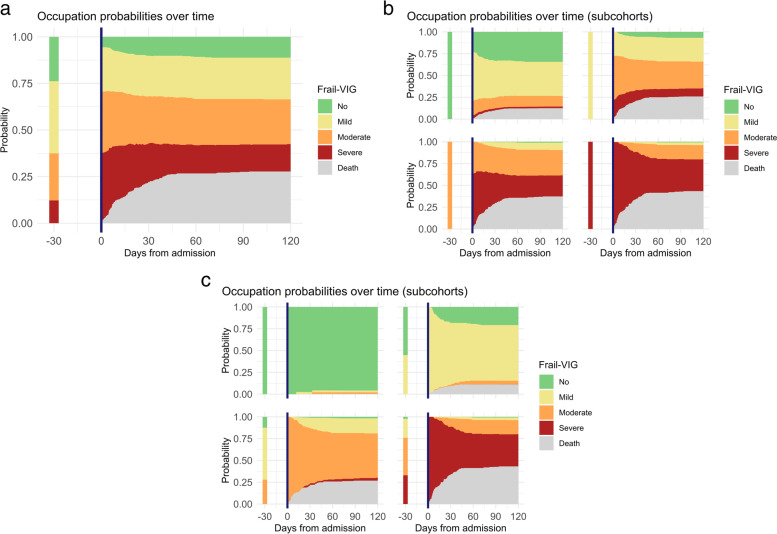
Occupation probabilities for each frailty status, estimated using a survival analysis of frailty status between admission to the intermediate care facility and discharge A Entire cohort. B stratified by frailty status at baseline. C stratified by frailty on admission
Fig. 4
Fig. 4
Increase in mortality risk (hazard ratio) associated with each additional deficit in the Frail-VIG scale. A frailty status at baseline (i.e., one month before admission); the HR associated with a gain of one additional deficit at baseline was 1.10 (95% CI 1.05 – 1.15), p < 0.001. B frailty status on admission; the HR associated with a gain of one additional deficit at baseline was 1.16 (1.10 – 1.22), p < 0.001

References

    1. Hoogendijk EO, Afilalo J, Ensrud KE, Kowal P, Onder G, Fried LP. Frailty: implications for clinical practice and public health. Lancet. 2019;394(10206):1365–1375. doi: 10.1016/S0140-6736(19)31786-6. - DOI - PubMed
    1. Joosten E, Demuynck M, Detroyer E, Milisen K. Prevalence of frailty and its ability to predict in hospital delirium, falls, and 6-month mortality in hospitalized older patients. BMC Geriatr. 2014;14(1):1–9. doi: 10.1186/1471-2318-14-1. - DOI - PMC - PubMed
    1. Richards SJG, D’Souza J, Pascoe R, Falloon M, Frizelle FA. Prevalence of frailty in a tertiary hospital: A point prevalence observational study. PLoS ONE. 2019;14(7):e0219083. doi: 10.1371/journal.pone.0219083. - DOI - PMC - PubMed
    1. Kanwar A, Singh M, Lennon R, Ghanta K, McNallan SM, Roger VL. Frailty and health-related quality of life among residents of long-term care facilities. J Aging Health. 2013;25(5):792–802. doi: 10.1177/0898264313493003. - DOI - PMC - PubMed
    1. Gill TM, Allore HG, Gahbauer EA, Murphy TE. Change in disability after hospitalization or restricted activity in older persons. JAMA. 2010;304(17):1919–1928. doi: 10.1001/jama.2010.1568. - DOI - PMC - PubMed

Publication types

LinkOut - more resources