


Anthracycline-induced cardiotoxicity: targeting high-density lipoproteins to limit the damage?
- PMID: 36050733
- PMCID: PMC9434835
- DOI: 10.1186/s12944-022-01694-y
Anthracycline-induced cardiotoxicity: targeting high-density lipoproteins to limit the damage?
Abstract
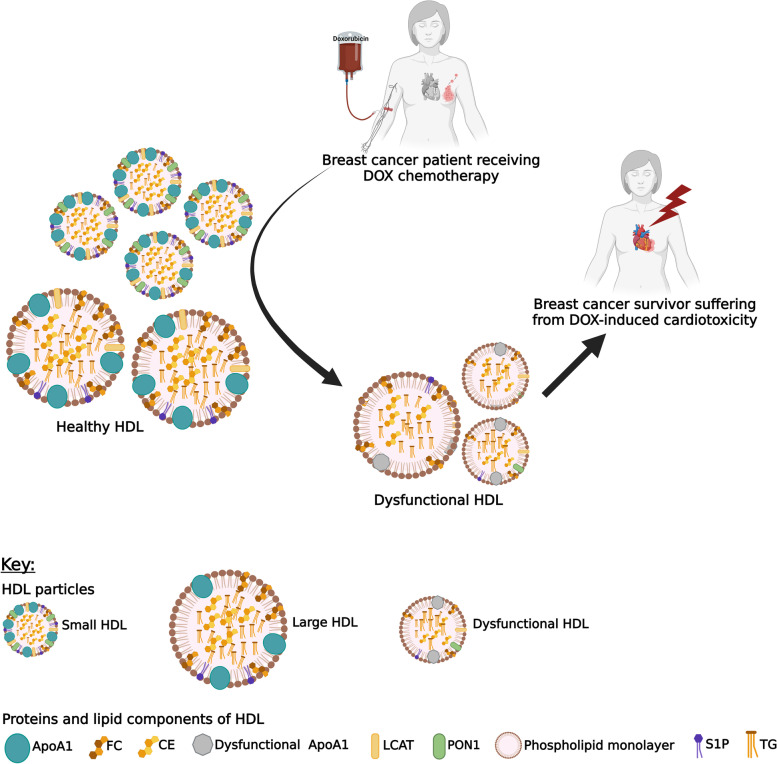
Doxorubicin (DOX) is an anthracycline antibiotic frequently used against a wide range of cancers, including breast cancer. Although the drug is effective as a treatment against cancer, many patients develop heart failure (HF) months to years following their last treatment with DOX. The challenge in preventing DOX-induced cardiotoxicity is that symptoms present after damage has already occurred in the myocardium. Therefore, early biomarkers to assess DOX-induced cardiotoxicity are urgently needed. A better understanding of the mechanisms involved in the toxicity is important as this may facilitate the development of novel early biomarkers or therapeutic approaches. In this review, we discuss the role of high-density lipoprotein (HDL) particles and its components as possible key players in the early development of DOX-induced cardiotoxicity. HDL particles exist in different subclasses which vary in composition and biological functionality. Multiple cardiovascular risk factors are associated with a change in HDL subclasses, resulting in modifications of their composition and physiological functions. There is growing evidence in the literature suggesting that cancer affects HDL subclasses and that healthy HDL particles enriched with sphingosine-1-phosphate (S1P) and apolipoprotein A1 (ApoA1) protect against DOX-induced cardiotoxicity. Here, we therefore discuss associations and relationships between HDL, DOX and cancer and discuss whether assessing HDL subclass/composition/function may be considered as a possible early biomarker to detect DOX-induced cardiotoxicity.
Keywords: Anthracycline; Cardiac toxicity; Cardio-oncology; High-density lipoproteins.
© 2022. The Author(s).
Conflict of interest statement
The authors declare that they have no competing interests.
Figures
References
-
- Bray F, Ferlay J, Soerjomataram I, Siegel RL, Torre LA, Jemal A. Global cancer statistics 2018: GLOBOCAN estimates of incidence and mortality worldwide for 36 cancers in 185 countries. CA Cancer J Clin. 2018;68:394–424. - PubMed
-
- Global Cancer Observatory: Cancer Today. International Agency for Research on Cancer. Lyon, France. 2020. https://gco.iarc.fr/today. Accessed 27 Jul 2021.
Publication types
MeSH terms
Substances
LinkOut - more resources
Full Text Sources
Medical
Research Materials
Miscellaneous
