. 2022 Aug;9(Suppl 2):S24001.
doi: 10.1117/1.NPh.9.S2.S24001. Epub 2022 Aug 30.

Optical imaging and spectroscopy for the study of the human brain: status report

Hasan Ayaz  1   2 Wesley B Baker  3   4 Giles Blaney  5 David A Boas  6   7 Heather Bortfeld  8 Kenneth Brady  9 Joshua Brake  10 Sabrina Brigadoi  11 Erin M Buckley  12   13 Stefan A Carp  14 Robert J Cooper  15 Kyle R Cowdrick  12 Joseph P Culver  16 Ippeita Dan  17 Hamid Dehghani  18 Anna Devor  7 Turgut Durduran  19   20 Adam T Eggebrecht  21 Lauren L Emberson  22 Qianqian Fang  23 Sergio Fantini  5 Maria Angela Franceschini  14 Jonas B Fischer  19 Judit Gervain  11   24 Joy Hirsch  25   26 Keum-Shik Hong  27   28 Roarke Horstmeyer  29   30   31 Jana M Kainerstorfer  32   33 Tiffany S Ko  34 Daniel J Licht  3 Adam Liebert  35 Robert Luke  36   37 Jennifer M Lynch  34 Jaume Mesquida  38 Rickson C Mesquita  39   40 Noman Naseer  41 Sergio L Novi  39   42 Felipe Orihuela-Espina  18 Thomas D O'Sullivan  43 Darcy S Peterka  44 Antonio Pifferi  45 Luca Pollonini  46 Angelo Sassaroli  5 João Ricardo Sato  47 Felix Scholkmann  48   49 Lorenzo Spinelli  50 Vivek J Srinivasan  51   52   53 Keith St Lawrence  54   55 Ilias Tachtsidis  26 Yunjie Tong  56 Alessandro Torricelli  45   50 Tara Urner  12 Heidrun Wabnitz  57 Martin Wolf  49 Ursula Wolf  48 Shiqi Xu  29 Changhuei Yang  58 Arjun G Yodh  59 Meryem A Yücel  6   7 Wenjun Zhou  51   60
Affiliations

Optical imaging and spectroscopy for the study of the human brain: status report

Hasan Ayaz et al. Neurophotonics. 2022 Aug.

Abstract

This report is the second part of a comprehensive two-part series aimed at reviewing an extensive and diverse toolkit of novel methods to explore brain health and function. While the first report focused on neurophotonic tools mostly applicable to animal studies, here, we highlight optical spectroscopy and imaging methods relevant to noninvasive human brain studies. We outline current state-of-the-art technologies and software advances, explore the most recent impact of these technologies on neuroscience and clinical applications, identify the areas where innovation is needed, and provide an outlook for the future directions.

Keywords: DCS; NIRS; diffuse optics; functional neuroscience; optical imaging; optical spectroscopy.


Figures

Fig. 1
Fig. 1
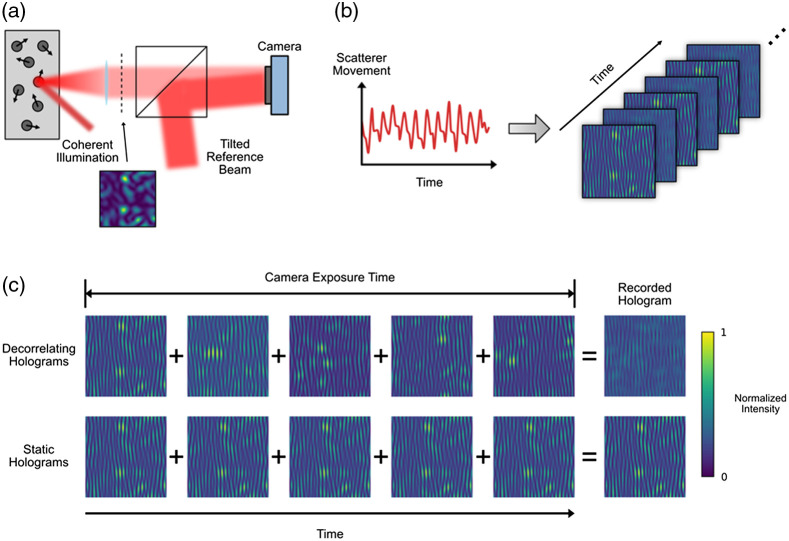
Measurement of scattering dynamics with interferometric speckle visibility spectroscopy (iSVS). (a) Coherent light illuminates a dynamic scattering media, generating a time-varying speckle field. The speckle field is combined with a tilted reference beam to form a hologram on the sensor. (b) The movement of scatterers (e.g., red blood cells) within the sample create captured holograms with normalized intensities proportional to the speed of the scatterer movement. (c) A depiction of how the recorded holograms are formed. If the medium is dynamic, the speckle pattern changes during the camera exposure time, leading to a reduced overall speckle contrast and maximum intensity in the recorded hologram. In contrast, if the scattering medium is static, the captured speckle pattern integrated over the exposure time is static, leading to a higher contrast captured hologram. (Figure modified from Xu et al.90)
Fig. 2
Fig. 2
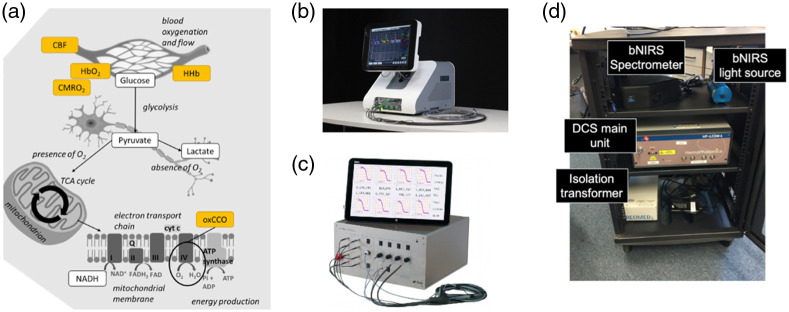
The power of combining diffuse optical techniques techniques (a) Yellow boxes indicate the physiological measurements that can be achieved non-invasively with diffuse optical techniques, demonstrating the capacity to interrogate from the vascular system down to the mitochondrial and the tricarboxylic acid (TCA) cycle, also called Krebs cycle, for adenosine triphosphate (ATP) energy production (CBF: cerebral blood flow; HbO2: oxygenated hemoglobin; HHb deoxygenated hemoglobin; CMRO2: cerebral metabolic rate of oxygen; oxCCO: oxidized cytochrome-c-oxidase). Figure modified from Bale et al. (b) The BabyLux system combines a two-wavelength time domain near-infrared spectroscopy (TD-NIRS) module with a dual-channel DCS module. It includes highly customizable software suitable for medical personnel with a self-guided software/hardware procedure. It has been developed within a European project funded by the European Commission (No. 620996) and is available as a custom system through HemoPhotonics S.L. (Spain). (c) The MetaOx system combines an eight wavelength, four-channel frequency domain NIRS (FD-NIRS) module with an eight-channel DCS module. It has been developed in collaboration with ISS, Inc. (Champaign, Illinois, USA) and the Massachusetts General Hospital (Boston, Massachusetts, USA) and is available as a research system through ISS, Inc. (d) The hybrid system comprising both broadband NIRS (bNIRS) and DCS recently developed at the University College London (London, UK).
Fig. 3
Fig. 3
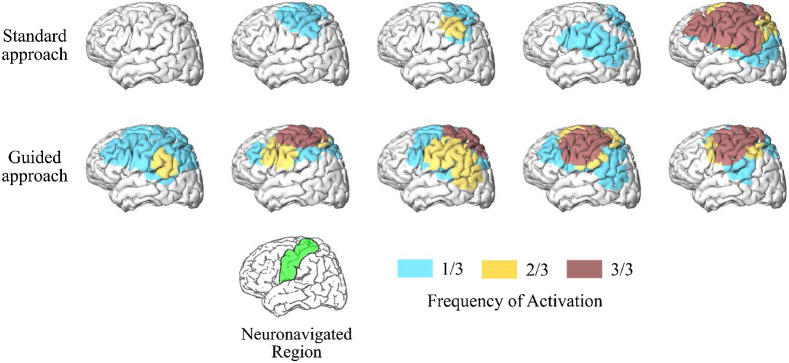
fNIRS reproducibility with a neuronavigation system. Frequency of activated brain regions during a motor task for the standard and guided approaches for probe positioning across five participants. The standard procedure used a tape to record head-size and find the optode location relative to the 10-20 system, while the guided approach used real-time neuronavigation software to place the optodes on the target region of interest (motor cortex, shown in green in the reference brain located at the bottom of the figure). Data were collected at three sessions on three different days for every subject. The frequency of activation represents reproducibility.
Fig. 4
Fig. 4
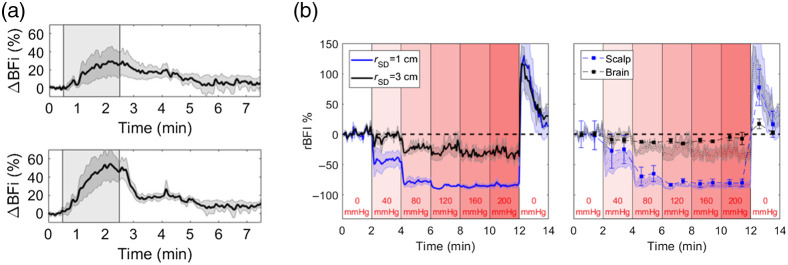
(a) Average increase in the blood flow index (ΔBFi) during a 2-min period of hypercapnia as indicated by the shaded region (N = 9). Time courses are presented for source-detector separations of 1 (top) and 2.7 cm (bottom). Shading surrounding each line represented the standard error of the mean. (b) Left: relative changes in BFI (rBFI) in response to increases in tourniquet pressure recorded at source-detector separations (rSD) of 1 and 3 cm. Shading around each line represents the standard error (N = 5). Right: rBFI for brain and scalp derived from the three-layer model. Error bars represent the standard error of the mean. For reference, the shading represents the individual time courses recorded at rSD=1 and 3 cm.
Fig. 5
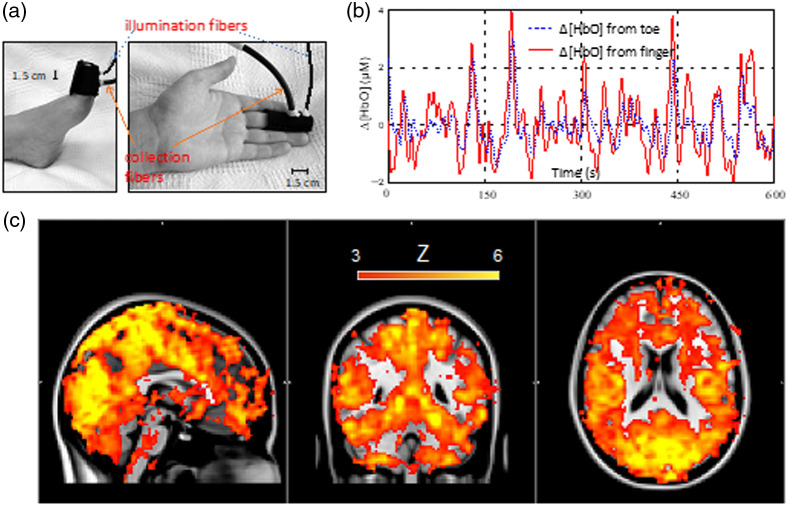
Fig. 5
Concurrent peripheral NIRS measurements and resting-state fMRI. (a) NIRS sensors on the finger and toes. (b) sLFOs of changes in oxyhemoglobin concentration (Δ[HbO]) measured from the toe (blue) and finger (red). These sLFOs are highly correlated with a delay about 3 s. c) Map of voxels wherein the BOLD fMRI signal was highly correlated with sLFOs of Δ[HbO] measured in the finger at any time lag. Figure modified from Tong et al.

References

    1. Jöbsis F. F., “Noninvasive, infrared monitoring of cerebral and myocardial oxygen sufficiency and circulatory parameters,” Science 198, 1264–1267 (1977). 10.1126/science.929199 - DOI - PubMed
    1. Zeff B. W., et al. , “Retinotopic mapping of adult human visual cortex with high-density diffuse optical tomography,” Proc. Natl. Acad. Sci. U.S.A. 104, 12169–12174 (2007). 10.1073/pnas.0611266104 - DOI - PMC - PubMed
    1. Ferradal S. L., et al. , “Atlas-based head modeling and spatial normalization for high-density diffuse optical tomography: in vivo validation against fMRI,” NeuroImage 85, 117–126 (2014). 10.1016/j.neuroimage.2013.03.069 - DOI - PMC - PubMed
    1. Eggebrecht A. T., et al. , “Mapping distributed brain function and networks with diffuse optical tomography,” Nat. Photonics 8, 448–454 (2014). 10.1038/nphoton.2014.107 - DOI - PMC - PubMed
    1. Eggebrecht A. T., et al. , “A quantitative spatial comparison of high-density diffuse optical tomography and fMRI cortical mapping,” NeuroImage 61, 1120–1128 (2012). 10.1016/j.neuroimage.2012.01.124 - DOI - PMC - PubMed