


Device-based remote monitoring strategies for congestion-guided management of patients with heart failure: a systematic review and meta-analysis
- PMID: 36054801
- PMCID: PMC10086988
- DOI: 10.1002/ejhf.2655
Device-based remote monitoring strategies for congestion-guided management of patients with heart failure: a systematic review and meta-analysis
Abstract
Aims: Pre-clinical congestion markers of worsening heart failure (HF) can be monitored by devices and may support the management of patients with HF. We aimed to assess whether congestion-guided HF management according to device-based remote monitoring strategies is more effective than standard therapy.
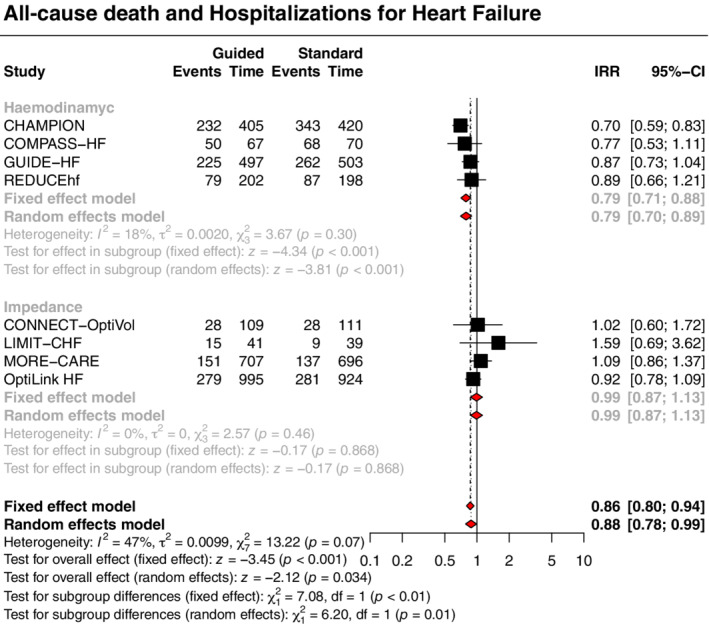
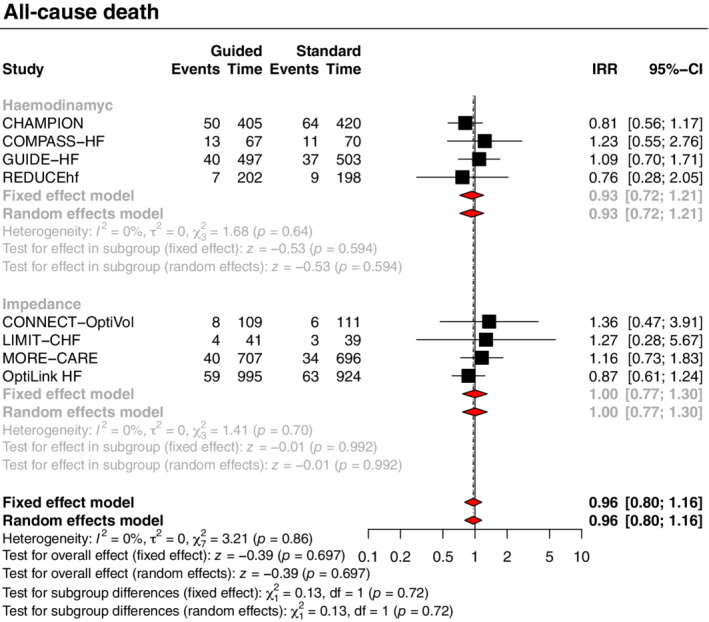
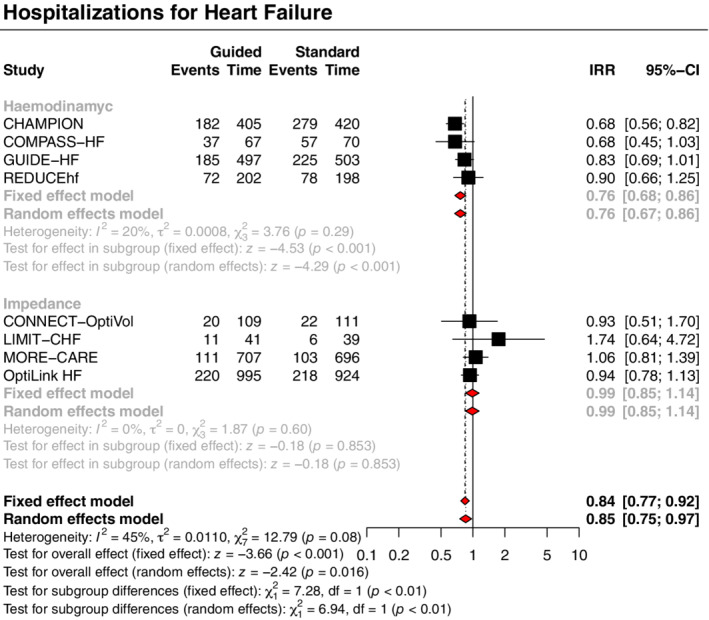
Methods and results: A comprehensive literature research for randomized controlled trials (RCTs) comparing device-based remote monitoring strategies for congestion-guided HF management versus standard therapy was performed on PubMed, Embase, and CENTRAL databases. Incidence rate ratios (IRRs) and associated 95% confidence intervals (CIs) were calculated using the Poisson regression model with random study effects. The primary outcome was a composite of all-cause death and HF hospitalizations. Secondary endpoints included the individual components of the primary outcome. A total of 4347 patients from eight RCTs were included. Findings varied according to the type of parameters monitored. Compared with standard therapy, haemodynamic-guided strategy (4 trials, 2224 patients, 12-month follow-up) reduced the risk of the primary composite outcome (IRR 0.79, 95% CI 0.70-0.89) and HF hospitalizations (IRR 0.76, 95% CI 0.67-0.86), without a significant impact on all-cause death (IRR 0.93, 95% CI 0.72-1.21). In contrast, impedance-guided strategy (4 trials, 2123 patients, 19-month follow-up) did not provide significant benefits.
Conclusion: Haemodynamic-guided HF management is associated with better clinical outcomes as compared to standard clinical care.
Keywords: Death; Guided management; Heart failure; Hospitalization; Remote monitoring; Telemonitoring.
© 2022 The Authors. European Journal of Heart Failure published by John Wiley & Sons Ltd on behalf of European Society of Cardiology.
Figures
References
-
- GBD 2017 Disease and Injury Incidence and Prevalence Collaborators . Global, regional, and national incidence, prevalence, and years lived with disability for 354 diseases and injuries for 195 countries and territories, 1990‐2017: a systematic analysis for the Global Burden of Disease Study 2017. Lancet. 2018;392:1789–858. - PMC - PubMed
-
- McDonagh TA, Metra M, Adamo M, Gardner RS, Baumbach A, Böhm M, et al. 2021 ESC Guidelines for the diagnosis and treatment of acute and chronic heart failure: developed by the Task Force for the diagnosis and treatment of acute and chronic heart failure of the European Society of Cardiology (ESC). With the special contribution of the Heart Failure Association (HFA) of the ESC. Eur J Heart Fail. 2022;24:4–131. - PubMed
-
- Vaduganathan M, Claggett BL, Jhund PS, Cunningham JW, Pedro Ferreira J, Zannad F, et al. Estimating lifetime benefits of comprehensive disease‐modifying pharmacological therapies in patients with heart failure with reduced ejection fraction: a comparative analysis of three randomised controlled trials. Lancet. 2020;396:121–8. - PubMed
-
- Gheorghiade M, Vaduganathan M, Fonarow GC, Bonow RO. Rehospitalization for heart failure: problems and perspectives. J Am Coll Cardiol. 2013;61:391–403. - PubMed
-
- Hasan A, Paul V. Telemonitoring in chronic heart failure. Eur Heart J. 2011;32:1457–64. - PubMed
Publication types
MeSH terms
Substances
LinkOut - more resources
Full Text Sources
Medical
Research Materials
Miscellaneous
