. 2022 Oct;49(5):363-370.
doi: 10.1053/j.seminoncol.2022.07.005. Epub 2022 Aug 5.

Influence of Cancer on COVID-19 Incidence, Outcomes, and Vaccine Effectiveness: A Prospective Cohort Study of U.S. Veterans

Affiliations

Influence of Cancer on COVID-19 Incidence, Outcomes, and Vaccine Effectiveness: A Prospective Cohort Study of U.S. Veterans

Harshraj Leuva et al. Semin Oncol. 2022 Oct.

Abstract

Purpose: Coronavirus disease 2019 (COVID-19) has been a constant health threat since its emergence. Amongst risk factors proposed, a diagnosis of cancer has been worrisome. We report the impact of cancer and other risk factors in US Veterans receiving care at Veterans Administration (VA) Hospitals, their adjusted odds ratio (aOR) for infection and death, and report on the impact of vaccines on the incidence and severity of COVID-19 infections in Veterans without/with cancer.

Methods: We conducted a cohort study of US Veterans without/with cancer by mining VA COVID-19 Shared Data Resource (CSDR) data using the VA Informatics and Computing Infrastructure (VINCI). Our observation period includes index dates from 14DEC2020 to 25JAN2022, encompassing both the delta and omicron waves in the US.

Results: We identified 915,928 Veterans, 24% of whom were African Americans who had undergone COVID testing-688,541 were and 227,387 were not vaccinated. 157,072 had a cancer diagnosis in the preceding two years. Age emerged as the major risk factor, with gender, BMI, and (Elixhauser) comorbidity contributing less. Among veterans with solid tumors other than lung cancer, risks of infection and death within 60 days were comparable to Veterans without cancer. However, those with hematologic malignancies fared worse. Vaccination was highly effective across all cancer cohorts; the respective rates of infection and death after infection were 8% and 5% among the vaccinated compared to 47% and 10% in the unvaccinated. Amongst vaccinated, increased risk of infection was noted in both, Veterans with hematologic malignancy treated with chemotherapy (HR, 2.993, P < 0.0001) or targeted therapies (HR, 1.781, P < 0.0001), and in solid tumors treated with either chemotherapy (HR 2.328, 95%CI 2.075-2.611, P < 0.0001) or targeted therapies (HR 1.328, P < 0.0001) when compared to those not on treatment.

Conclusions: Risk for COVID-19 infection and death from infection vary based on cancer type and therapies administered. Importantly and encouragingly, the duration of protection from infection following vaccination in Veterans with a diagnosis of cancer was remarkably like those without a cancer diagnosis. Veterans with hematologic malignancies are especially vulnerable, with lower vaccine effectiveness (VE).

Keywords: Cancer; Chemotherapy; Covid-19 vaccine effectiveness; Hematologic malignancies; Immunotherapy; Solid tumors.


Conflict of interest statement

Conflicts of Interest None

Figures
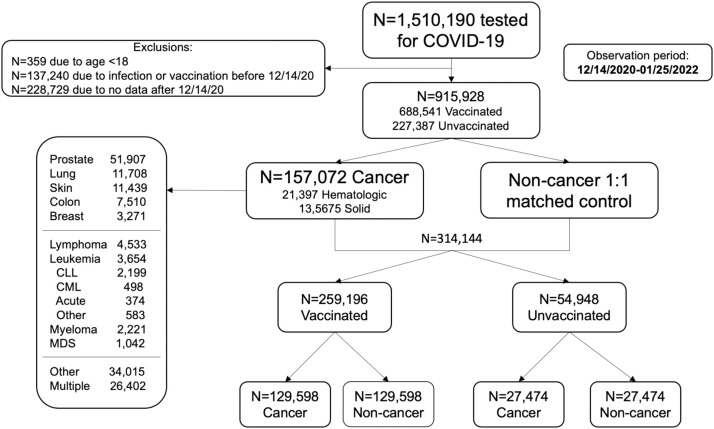
Fig 1
Fig. 1
Flow diagram.
Fig 2
Fig. 2
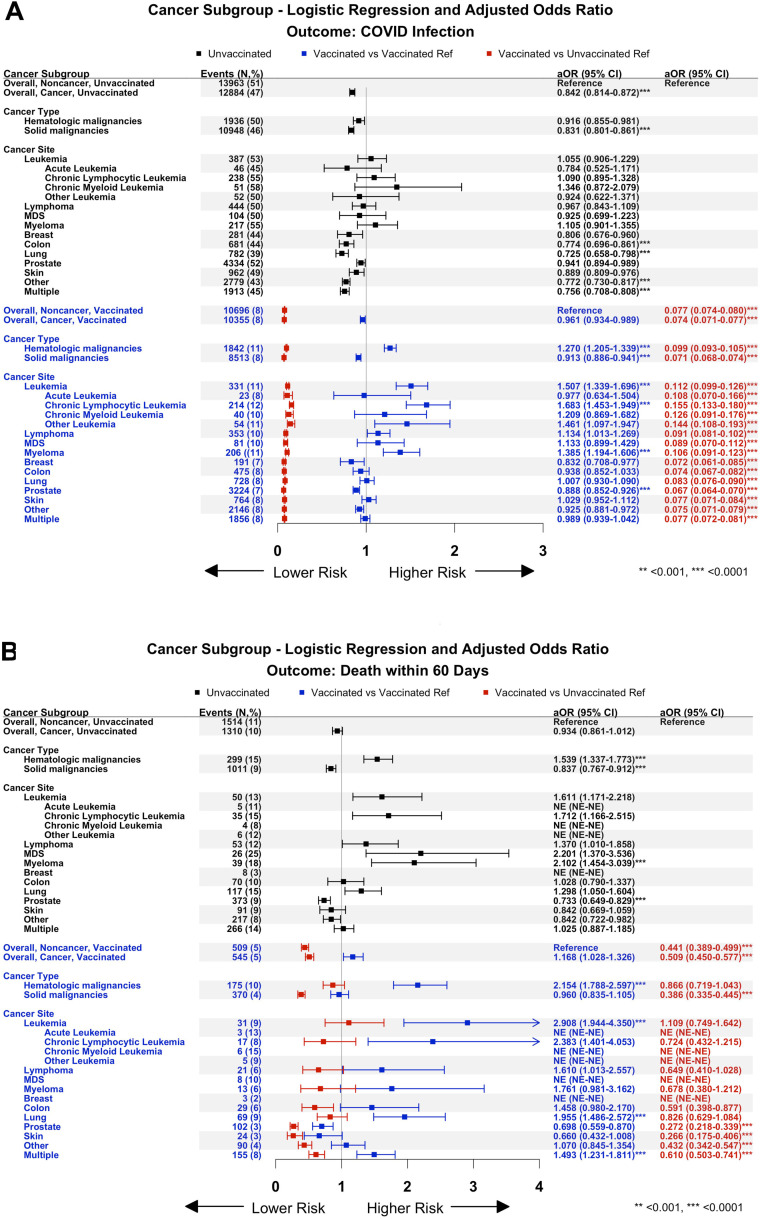
Adjusted odds ratios for infection (2A) and death within 60 days of infection (2B) presented as forest plots. The vertical line at 1 represents the risk of infection or death within 60 days of infection for the respective reference cohort. The data is shown as the means with their respective confidence intervals. Movement to the right occurs when the risk is increased, while movement to the left represents a reduction in the risk. See text for a description of the black, blue, and red symbols. Both unvaccinated and vaccinated Veterans with hematologic malignancies are seen to be at greater risk than those with solid tumors for COVID-19 infection (2A) and except for lung cancer and “multiple” cancers, at more risk for death within 60 days (2B). As regards solid tumors, multiple refers to Veterans with more than one cancer diagnosis with prostate and lung cancer often one of those.
Fig 3
Fig. 3
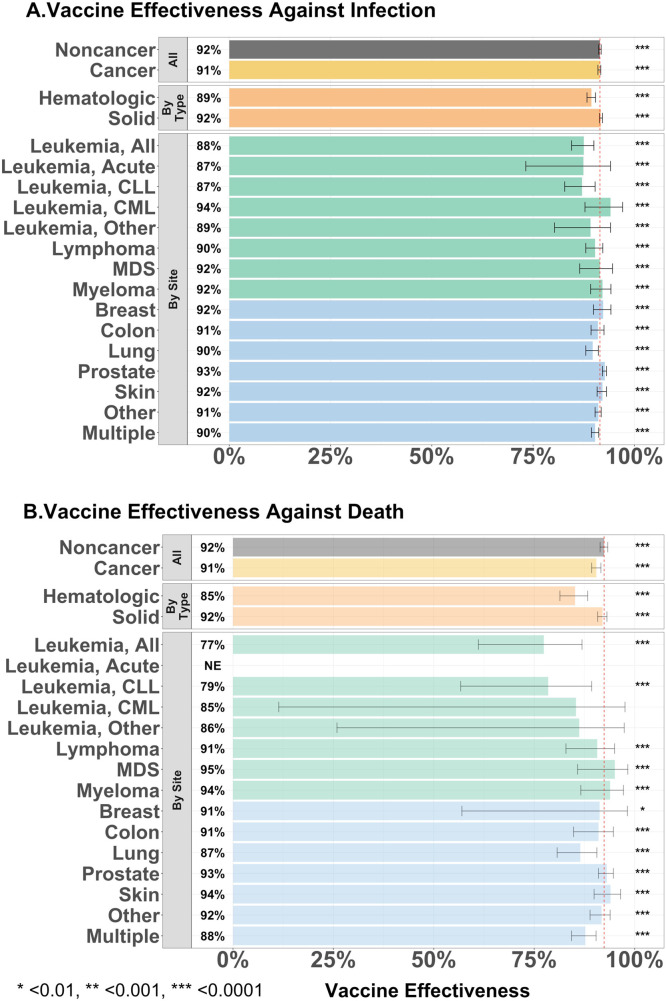
Estimates of vaccine efficacy in Veterans without/with a diagnosis of cancer as regards infection (3A) and death within 60 days of infection (3B). The data is plotted for all Veterans without/with a cancer diagnosis and with a cancer diagnosis by hematologic or solid tumor malignancy and across individual malignancies. Compared to Veterans without a diagnosis of cancer, vaccine efficacy amongst Veterans with a diagnosis of cancer is comparable in preventing infection and death within 60 days of infection, except for preventing death in Veterans with diagnoses of leukemia. Asterisks coincide with P-value of difference between the cohort of vaccinated compared the corresponding unvaccinated in each group.
Fig 4
Fig. 4
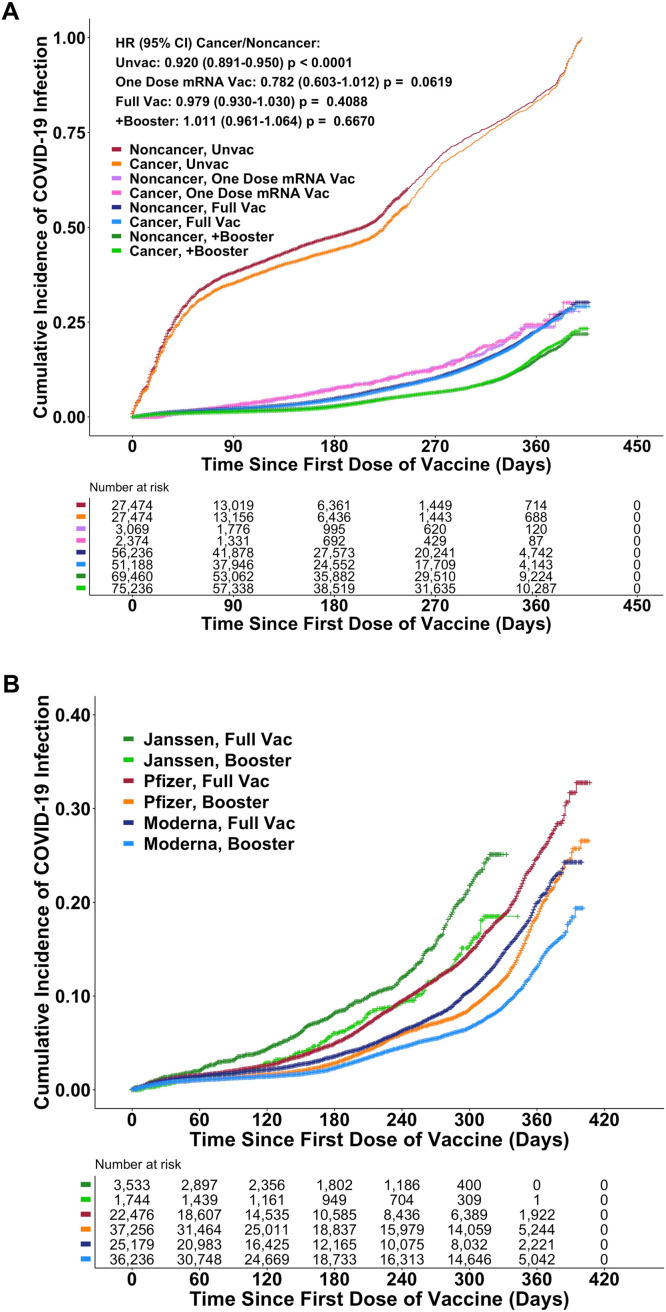
Kaplan-Meier plots of cumulative COVID-19 infection over time. Fig. 4A demonstrates comparable impact of vaccination and of boosting in Veterans without/with a diagnosis of cancer. Comparable results with a single dose of the mRNA vaccines are observed in the group of Veterans who received only one dose of either mRNA vaccine [Full dose v One dose: HR, 0.827, 95%CI, 0.728–0.939, P = 0.0033]. Hazard ratios for combined Noncancer + Cancer (95%CI): One dose vs. Unvaccinated: 0.260 (0.229–0.295). Full dose vs. Unvaccinated: 0.220 (0.213–0.228). Full dose + booster v Unvaccinated: 0.141 (0.141–0.150). The analysis excludes 733 Veterans who died and 262 who were infected before the 2nd dose could be administered. See Supplementary Fig. 2 for discussion and alternate plots. Fig. 4B documents an increasing rate of infection that begins sooner with the Janssen vaccine and at 6–8 months after completing both vaccinations with the Pfizer-BioNTech and Moderna mRNA products. For the 3 vaccinations, the administration of a booster delays the rise of the infections but does not meaningfully change the qualitative shape of the rising curve consistent with transient increases in the level of immunity but not a change in immune competence and its durability.
Fig 5
Fig. 5
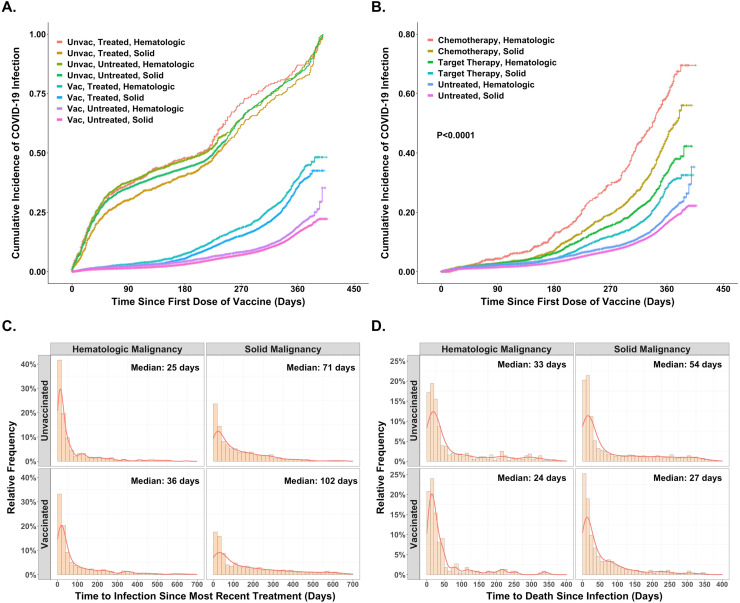
A and B compares the (cumulative) probability of infection in those who did or did not receive chemotherapy and/or targeted therapy for their cancer during the period of observation. Fig. 5A looks at the impact of vaccination status on the probability of infection presented according to a diagnosis of either a hematologic malignancy or a solid tumor. Fig. 5B compares the results in those treated with either chemotherapy or targeted therapies to those not treated according to their diagnosis of either a hematologic malignancy or a solid tumor. In both figures the order of the legend tracks with the curves from top to bottom. A total of 157,072 Veterans with a diagnosis of cancer were evaluated, with 19,307 having received one of the 82 therapies identified in Supplementary Table 1. Figs. 5C and D present distribution plots looking at the occurrence of infection or death following infection. The data are shown for those who had not been vaccinated separately from those who were vaccinated and presented separately for those with a diagnosis of either a hematologic malignancy or a solid tumor. The X-axis is time after the receipt of therapy and the Y-axis the percent of all those treated in whom infection or death was recorded in successive 20-day time intervals–each bar comprises 20 days. Fig. 5C shows the fraction of infections occurring closer in time to and more likely impacted by treatment was higher in the unvaccinated and those with hematologic malignancies. Fig. 5D peaks of death 4 weeks following infection consistent with most deaths more likely caused by the infection than as a result of the underlying disease.

References

    1. WHO. Weekly epidemiological update on COVID-19 - 27 April 2022. Available from: https://www.who.int/publications/m/item/weekly-epidemiological-update-on...—27-april-2022.
    1. Gao YD, Ding M, Dong X, et al. Risk factors for severe and critically ill COVID-19 patients: a review. Allergy. 2021;76(2):428–455. - PubMed
    1. Lowe KE, Zein J, Hatipoglu U, Attaway A. Association of smoking and cumulative pack-year exposure with COVID-19 outcomes in the Cleveland Clinic COVID-19 Registry. JAMA Intern Med. 2021;181(5):709–711. - PMC - PubMed
    1. Thomas SJ, Moreira ED, Jr., Absalon J, et al. Safety and efficacy of the BNT162b2 mRNA Covid-19 vaccine through 6 months. N Engl J Med. 2021;385(19):1761–1773. - PMC - PubMed
    1. El Sahly HM, Baden LR, Essink B, et al. Efficacy of the mRNA-1273 SARS-CoV-2 vaccine at completion of blinded phase. N Engl J Med. 2021;385(19):1774–1785. - PMC - PubMed

Publication types