Review
. 2022 Sep 6;11(17):e026528.
doi: 10.1161/JAHA.122.026528. Epub 2022 Sep 3.

Stroke-Heart Syndrome: Recent Advances and Challenges

Affiliations
Review

Stroke-Heart Syndrome: Recent Advances and Challenges

Jan F Scheitz et al. J Am Heart Assoc. .

Abstract

After ischemic stroke, there is a significant burden of cardiovascular complications, both in the acute and chronic phase. Severe adverse cardiac events occur in 10% to 20% of patients within the first few days after stroke and comprise a continuum of cardiac changes ranging from acute myocardial injury and coronary syndromes to heart failure or arrhythmia. Recently, the term stroke-heart syndrome was introduced to provide an integrated conceptual framework that summarizes neurocardiogenic mechanisms that lead to these cardiac events after stroke. New findings from experimental and clinical studies have further refined our understanding of the clinical manifestations, pathophysiology, and potential long-term consequences of the stroke-heart syndrome. Local cerebral and systemic mediators, which mainly involve autonomic dysfunction and increased inflammation, may lead to altered cardiomyocyte metabolism, dysregulation of (tissue-resident) leukocyte populations, and (micro-) vascular changes. However, at the individual patient level, it remains challenging to differentiate between comorbid cardiovascular conditions and stroke-induced heart injury. Therefore, further research activities led by joint teams of basic and clinical researchers with backgrounds in both cardiology and neurology are needed to identify the most relevant therapeutic targets that can be tested in clinical trials.

Keywords: brain–heart axis; heart; inflammation; outcomes; stroke.


Figures
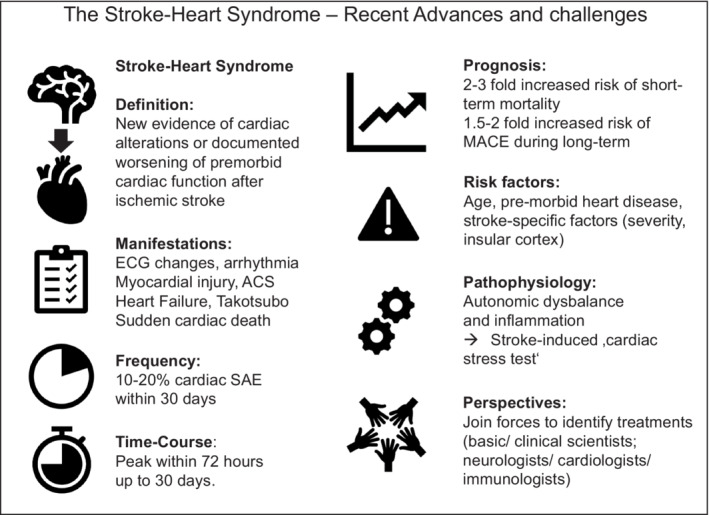
Figure 1
Figure 1. Summary of key criteria and of the stroke–heart syndrome.
ACS indicates acute coronary syndrome; MACE, major adverse cardiovascular events; and SAE, severe adverse events.
Figure 2
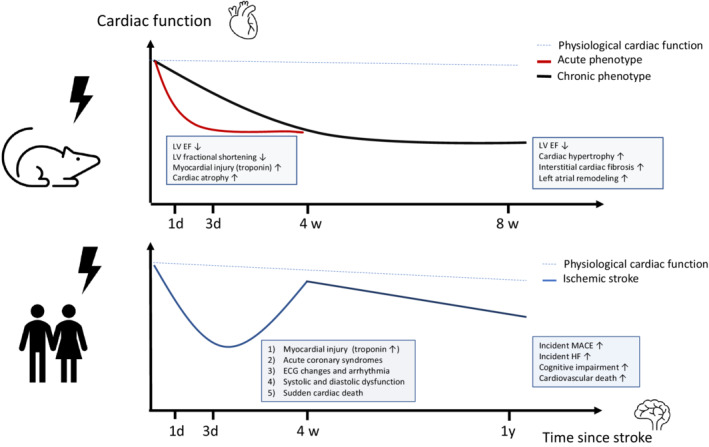
Figure 2. Phenotypes and time course of the stroke–heart syndrome in rodent models and clinical practice.
(Top) Phenotype observed in rodent ischemic stroke models. The dashed blue line indicates physiological cardiac function. The red line indicates the severity of acute cardiac dysfunction that peaks within 24 to 72 hours and persists up to 14 days after experimental stroke. Note that this phenotype was most consistently inducible by severe brain ischemia. The black line indicates a phenotype of chronic cardiac dysfunction starting 4 to 8 weeks after experimental brain ischemia. Note that this phenotype was most consistently inducible by mild, right‐sided brain ischemia. (Bottom) Spectrum and time‐course of stroke–heart syndrome observed in human clinical studies. The dashed blue line indicates physiological trajectory of cardiac function during aging. The blue line indicates the trajectory of cardiac alterations after stroke observed in observational clinical studies. Note that there is large individual variability, and that further studies are needed to predict the incidence of long‐term cardiovascular outcomes and heart failure. EF indicates ejection fraction; HF, heart failure; LV, left ventricular; and MACE, major adverse cardiovascular events.
Figure 3
Figure 3. Overview about stroke‐specific characteristics, mediators, downstream cardiac mechanisms, and outcomes of stroke–heart syndrome.
The 4 columns describe the most promising and well‐studied stroke characteristics, mediators, cardiac mechanisms, and short‐term and long‐term outcomes of stroke–heart syndrome.

References

    1. Scheitz JF, Nolte CH, Doehner W, Hachinski V, Endres M. Stroke‐heart syndrome: clinical presentation and underlying mechanisms. Lancet Neurol. 2018;17:1109–1120. doi: 10.1016/S1474-4422(18)30336-3 - DOI - PubMed
    1. Prosser J, MacGregor L, Lees KR, Diener HC, Hacke W, Davis S; Investigators V . Predictors of early cardiac morbidity and mortality after ischemic stroke. Stroke. 2007;38:2295–2302. doi: 10.1161/STROKEAHA.106.471813 - DOI - PubMed
    1. Sposato LA, Hilz MJ, Aspberg S, Murthy SB, Bahit MC, Hsieh CY, Sheppard MN, Scheitz JF. Post‐stroke cardiovascular complications and neurogenic cardiac injury: JACC state‐of‐the‐art review. J Am Coll Cardiol. 2020;76:2768–2785. doi: 10.1016/j.jacc.2020.10.009 - DOI - PubMed
    1. Kallmunzer B, Breuer L, Kahl N, Bobinger T, Raaz‐Schrauder D, Huttner HB, Schwab S, Kohrmann M. Serious cardiac arrhythmias after stroke: incidence, time course, and predictors—a systematic, prospective analysis. Stroke. 2012;43:2892–2897. doi: 10.1161/STROKEAHA.112.664318 - DOI - PubMed
    1. Lettow I, Jensen M, Schlemm E, Boutitie F, Quandt F, Cheng B, Ebinger M, Endres M, Fiebach JB, Thijs V, et al. Serious adverse events and their impact on functional outcome in acute ischemic stroke in the WAKE‐UP trial. Stroke. 2021;52:3768–3776. doi: 10.1161/STROKEAHA.120.033425 - DOI - PubMed

Publication types