


Comment
doi: 10.1016/j.tips.2022.08.005.
Epub 2022 Aug 31.
Structural snapshot of a β-arrestin-biased receptor
Affiliations
- PMID: 36057461
- PMCID: PMC7614537
- DOI: 10.1016/j.tips.2022.08.005
Item in Clipboard
Comment
Structural snapshot of a β-arrestin-biased receptor
Trends Pharmacol Sci.
2023 Jan.
Abstract
Atypical chemokine receptor subtype 3 (ACKR3), a chemokine receptor, couples selectively to β-arrestins (βarrs) but not to G proteins despite having seven transmembrane (7TM) helix architecture. Yen et al. present cryogenic-electron microscopy (cryo-EM) structures of agonist-bound ACKR3, elucidating a distinct chemokine-binding mechanism, and offering a structural template to probe the transducer-coupling bias at this receptor.
Keywords: ACKR3; ACRs; GPCRs; biased agonism; chemokines; intrinsic bias; β-arrestins.
Copyright © 2022 Elsevier Ltd. All rights reserved.
Conflict of interest statement
Declaration of interests The authors declare no conflicts of interest.
Figures
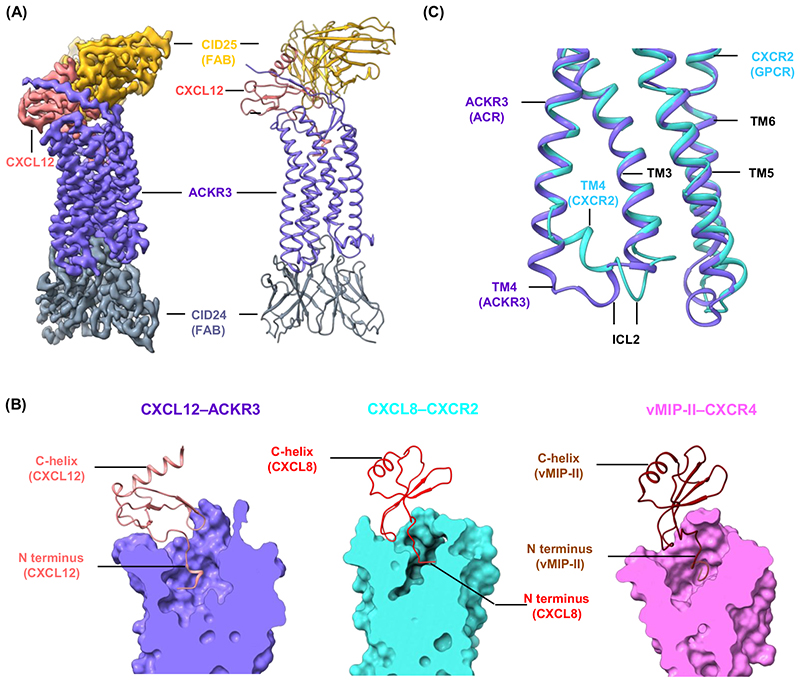
(A) Overall structural snapshot of CXCL12–ACKR3 in the presence of two stabilizing antigen-binding fragments of antibodies (FABs) (CID25 and CID24). (B) Distinct binding pose of CXCL12 to ACKR3 compared with CXCL8 and viral macrophage inflammatory protein II (vMIP-II) on CXCR2 and CXCR4, respectively. (C) Transmembrane helix 4 (TM4) in ACKR3 is an extended conformation at the cytoplasmic end while it exhibits a kink in the CXCL8-bound CXCR2 structure. These structural snapshots are designed based on PDB ID 7SK3, 6LFO, and 4RWS for ACKR3, CXCR2, and CXCR4, respectively. Abbreviations: ACR, arrestin-coupled receptor; GPCR, G protein-coupled receptor.
Comment on
-
Structures of atypical chemokine receptor 3 reveal the basis for its promiscuity and signaling bias.Sci Adv. 2022 Jul 15;8(28):eabn8063. doi: 10.1126/sciadv.abn8063. Epub 2022 Jul 13. Sci Adv. 2022. PMID: 35857509 Free PMC article.
References
Publication types
MeSH terms
Substances
Grants and funding
LinkOut - more resources
Full Text Sources
