


Longitudinal change in ATN biomarkers in cognitively normal individuals
- PMID: 36057616
- PMCID: PMC9440493
- DOI: 10.1186/s13195-022-01069-6
Longitudinal change in ATN biomarkers in cognitively normal individuals
Abstract
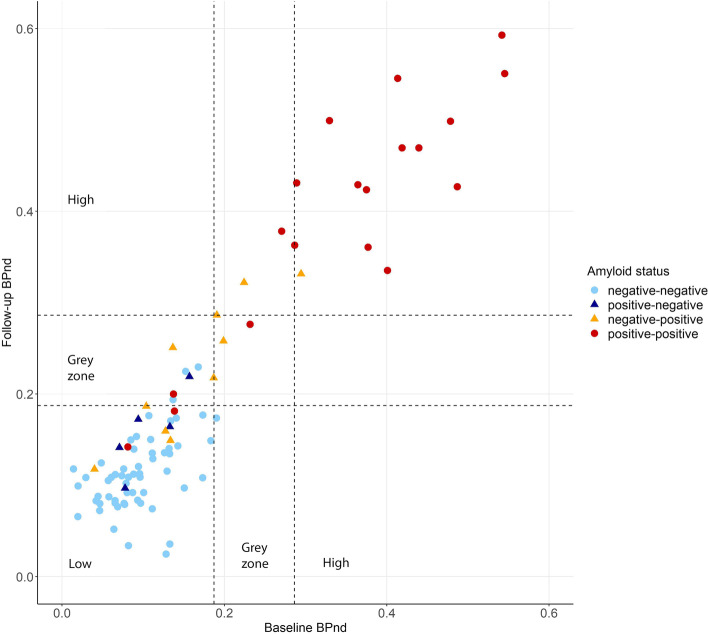
Background: Biomarkers for amyloid, tau, and neurodegeneration (ATN) have predictive value for clinical progression, but it is not clear how individuals move through these stages. We examined changes in ATN profiles over time, and investigated determinants of change in A status, in a sample of cognitively normal individuals presenting with subjective cognitive decline (SCD).
Methods: We included 92 individuals with SCD from the SCIENCe project with [18F]florbetapir PET (A) available at two time points (65 ± 8y, 42% female, MMSE 29 ± 1, follow-up 2.5 ± 0.7y). We additionally used [18F]flortaucipir PET for T and medial temporal atrophy score on MRI for N. Thirty-nine individuals had complete biomarker data at baseline and follow-up, enabling the construction of ATN profiles at two time points. All underwent extensive neuropsychological assessments (follow-up time 4.9 ± 2.8y, median number of visits n = 4). We investigated changes in biomarker status and ATN profiles over time. We assessed which factors predisposed for a change from A- to A+ using logistic regression. We additionally used linear mixed models to assess change from A- to A+, compared to the group that remained A- at follow-up, as predictor for cognitive decline.
Results: At baseline, 62% had normal AD biomarkers (A-T-N- n = 24), 5% had non-AD pathologic change (A-T-N+ n = 2,) and 33% fell within the Alzheimer's continuum (A+T-N- n = 9, A+T+N- n = 3, A+T+N+ n = 1). Seventeen subjects (44%) changed to another ATN profile over time. Only 6/17 followed the Alzheimer's disease sequence of A → T → N, while 11/17 followed a different order (e.g., reverted back to negative biomarker status). APOE ε4 carriership inferred an increased risk of changing from A- to A+ (OR 5.2 (95% CI 1.2-22.8)). Individuals who changed from A- to A+, showed subtly steeper decline on Stroop I (β - 0.03 (SE 0.01)) and Stroop III (- 0.03 (0.01)), compared to individuals who remained A-.
Conclusion: We observed considerable variability in the order of ATN biomarkers becoming abnormal. Individuals who became A+ at follow-up showed subtle decline on tests for attention and executive functioning, confirming clinical relevance of amyloid positivity.
© 2022. The Author(s).
Conflict of interest statement
Jarith Ebenau reports no disclosures relevant to the manuscript.
Denise Visser reports no disclosures relevant to the manuscript.
Lior Kroeze reports no disclosures relevant to the manuscript.
Mardou van Leeuwenstijn reports no disclosures relevant to the manuscript.
Argonde van Harten reports no disclosures relevant to the manuscript.
Albert Windhorst reports no disclosures relevant to the manuscript.
Sandeep Golla reports no disclosures relevant to the manuscript.
Ronald Boellaard reports no disclosures relevant to the manuscript.
Philip Scheltens has acquired grant support (for the institution) from Biogen. In the past 2 years, he has received consultancy/speaker fees (paid to the institution) from Probiodrug Biogen, EIP Pharma, Merck AG.
Frederik Barkhof is a consultant for Biogen-Idec, Bayer-Schering, Merck-Serono, Roche, NovartisIXICO and Combinostics; has received sponsoring from European Commission-Horizon 2020, National Institute for Health Research-University College London Hospitals Biomedical Research Centre, TEVA, Novartis, and Biogen; and serves on the editorial boards of
Bart van Berckel has received research support from EU-FP7, CTMM, ZonMw, NWO, and Alzheimer Nederland. BvB has performed contract research for Rodin, IONIS, AVID, Eli Lilly, UCB, DIAN-TUI, and Janssen. BvB was a speaker at a symposium organized by Springer Healthcare. BvB has a consultancy agreement with IXICO for the reading of PET scans. BvB is a trainer for GE. BvB only receives financial compensation from Amsterdam UMC.
Wiesje van der Flier Research programs have been funded by ZonMW, NWO, EU-FP7, EU-JPND, Alzheimer Nederland, CardioVascular Onderzoek Nederland, Health~Holland, Topsector Life Sciences & Health, stichting Dioraphte, Gieskes-Strijbis fonds, stichting Equilibrio, Pasman stichting, Biogen MA Inc., Boehringer Ingelheim, Life-MI, AVID, Roche BV, Fujifilm, Combinostics. WF holds the Pasman chair. WF has performed contract research for Biogen MA Inc and Boehringer Ingelheim. WF has been an invited speaker at Boehringer Ingelheim, Biogen MA Inc., Danone, Eisai and WebMD Neurology (Medscape). WF is consultant to Oxford Health Policy Forum CIC, Roche, and Biogen MA Inc. WF was associate editor at
Figures



References
-
- McKhann GM, Knopman DS, Chertkow H, Hyman BT, Jack CR, Jr, Kawas CH, et al. The diagnosis of dementia due to Alzheimer’s disease: recommendations from the National Institute on Aging-Alzheimer’s association workgroups on diagnostic guidelines for Alzheimer’s disease. Alzheimer’s Dement. 2011;7(3):263–269. doi: 10.1016/j.jalz.2011.03.005. - DOI - PMC - PubMed
Publication types
MeSH terms
Substances
Grants and funding
LinkOut - more resources
Full Text Sources
Medical
Miscellaneous
