. 2022 Sep 3;6(1):41.
doi: 10.1038/s41538-022-00155-1.

Production of scaffold-free cell-based meat using cell sheet technology

Affiliations

Production of scaffold-free cell-based meat using cell sheet technology

Ryu-Ichiro Tanaka et al. NPJ Sci Food. .

Abstract

In the production of cell-based meat, it is desirable to reduce animal-derived materials as much as possible to meet the challenges of sustainability. Here, we demonstrate the "cell sheet-based meat": scaffold-free cell-based meat using cell sheet technology and characterize its texture and nutrients. Bovine myoblast cell sheets were prepared using temperature-responsive culture dishes (TRCDs) and 10 stacked cell sheets to fabricate three-dimensional tissue of 1.3-2.7 mm thickness. Hardness was increased by incubation on the TRCD and was further increased by boiling as is characteristic of natural meat. The wet weight percentage of total protein in the cell sheet was about half that of beef. In this method, large-sized items of cell sheet-based meat were also created by simply scaling up the TRCD. This method promises an environment-friendly food product.


Conflict of interest statement

R.T., K.S., A.Y., H.T., and Y.H. declare no Competing Financial or Non-Financial Interests. T.S. is a member of the scientific advisory board and a shareholder of CellSeed Inc. Tokyo Women’s Medical University received research funds from CellSeed Inc., Cell Sheet Tissue Engineering Regenerative Medicine Initiatives.

Figures
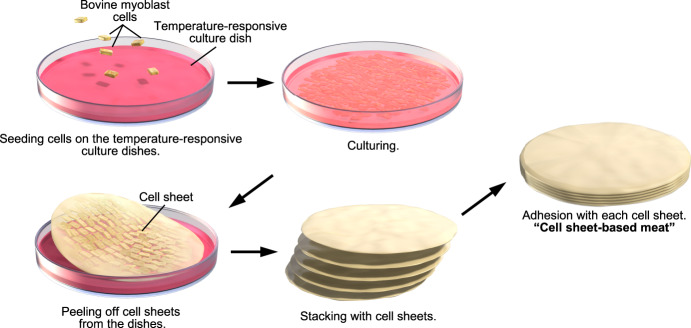
Fig. 1
Fig. 1
Production of cell sheet-based meat.
Fig. 2
Fig. 2. Dimensional and structural characteristics of the bovine myoblast cell sheets.
ac One and 10-layered-bovine myoblast cell sheets. a day 1 of culture. b day 3 of culture. c day 7 of culture. Scale bar: 1 cm. d Diameter and (e) thickness of the individual bovine myoblast cell sheets (n = 4). f Thickness and (g) volume of the 10-layered-bovine myoblast cell sheets (n = 4). h Representative immunofluorescent images of bovine myoblast cell cytoskeleton (Green: F-actin, blue: Hoechst). Left: day 1 of culture. Right: day 7 of culture. Scale bar: 50 μm. In (dg) the data points represent individual values and error bars represent SD. *P < 0.05, **P < 0.01 was considered significant in the analysis between groups using one-way ANOVA, with Tukey’s HSD.
Fig. 3
Fig. 3. Histological analysis of a bovine myoblast cell sheet.
a HE-stained sections of bovine myoblast cell sheets. b AZAN-stained sections of bovine myoblast cell sheets. c PAX7 and d, MYOD staining of the bovine myoblast cell sheets. Left: day 1 of culture, center: day 3 of culture, right: day 7 of culture. Scale bar: 1 cm.
Fig. 4
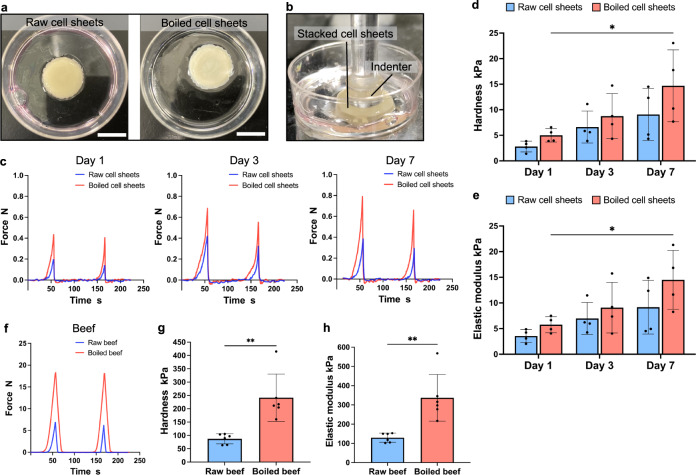
Fig. 4. TPA of the stacked cell sheets and beef.
a Left: raw cell sheet tissue. Right: boiled cell sheet tissue. Scale bar: 1 cm. b Image of the indenter pressing the stacked cell sheet. c TPA curves, (d) hardness, and (e) Elastic modulus of raw and boiled stacked cell sheets (n = 4). f TPA curves, (g) hardness, and (h) Elastic modulus of raw and boiled beef (n = 6). In (d, e), the error bars represent SD, and the data points represent individual values. *P < 0.05 was considered significant in the analysis between groups using two-way ANOVA, with Tukey’s HSD. In (g) and (h), the error bars represent SD, and the data points represent individual values. **P < 0.01 was considered significant in the analysis between paired t tests.
Fig. 5
Fig. 5. Nutritional analysis of cell sheets and beef.
a Water content of cell sheets and beef. b Total protein in wet weight. c Total protein in dry weight. d Carbohydrate in wet weight. e Carbohydrate in dry weight. f Unsaturated fatty acids in wet weight. g Unsaturated fatty acids in dry weight. In (bg), the data points represent individual values (Cell sheet: n = 3, Beef: n = 4), and the error bars represent SD. **P < 0.01, ***P = 0.0001, ****P < 0.0001 was considered significant in the analysis between groups using one-way ANOVA, with Tukey’s HSD.

References

    1. Cole MB, Augustin MA, Robertson MJ, Manners JM. The science of food security. npj Sci. Food. 2018;2:1–8. doi: 10.1038/s41538-018-0021-9. - DOI - PMC - PubMed
    1. FAO. World Livestock 2011—Livestock in Food Security (Food and Agriculture Organization of the United Nations—FAO, 2011).
    1. Gerber, P. J. et al. Tackling Climate Change through Livestock—A Global Assessment of Emissions and Mitigation Opportunities (Food and Agriculture Organization of the United Nations—FAO, 2013).
    1. Post MJ. Cultured meat from stem cells: challenges and prospects. Meat Sci. 2012;92:297–301. doi: 10.1016/j.meatsci.2012.04.008. - DOI - PubMed
    1. Post MJ, et al. Scientific, sustainability and regulatory challenges of cultured meat. Nat. Food. 2020;1:403–415. doi: 10.1038/s43016-020-0112-z. - DOI