Meta-Analysis
. 2022 Sep 3;13(1):5198.
doi: 10.1038/s41467-022-32896-8.

Identification of risk loci for primary aldosteronism in genome-wide association studies

Affiliations
Meta-Analysis

Identification of risk loci for primary aldosteronism in genome-wide association studies

Edith Le Floch et al. Nat Commun. .

Abstract

Primary aldosteronism affects up to 10% of hypertensive patients and is responsible for treatment resistance and increased cardiovascular risk. Here we perform a genome-wide association study in a discovery cohort of 562 cases and 950 controls and identify three main loci on chromosomes 1, 13 and X; associations on chromosome 1 and 13 are replicated in a second cohort and confirmed by a meta-analysis involving 1162 cases and 3296 controls. The association on chromosome 13 is specific to men and stronger in bilateral adrenal hyperplasia than aldosterone producing adenoma. Candidate genes located within the two loci, CASZ1 and RXFP2, are expressed in human and mouse adrenals in different cell clusters. Their overexpression in adrenocortical cells suppresses mineralocorticoid output under basal and stimulated conditions, without affecting cortisol biosynthesis. Our study identifies the first risk loci for primary aldosteronism and highlights new mechanisms for the development of aldosterone excess.


Conflict of interest statement

The authors declare no competing interests.

Figures
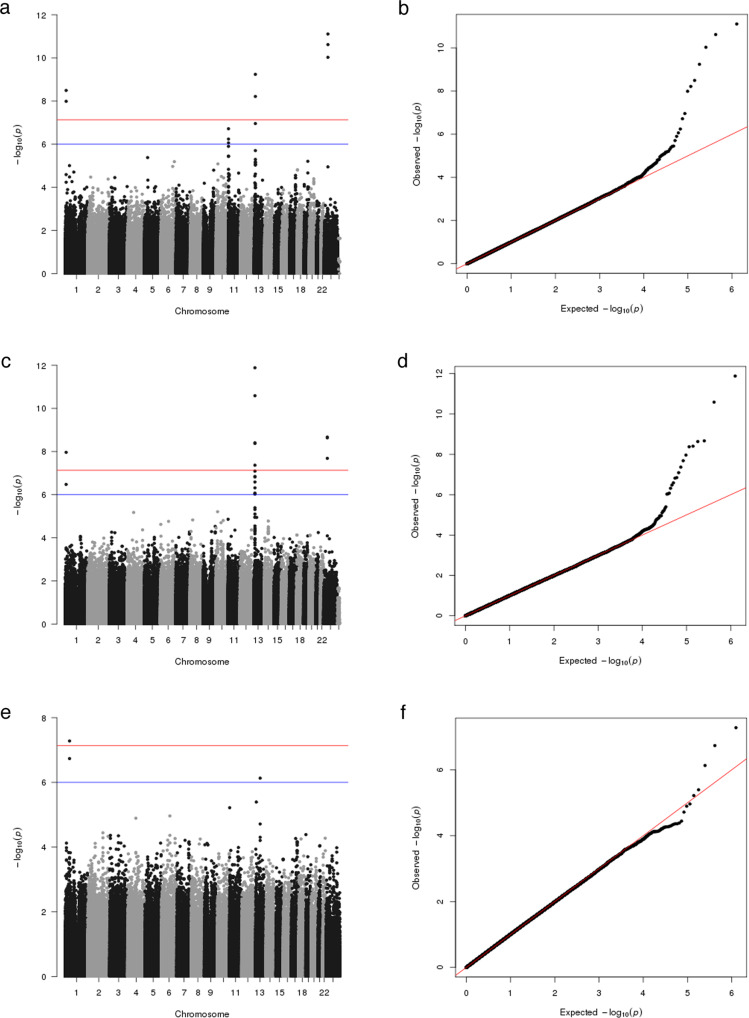
Fig. 1
Fig. 1. Results of the discovery-stage genome-wide association study.
Manhattan plots (a, c, e) and quantile-quantile (QQ) plots (b, d, f) showing results for the entire discovery cohort (a, b) and subanalyses for men (c, d) and women (e, f). For the entire discovery cohort, three loci with genome-wide significance (P < 7.36 × 10−8) on chromosome 1, 13, and X and a fourth locus on chromosome 11 with suggestive evidence (p value < 10−6) of association were identified (a). For men, the three loci on chromosome 1, 13, and X reached genome-wide significance (b). For women, a fifth locus on chromosome 1 around 48.52 Mb was identified at genome-wide significance and a sixth locus with suggestive evidence of association on chromosome 13 around 70.1 Mb (c).
Fig. 2
Fig. 2. Genomic context of the association signals observed in the GWAS in the discovery cohort.
The regional association plots were generated using LocusZoom on imputed data and display surrounding genes (genome build 37). The two different loci on chromosome 1 (a) and chromosome 13 (b) confirmed in the meta-analysis are represented; dot color indicates linkage disequilibrium of each variant with the highlighted lead variant in common between discovery and replication cohorts (purple diamond). c Genome browser view of public ATAC-seq and ChIP-seq signals produced by the ENCODE consortium from adrenal gland tissue on chromosome 8 (region 142,810,559–143,017,843, hg38 build), chromosome 1 (region 10,620,000–10,860,000) and chromosome 13 (region 31,100,000−32,000,000). Top tracks (in green) are ATAC-seq signals from four donors (two females and two males). The lower tracks are ChIP-seq results from three different donors (one female and two males). For each sex, we show tracks corresponding to three histone marks, known to be associated with regulatory elements: H3K4me3 (blue), H3K27ac (purple), and H3K4me1 (orange). The black horizontal bar delimitates the regions in linkage disequilibrium, found associated with PA. Vertical dashed lines indicate the position of SNPs identified in this study.
Fig. 3
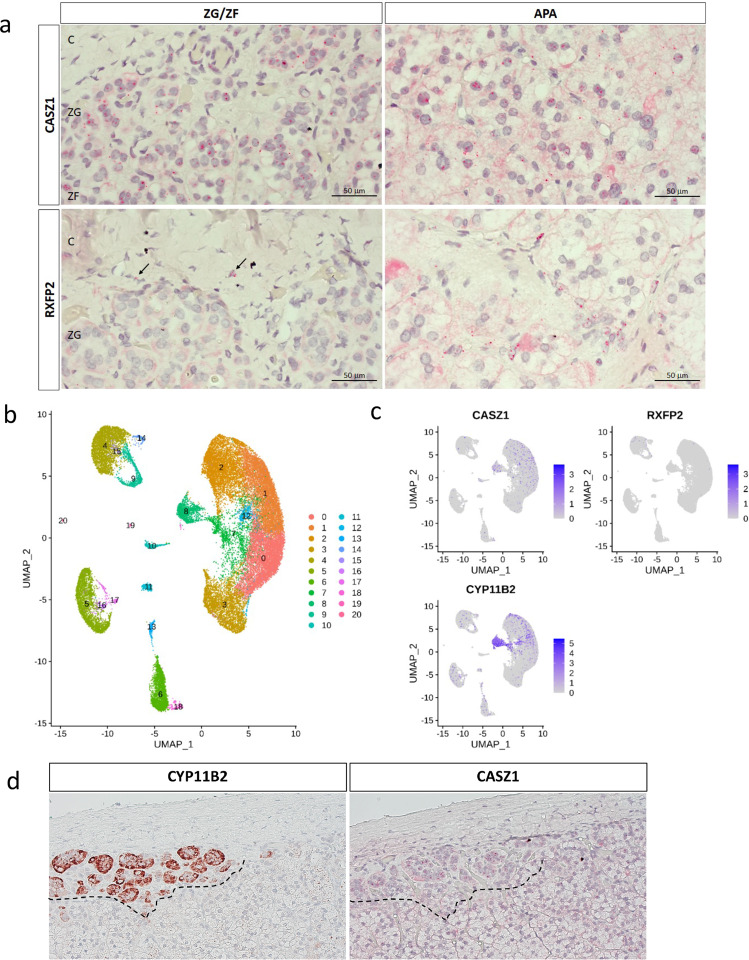
Fig. 3. Expression of CASZ1 and RXFP2 in the adrenal cortex and APA.
a CASZ1 and RXFP2 mRNA localization in the adrenal cortex of an adrenal with APA carrying a somatic KCNJ5 mutation analyzed by RNAscope. Red dots represent positive staining. Images are representative of results obtained in adrenals from four patients. C capsule, ZG zona glomerulosa, ZF zona fasciculata. b Uniform Manifold Approximation and Projection (UMAP) diagram from snRNA-seq from 5 pieces of adrenal cortex adjacent to APA from two adrenals; cells are colored by 1–20 cell-type clusters. c UMAP plots showing the expression of CASZ1, RXFP2, and CYPP11B2 within the different clusters. d CASZ1 mRNA localization in cells expressing CYP11B2 in the adrenal cortex of an adrenal with APA (patient 1 analyzed by snRNAseq) carrying a somatic KCNJ5 mutation. CASZ1 mRNA expression was analyzed by RNAscope; CYP11B2 protein expression was analyzed by immunohistochemistry. For each sample, one experiment was performed.
Fig. 4
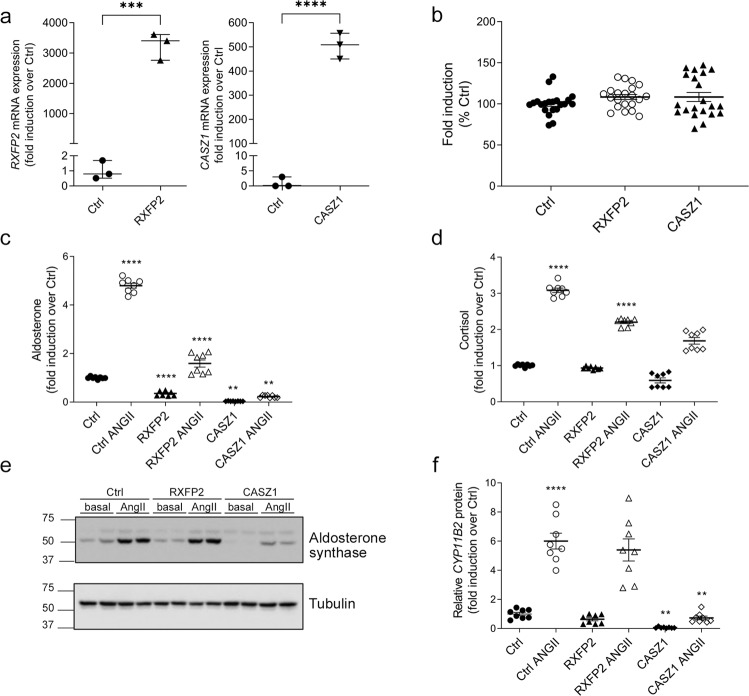
Fig. 4. Effect of RXFP2 and CASZ1 overexpression in H295R-S2 cells.
a RXFP2 and CASZ1 mRNA expression in H295R-S2 cells stably transfected with expression vectors coding for pcDNA3 (Ctrl), RXFP2 (RXFP2), or CASZ1 (CASZ1). mRNA expression is normalized against the geometric mean of three housekeeping genes. RXFP2 vs Ctrl, ***p = 0.0002; CASZ1 vs Ctrl ****p < 0.0001; unpaired t test, two-sided. b Effect of RXFP2 and CASZ1 overexpression in stably transfected H295R-S2 cells on cell proliferation. Cells were seeded in 96-well plates at a density of 5000 cells/well and grown for 4 days. Basal and stimulated aldosterone (c) and cortisol (d) production by H295R-S2 cells stably expressing RXFP2 or CASZ1. H295R-S2 cells were serum deprived for 24 h and then incubated for another 24 h with fresh serum deprived medium in absence (basal) or presence of 10 nM AngII. Aldosterone and cortisol levels are indicated as fold induction over mock-transfected cells in basal conditions. Aldosterone: Ctrl+AngII vs Ctrl ****p < 0.0001; RXFP2 vs Ctrl ****p < 0.0001; CASZ1 vs Ctrl **p = 0.0013; RXFP2 + AngII vs Ctrl+AngII ****p < 0.0001; CASZ1 + AngII vs Ctrl+AngII **p = 0.0013. Cortisol: Ctrl+AngII vs Ctrl ****p < 0.0001; RXFP2 + AngII vs Ctrl+AngII ****p < 0.0001. e Representative Western blot of aldosterone synthase expression in H295R-S2 cells stably expressing RXFP2 and CASZ1. f Quantification of aldosterone synthase expression (using tubulin as a loading control). Values are represented as mean + SEM of two independent experiments performed in quaduplicate (in a, median + interquartile range of one experiment performed in triplicate). Ctrl+AngII vs Ctrl ****p < 0.0001; CASZ1 vs Ctrl **p = 0.0052; CASZ1 + AngII vs Ctrl+AngII **p = 0.0052. c, d, f: Global comparison was evaluated using ANOVA or Kruskall Wallis test followed by Sidak’s or Dunn’s multiple comparison test. Cells overexpressing RXFP2 or CASZ1 were analyzed separately. Comparison between Ctrl vs Ctrl+Ang was performed with two-sided unpaired t test to control for cell response to AngII.

References

    1. Forouzanfar MH, et al. Global burden of hypertension and systolic blood pressure of atleast 110 to 115 mmHg, 1990–2015. JAMA. 2017;317:165–182. doi: 10.1001/jama.2016.19043. - DOI - PubMed
    1. Collaborators GBDRF. Global, regional, and national comparative risk assessment of 84 behavioural, environmental and occupational, and metabolic risks or clusters of risks for 195 countries and territories, 1990-2017: a systematic analysis for the Global Burden of Disease Study 2017. Lancet. 2018;392:1923–1994. doi: 10.1016/S0140-6736(18)32225-6. - DOI - PMC - PubMed
    1. Lewington S, et al. Age-specific relevance of usual blood pressure to vascular mortality: a meta-analysis of individual data for one million adults in 61 prospective studies. Lancet. 2002;360:1903–1913. doi: 10.1016/S0140-6736(02)11911-8. - DOI - PubMed
    1. Olsen MH, et al. A call to action and a lifecourse strategy to address the global burden of raised blood pressure on current and future generations: the Lancet Commission on hypertension. Lancet. 2016;388:2665–2712. doi: 10.1016/S0140-6736(16)31134-5. - DOI - PubMed
    1. Hannemann A, Wallaschofski H. Prevalence of primary aldosteronism in patient’s cohorts and in population-based studies-a review of the current literature. Horm. Metab. Res. 2012;44:157–162. doi: 10.1055/s-0031-1295438. - DOI - PubMed

Publication types