


Spasticity-related pain in children/adolescents with cerebral palsy. Part 2: IncobotulinumtoxinA efficacy results from a pooled analysis
- PMID: 36057802
- PMCID: PMC10116134
- DOI: 10.3233/PRM-220020
Spasticity-related pain in children/adolescents with cerebral palsy. Part 2: IncobotulinumtoxinA efficacy results from a pooled analysis
Abstract
Purpose: This pooled analysis of data from three Phase 3 studies investigated the effects of incobotulinumtoxinA on spasticity-related pain (SRP) in children/adolescents with uni-/bilateral cerebral palsy (CP).
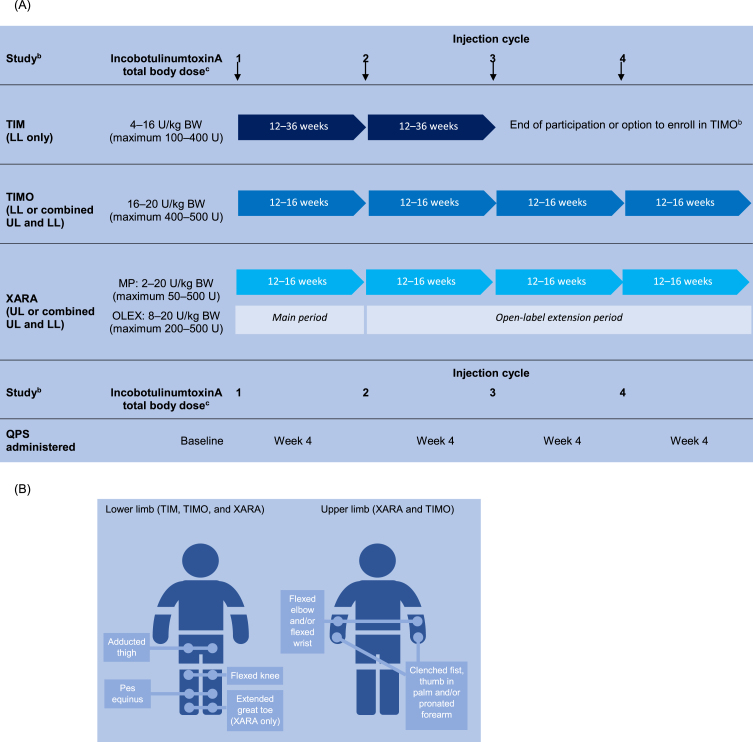
Methods: Children/adolescents (ambulant and non-ambulant) were evaluated for SRP on increasingly difficult activities/tasks 4 weeks after each of four incobotulinumtoxinA injection cycles (ICs) using the Questionnaire on Pain caused by Spasticity (QPS; six modules specific to lower limb [LL] or upper limb [UL] spasticity and respondent type [child/adolescent, interviewer, or parent/caregiver]). IncobotulinumtoxinA doses were personalized, with all doses pooled for analysis.
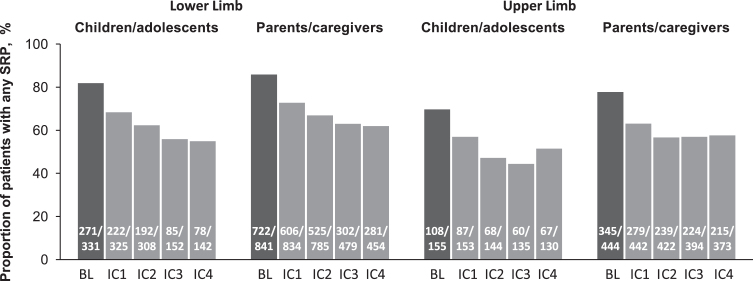
Results: QPS key item responses were available from 331 and 155 children/adolescents with LL- and UL-spasticity, respectively, and 841/444 (LL/UL) of their parents/caregivers. IncobotulinumtoxinA efficacy was evident with the first IC. Efficacy was sustained and became more robust with further subsequent ICs. By Week 4 of the last (i.e. fourth) IC, 33.8-53.3% of children/adolescents reported complete SRP relief from their baseline pain for respective QPS items. Children/adolescents reported reductions in mean LL SRP intensity at levels that surpassed clinically meaningful thresholds. Similarly, parents/caregivers observed complete SRP relief and less frequent SRP with incobotulinumtoxinA. Similar results were found for UL SRP.
Conclusion: These findings indicate that incobotulinumtoxinA could bring considerable benefit to children/adolescents with spasticity by reducing SRP, even during strenuous activities.
Keywords: Botulinum toxin; all movement disorders; all pediatric; cerebral palsy; muscle spasticity; pain.
Conflict of interest statement
Florian Heinen has received speaker’s honoraria from Allergan plc, Desitin, Ipsen Biopharmaceuticals, Merz Therapeutics, and Novartis and unrestricted educational grants from Allergan and Merz Therapeutics. Michaela Bonfert has received research grants from the HABA Foundation, the Deutsche Rentenversicherung, the Deutsche Migräne und Kopfschmerzgesellschaft, the European Research Council, ERA-NET Neuron, CSL Behring, and ZNS - Hannelore Kohl Foundation, and a research scholarship of the Bavarian Gender Equality Grant of the Free State of Bavaria, Germany. Petr Kaňovský has received speaker’s honoraria from Desitin, Ipsen Biopharmaceuticals, Merz Therapeutics, and Medtronic. A. Sebastian Schroeder has received speaker’s honoraria from and participated in advisory boards for Allergan plc, Ipsen Biopharmaceuticals, and Merz Therapeutics. Henry G. Chambers serves as a consultant for Orthopediatrics Corp and Allergan Corporation. Edward Dabrowski has participated in an advisory board and speaker bureau for Ipsen Biopharmaceuticals. Thorin L. Geister, Angelika Hanschmann, and Michael Althaus are employees of Merz Therapeutics GmbH. Marta Banach has served as a consultant and speaker and participated in an advisory board for Merz Therapeutics and has served as a speaker for Allergan, Ipsen, and Kedrion. Deborah Gaebler-Spira has served as a consultant for Teva and Kashiva.
Figures
References
Publication types
MeSH terms
Substances
LinkOut - more resources
Full Text Sources
Medical
Miscellaneous
