. 2022 Aug 17:13:981350.
doi: 10.3389/fimmu.2022.981350. eCollection 2022.

Cellular and humoral immune responses and breakthrough infections after three SARS-CoV-2 mRNA vaccine doses

Affiliations

Cellular and humoral immune responses and breakthrough infections after three SARS-CoV-2 mRNA vaccine doses

Patricia Almendro-Vázquez et al. Front Immunol. .

Abstract

Background: SARS-CoV-2 vaccination has proven the most effective measure to control the COVID-19 pandemic. Booster doses are being administered with limited knowledge on their need and effect on immunity.

Objective: To determine the duration of specific T cells, antibodies and neutralization after 2-dose vaccination, to assess the effect of a third dose on adaptive immunity and to explore correlates of protection against breakthrough infection.

Methods: 12-month longitudinal assessment of SARS-CoV-2-specific T cells, IgG and neutralizing antibodies triggered by 2 BNT162b2 doses followed by a third mRNA-1273 dose in a cohort of 77 healthcare workers: 17 with SARS-CoV-2 infection prior to vaccination (recovered) and 60 naïve.

Results: Peak levels of cellular and humoral response were achieved 2 weeks after the second dose. Antibodies declined thereafter while T cells reached a plateau 3 months after vaccination. The decline in neutralization was specially marked in naïve individuals and it was this group who benefited most from the third dose, which resulted in a 20.9-fold increase in neutralization. Overall, recovered individuals maintained higher levels of T cells, antibodies and neutralization 1 to 6 months post-vaccination than naïve. Seventeen asymptomatic or mild SARS-CoV-2 breakthrough infections were reported during follow-up, only in naïve individuals. This viral exposure boosted adaptive immunity. High peak levels of T cells and neutralizing antibodies 15 days post-vaccination associated with protection from breakthrough infections.

Conclusion: Booster vaccination in naïve individuals and the inclusion of viral antigens other than spike in future vaccine formulations could be useful strategies to prevent SARS-CoV-2 breakthrough infections.

Keywords: COVID-19; SARS-CoV-2; breakthrough infection; hybrid immunity; immune response; third dose; vaccination.


Conflict of interest statement

The authors declare that the research was conducted in the absence of any commercial or financial relationships that could be construed as a potential conflict of interest.

Figures
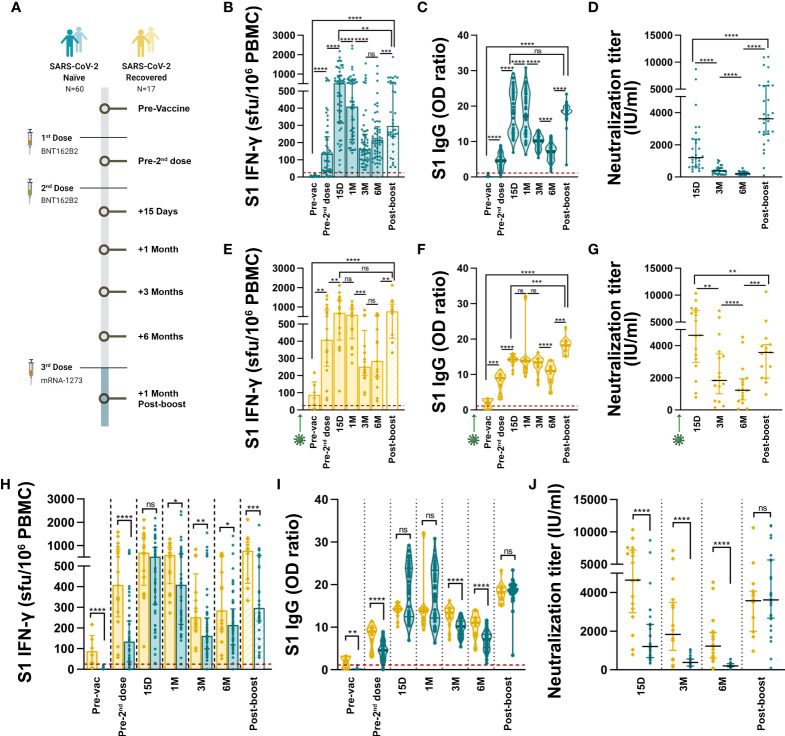
Figure 1
Figure 1
Development and maintenance of SARS-CoV-2-specific cellular and humoral immunity after 3 mRNA vaccine doses. (A) Study design and cohorts, samples were collected pre-vaccine, 21 days after the first dose, 15, 30, 90 and 180 days after the second dose and 30 days after third boost dose. (B) Dynamics of vaccine-triggered S1-IFN-γ-producing T cell response in SARS-CoV-2 naïve individuals (in blue). Data is represented as spot forming unit (sfu) per million PBMC. Dashed lines represent the positivity cut-off established by using a non-infected control group: >25 sfu/106 PBMC. (C) anti-S1 IgG levels elicited by mRNA vaccination in SARS-CoV-2 naïve individuals. Dashed line represents the established cut-off of positivity: OD ratio ≥1.1. (D) Vaccine-triggered neutralizing activity in SARS-CoV-2-naïve serum samples, represented as International Units per ml (IU/ml). (E–G) Dynamics of S1-IFN-γ-producing T cell (E), anti-S1 IgG (F) and neutralizing antibody (G) responses elicited by mRNA vaccination in SARS-CoV-2 recovered individuals (in yellow). (H–J) Comparison of S1 T cell (H), anti-S1 IgG (I) and neutralizing (J) responses between SARS-CoV-2 naïve and recovered individuals. Green arrows represent the time of SARS-CoV-2 infection. Horizontal bars and whiskers represent median values and interquartile ranges, respectively. The significance between groups was determined using Mann Whitney, Wilcoxon signed rank or Kruskal-Wallis tests, ns: not statistically significant, *p<0.05, **p<0.01, ***p<0.001, ****p<0.0001.
Figure 2
Figure 2
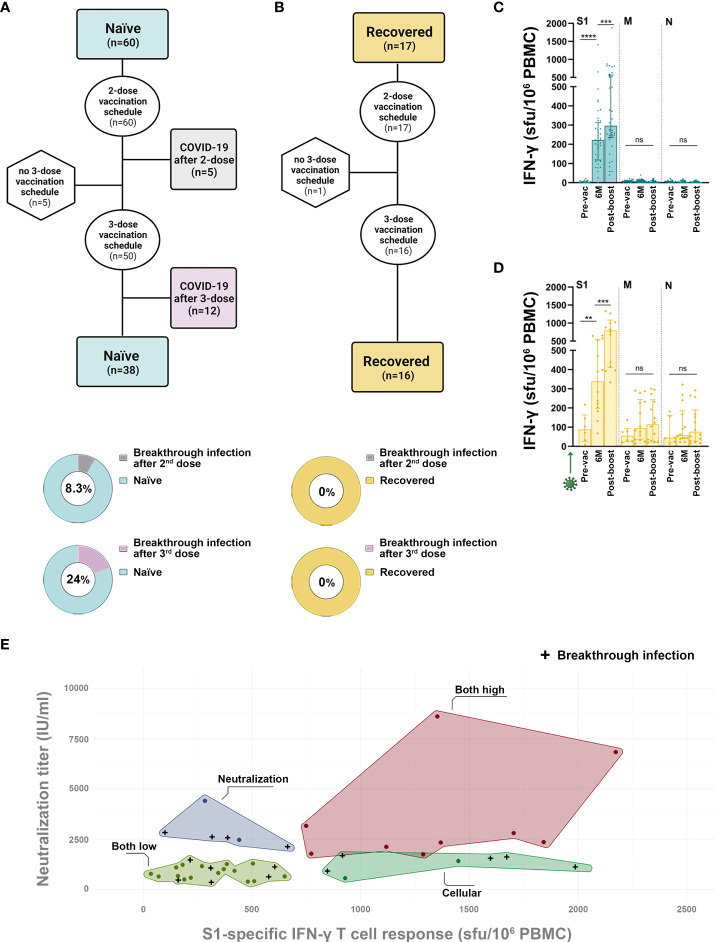
Factors associated with protection against breakthrough infection after SARS-CoV-2 vaccination. (A, B) Flowchart of SARS-CoV-2 naïve (A) and recovered (B) individuals included in the study and the frequency of SARS-CoV-2 infection reported after the second or third vaccine dose. (C, D) SARS-CoV-2-specific IFN-γ-producing T cell responses reactive to the S1, M and N proteins in subjects who remained SARS-CoV-2 naïve during follow-up (C) and in recovered (D) individuals. (E) Clustering based on S1-IFN-γ-producing T cell average and neutralizing titer average 15 days after the second BNT162b2 dose, when the vaccine-elicited immune response peaked, in naïve individuals. Green arrows represent the time of SARS-CoV-2 infection. Black crosses represent SARS-CoV-2-infected subjects after mRNA vaccination. Horizontal bars and whiskers represent median values and interquartile ranges, respectively. The significance between groups was determined using Mann-Whitney or Kruskal-Wallis tests, ns: not statistically significant, **p<0.01, ***p<0.001, ****p<0.0001.
Figure 3
Figure 3
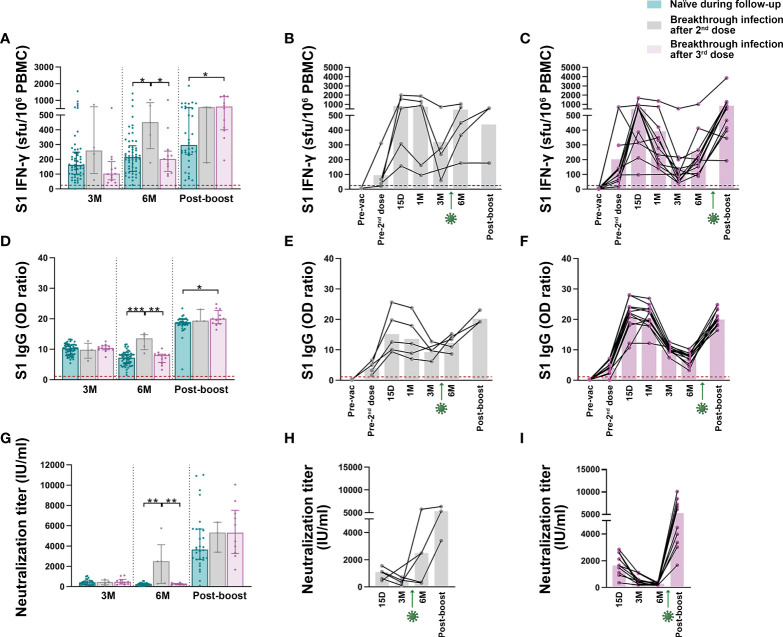
Effect of breakthrough infections on existing SARS-CoV-2 immunity. (A) Comparison of S1-IFN-γ-producing T cells among naïve individuals who remain naïve (in blue) and those with breakthrough infections after 2nd (in grey) and 3rd dose (in purple). Out of the 5 subjects who had SARS-CoV-2 infection after the 2nd dose only 3 subjects received the third vaccine dose. (B, C) Longitudinal data on the dynamics of specific T cells in the 5 subjects infected by SARS-CoV-2 after the 2nd dose (B) and in the 12 individuals infected after the 3rd dose (C). (D) Comparison of anti-S1IgG levels among SARS-CoV-2 naïve individuals and breakthrough infections after 2nd and 3rd dose. (E, F) Dynamics of antibody levels in subjects infected after the 2nd (E) and the 3rd dose (F). (G) Comparison of neutralizing activity among SARS-CoV-2 naïve individuals and breakthrough infections after 2nd and 3rd dose. (H, I) Neutralizing activity in SARS-CoV-2 infected subjects after the 2nd (H) and the 3rd dose (I). Green arrows represent the time of SARS-CoV-2 infection. Dashed lines represent the positivity cut-off. The significance between groups was determined using Mann Whitney test, *p<0.05, **p<0.01, ***p<0.001. (See Figure 1 footnote for more detailed information).

References

    1. Thompson MG, Burgess JL, Naleway AL, Tyner H, Yoon SK, Meece J, et al. Prevention and attenuation of covid-19 with the Bnt162b2 and mrna-1273 vaccines. N Engl J Med (2021) 385(4):320–9. doi: 10.1056/NEJMoa2107058 - DOI - PMC - PubMed
    1. Baden LR, El Sahly HM, Essink B, Kotloff K, Frey S, Novak R, et al. Efficacy and safety of the mrna-1273 sars-Cov-2 vaccine. N Engl J Med (2021) 384(5):403–16. doi: 10.1056/NEJMoa2035389 - DOI - PMC - PubMed
    1. Polack FP, Thomas SJ, Kitchin N, Absalon J, Gurtman A, Lockhart S, et al. Safety and efficacy of the Bnt162b2 mrna covid-19 vaccine. N Engl J Med (2020) 383(27):2603–15. doi: 10.1056/NEJMoa2034577 - DOI - PMC - PubMed
    1. Goel RR, Apostolidis SA, Painter MM, Mathew D, Pattekar A, Kuthuru O, et al. Distinct antibody and memory b cell responses in sars-Cov-2 naive and recovered individuals following mrna vaccination. Sci Immunol (2021) 6(58). doi: 10.1126/sciimmunol.abi6950 - DOI - PMC - PubMed
    1. Kalimuddin S, Tham CYL, Qui M, de Alwis R, Sim JXY, Lim JME, et al. Early T cell and binding antibody responses are associated with covid-19 rna vaccine efficacy onset. Med (N Y) (2021) 2(6):682–8 e4. doi: 10.1016/j.medj.2021.04.003 - DOI - PMC - PubMed

Publication types