


Anxiety and depression risk in Taiwan women with breast cancer and cervical cancer
- PMID: 36059620
- PMCID: PMC9437326
- DOI: 10.3389/fonc.2022.946029
Anxiety and depression risk in Taiwan women with breast cancer and cervical cancer
Abstract
Background: Studies comparing mental disorder risks between women with breast cancer and cervical cancer are lacking. This study compared risks of developing anxiety and depression between women with breast cancer (BC cohort) and women with cervical cancer (CC cohort) using insurance claims data of Taiwan.
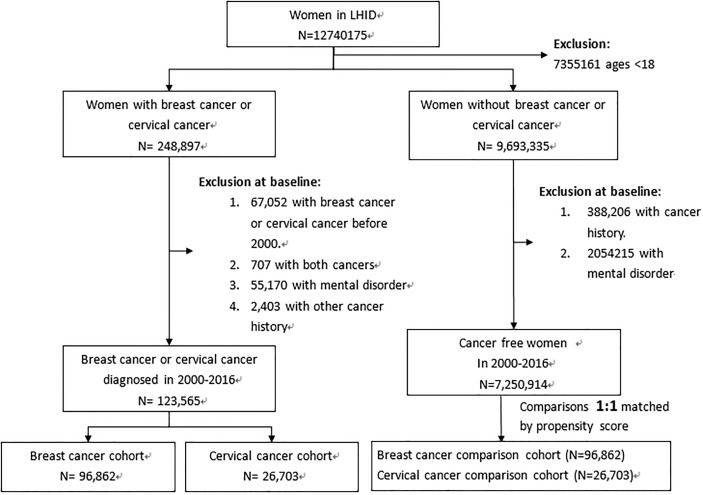
Methods: From the 2000 to 2016 data, we identified a BC cohort and BC controls (N = 96,862) and a CC cohort and CC controls (N = 26,703), matched by propensity scores. Incident mental disorders and the Cox method estimated the related cancer cohort to control cohort hazard ratios (HRs), and 95% confidence intervals (CIs) were estimated by the end of 2016.
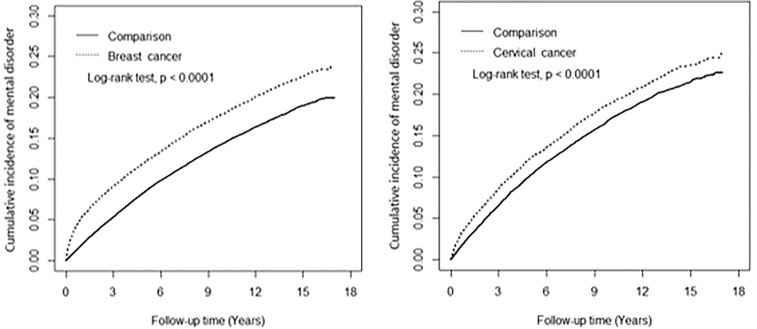
Results: Compared to the CC cohort, the BC cohort had slightly higher incident anxiety (15.9 versus 15.5 per 1,000 person-years) and depression (6.92 vs. 6.28 per 1,000 person-years). These mental disorders were higher in respective cancer cohorts than controls. The BC cohort to BC control adjusted HRs of anxiety and depression were 1.29 (95% CI = 1.25-1.33) and 1.78 (95% CI = 1.69-1.87), respectively. The corresponding adjusted HRs for the CC cohort were 1.12 (95% CI = 1.06-1.18) and 1.29 (95% CI = 1.18-1.41). The combined incidence rates of both disorders were 1.4-fold greater in the BC cohort than in BC controls (22.8 vs. 15.8 per 1,000 person-years), and 1.2-fold greater in the CC cohort than in the CC controls (21.7 vs. 18.3 per 1,000 person-years).
Conclusion: Women with breast cancer or cervical cancer are at an elevated likelihood of developing anxiety and depression disorders. These incident disorders are slightly higher in those with breast cancer.
Keywords: anxiety; breast cancer; cervical cancer; depression; retrospective cohort study.
Copyright © 2022 Yang, Sung, Mou, Liao, Wang and Shieh.
Conflict of interest statement
The authors declare that the research was conducted in the absence of any commercial or financial relationships that could be construed as a potential conflict of interest.
Figures
References
-
- WHO Depression . World health organization, Geneva (2021). Available at: https://www.who.int/news-room/fact-sheets/detail/depression (Accessed September 13, 2020).
LinkOut - more resources
Full Text Sources
