. 2022 Jun 6;23(2):e00328-21.
doi: 10.1128/jmbe.00328-21. eCollection 2022 Aug.

An Upper-Division, Remote Microbiology Laboratory That Blends Virtual and Hands-on Components to Promote Student Success during the COVID-19 Pandemic

Affiliations

An Upper-Division, Remote Microbiology Laboratory That Blends Virtual and Hands-on Components to Promote Student Success during the COVID-19 Pandemic

Candace Guzman-Cole et al. J Microbiol Biol Educ. .

Abstract

The COVID-19 shutdown forced many institutions of higher education to shift in-person teaching to emergency remote teaching. This was particularly challenging for laboratory courses, where students are expected to learn hands-on skills needed for their career goals. Here, we describe the transformation of an upper-division microbiology laboratory to a course that seamlessly integrates online simulations with safe, hands-on experiences that can be done from home. This blended lab course helped students attain learning outcomes similar to those achieved in the in-person class. We illustrate the implementation of Unknown Portfolios to help students gain the data analysis and critical thinking skills needed to identify an unknown microorganism. Our data show that students who took these online courses mastered material as well as students who took the lab in person, demonstrating proficiency in laboratory safety skills, hands-on techniques, and theoretical class content. Last, we explore online adaptations to enhance in-person lab classes, aiming at reducing the accessibility and equity gaps inherited in many courses, as well as discussing challenges that instructors might experience in this process.

Keywords: COVID-19; hands-on experience; microbiology laboratory; online class; unknown identification.


Conflict of interest statement

The authors declare no conflict of interest.

Figures
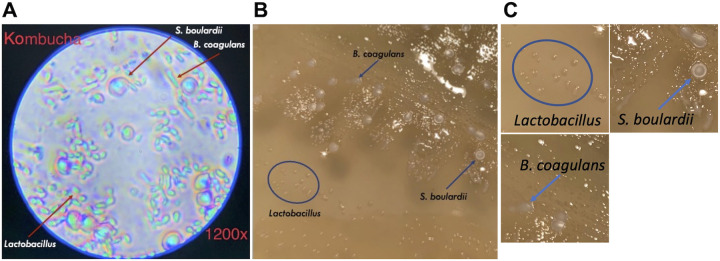
FIG 1
FIG 1
Illustration of the microbial community in GT’s kombucha. (A) Microscopic image, at ×1,200 magnification, showing the cell morphologies for presumed Bacillus coagulans, Saccharomyces boulardii, and Lactobacillus. The image was taken with the microscope provided to students. (B) Colony morphology of kombucha microbes grown in homemade petri dishes. (C) Enlargement of selected colonies to enhance visualization.
FIG 2
FIG 2
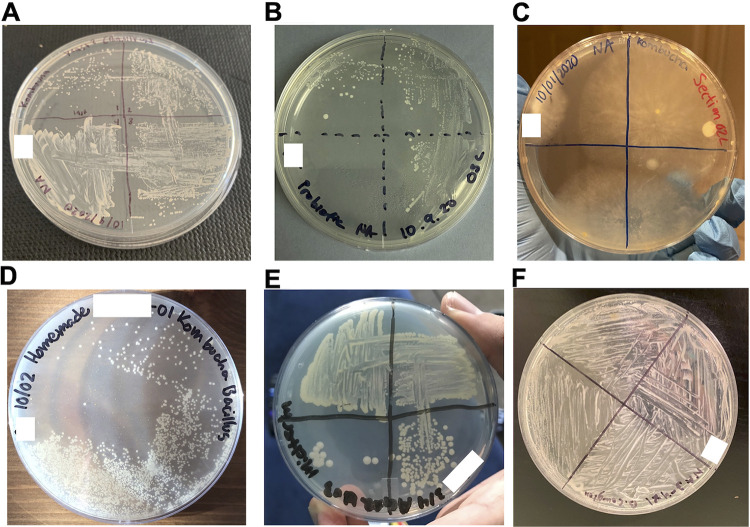
Students’ streak plating technique for the isolation of single colonies from kombucha as part of exam 1. (A and D) Representative streak plates demonstrating a high level of mastery of the streak plating technique. Note the single colonies in the fourth quadrant. (B and E) Plates demonstrating intermediate levels of mastery of the streak plating technique. Note the absence of colonies in the fourth quadrant (B) and the lack of separation of colonies (E). (C and F) Representative samples of unsuccessful streak technique. Note the presence of contamination (C) and the absence of sample dilution (F). White squares hide students’ identifying information.
FIG 3
FIG 3
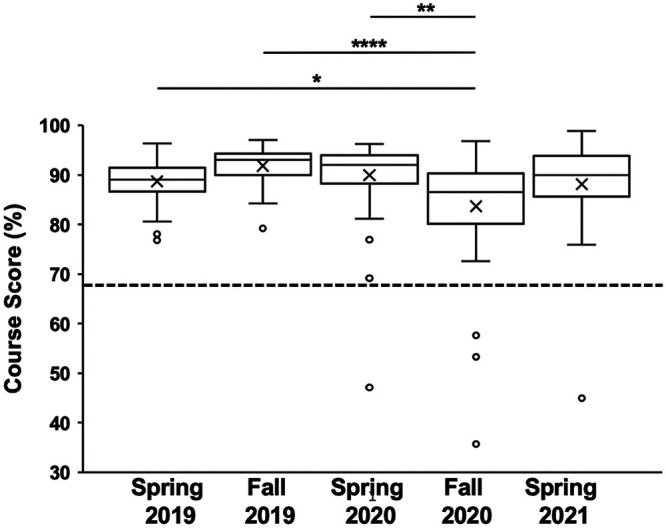
Box-and-whisker graph of the overall course score (in percent) for each semester examined. The “×” in each box represents the average score of the class, while the horizontal line in the box represents the median score. The dashed line at 68% represents a C−, the passing threshold grade for the class; Students with scores of ≥68% passed the class. Outliers are shown as open dots. Spring 2019, n = 56; fall 2019, n = 34; spring 2020, n = 58; fall 2020, n = 40; spring 2021, n = 41. *, P ≤ 0.05; **, P ≤ 0.01; ****, P ≤ 0.0001.
FIG 4
FIG 4
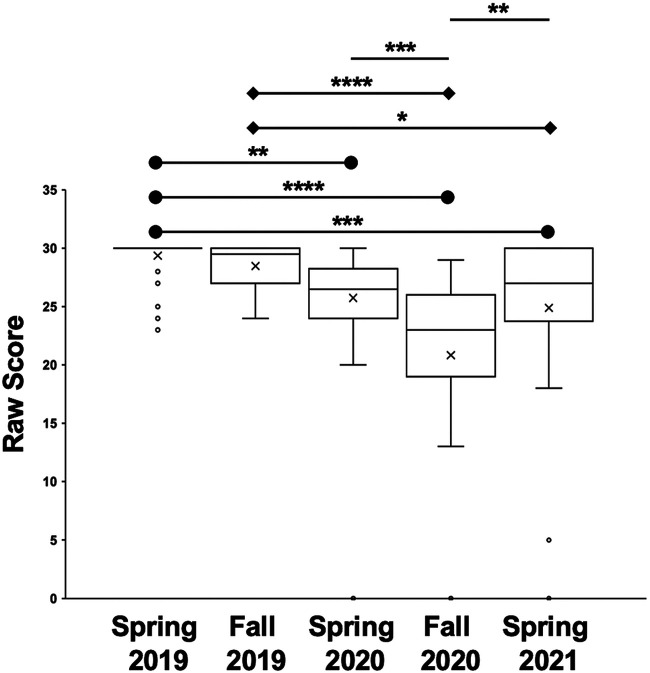
Box-and-whisker graph illustrating the experiment 4/5 homework scores for each semester examined. The “×” in each box represents the average score of the class, while the horizontal line in the box represents the median score. Outliers are shown as open dots. Horizontal lines with circles compare IP spring 2019 scores, while horizontal lines with diamonds compare the IP fall 2019 scores. This assignment had a maximum value of 30 points. Spring 2019, n = 56; fall 2019, n = 34; spring 2020, n = 58; fall 2020, n = 39; and spring 2021, n = 41. *, P ≤ 0.05; **, P ≤ 0.01; ***, P ≤ 0.001; ****, P ≤ 0.0001.
FIG 5
FIG 5
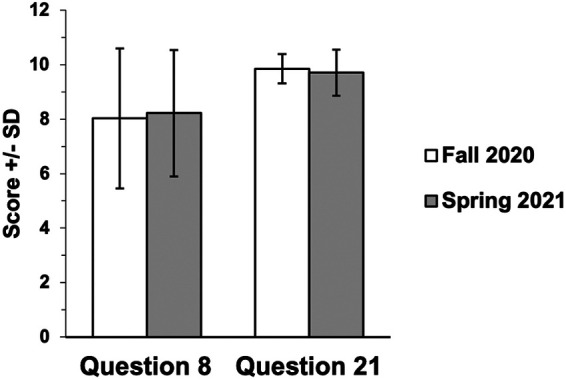
Bar graph comparing the mean value scores on two biosafety questions from exam 1 from the fall 2020 and spring 2021 semesters. Students were asked to identify hazards in a microbiology lab for question 8 and point out bad lab practices from an image in question 21. The maximum score in both questions is 10 points. Fall 2020, n = 40; spring 2021, n = 41.

References

    1. Hodges C, Moore S, Lockee B, Trust T, Bond A. 2020. The difference between emergency remote teaching and online learning. Educause. https://er.educause.edu/articles/2020/3/the-difference-between-emergency.... Retrieved 3 December 2021.
    1. ASM. 2021. ASM curriculum guidelines for undergraduate microbiology. https://asm.org/Guideline/ASM-Curriculum-Guidelines-for-Undergraduate-Mi....
    1. Noel TC, Rubin JE, Acebo Guerrero Y, Davis MC, Dietz H, Libertucci J, Sukdeo N. 2020. Keeping the microbiology lab alive: essential microbiology lab skill development in the wake of COVID-19. Can J Microbiol 66:603–604. doi: 10.1139/cjm-2020-0373. - DOI - PubMed
    1. Yap WH, Teoh ML, Tang YQ, Goh BH. 2021. Exploring the use of virtual laboratory simulations before, during, and post COVID-19 recovery phase: an animal biotechnology case study. Biochem Mol Biol Educ 49:685–691. doi: 10.1002/bmb.21562. - DOI - PMC - PubMed
    1. Allen TE, Barker SD. 2021. BME labs in the era of COVID-19: transitioning a hands-on integrative lab experience to remote instruction using gamified lab simulations. Biomed Eng Educ 1:99–104. doi: 10.1007/s43683-020-00015-y. - DOI - PMC - PubMed