. 2022 Jul 14;11(8):e1473-e1478.
doi: 10.1016/j.eats.2022.03.038. eCollection 2022 Aug.

Arthroscopic Modified McLaughlin Procedure and Remplissage for Treatment of Simultaneous Reverse Hill-Sachs and Hill-Sachs Lesions

Affiliations

Arthroscopic Modified McLaughlin Procedure and Remplissage for Treatment of Simultaneous Reverse Hill-Sachs and Hill-Sachs Lesions

Santiago Arauz et al. Arthrosc Tech. .

Abstract

Hill-Sachs lesions (HSLs) can be present after a primary shoulder dislocation and may go unrecognized; this can alter the necessary bony constraint within the glenohumeral joint. To deal with HSLs, remplissage is a safe procedure with low complication rates, low recurrent instability rates, and good patient outcome scores compared with many of the other alternative techniques. On the other hand, a great number of techniques have been described to treat reverse Hill-Sachs lesions (RHSLs). In this article, we propose a method of treatment for combined simultaneous HSL and RHSL shoulder injuries. However, consensus on a specific treatment is yet to be established. We present an arthroscopic treatment guideline for patients with shoulder instability due to anterior and posterior labral lesions, HSL, and RHSL.


Figures

Figure 1
Figure 1
Shoulder MRI showing lesions. (A) Sagittal plane: simultaneous acute HSL and RHSL after traumatic injuries. (B) Axial plane: RHSL. There are no relevant posterior glenoid defects, and the anterior glenoid defect is <20%. Abbreviations: HH, humeral head; HSL, Hill-Sachs lesion; MRI, magnetic resonance imaging; RHSL, reverse Hill-Sachs lesion.
Figure 2
Figure 2
(A) PL lesion. (B) Posterior labral repair, with 3 × 3-mm double suture-loaded anchors (Biosuturetak), passing the tissue with right Suturelasso and knotting the posterior labral repair (C). Abbreviations: GL, glenoid; HH, humeral head; PL, posterior labral.
Figure 3
Figure 3
5-mm resorbable threaded implant (A) (Bio-Corkscrew) is prepared for remplissage, but without passing the sutures through the tissue (B). The implant is placed in the part closest to the cartilage of the Hill-Sachs defect.
Figure 4
Figure 4
Detachment of the anterior labrum (AL) is performed with a periostotome to lift it up to the underside of the glenoid (A). After checking that the anterior labrum can be mobilized and reduced to its anatomic area, the anterior labrum is repaired (B) with multiple 3-mm double suture-loaded anchors (Biosuturetak), passing the tissue with Suturelasso.
Figure 5
Figure 5
The head is reduced and centered on the glenoid.
Figure 6
Figure 6
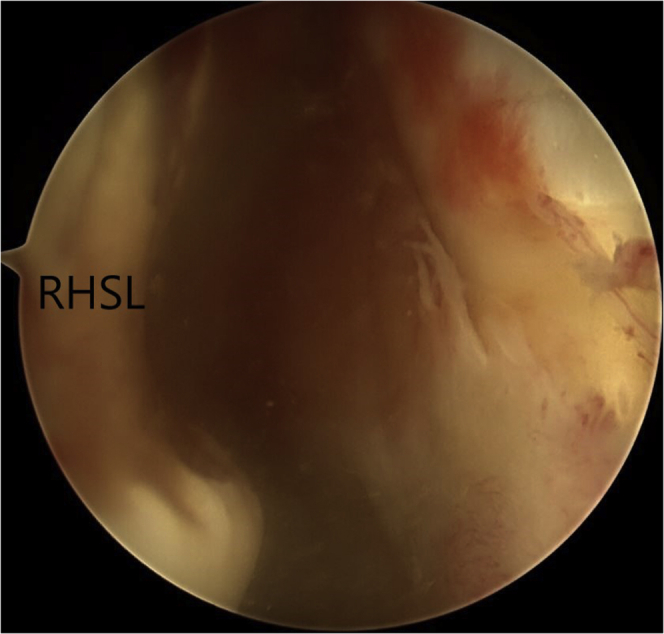
The reverse Hill-Sachs lesion is identified and debrided of all soft tissue using an arthroscopic shaver.
Figure 7
Figure 7
The arthroscopic shaver is also used to excise the central portion of the rotator interval tissue to generate better exposure of the subscapularis tendon (ST).
Figure 8
Figure 8
The center of the reverse Hill-Sachs lesion is identified (A), and a 5-mm resorbable threaded implant (Bio-Corkscrew) is inserted from the anterior cannula. The tissue is passed through the top of the subscapularis with suture lasso, with mattress stitches (B).
Figure 9
Figure 9
The posterior threaded cannula is partially removed until it is extra-articular (behind the infraspinatus) but deep to the deltoid. Using straight through forceps (Birdbeak; Arthrex), the infraspinatus and posterior capsule (PC) are traversed inferiorly to superiorly at 5-mm intervals, retrieving each of the 2 implant sutures (Bio-Corkscrew). The remplissage is tied, achieving a good filling of the Hill-Sachs defect with the infraspinatus and posterior capsule (tenodesis effect).

References

    1. Haley C.C.A. History and physical examination for shoulder instability. Sports Med Arthrosc Rev. 2017;25:150–155. - PubMed
    1. Coyner K.J., Arciero R.A. Shoulder instability: Anterior, posterior, multidirectional, arthroscopic versus open, bone block procedures. Sports Med Arthrosc Rev. 2018;26:168–170. - PubMed
    1. Kelly B.J., Field L.D. Arthroscopic transfer of the subscapularis tendon for treatment of a reverse Hill-Sachs lesion. Arthrosc Tech. 2017;6:e2061–e2064. - PMC - PubMed
    1. Alexander T.C., Beicker C., Tokish J.M. Arthroscopic remplissage for moderate-size Hill-Sachs lesion. Arthrosc Tech. 2016;5:e975–e979. - PMC - PubMed
    1. Hachem A.I., Bascones K.R., D’O G.C., Rondanelli S.R., Rius X. Arthroscopic knotless subscapularis bridge technique for reverse Hill-Sachs lesion with posterior shoulder instability. Arthrosc Tech. 2021;10:e103–e116. - PMC - PubMed

LinkOut - more resources