Intercriteria Analysis to Diagnose the Reasons for Increased Fouling in a Commercial Ebullated Bed Vacuum Residue Hydrocracker
- PMID: 36061707
- PMCID: PMC9434761
- DOI: 10.1021/acsomega.2c03876
Intercriteria Analysis to Diagnose the Reasons for Increased Fouling in a Commercial Ebullated Bed Vacuum Residue Hydrocracker
Abstract
The intercriteria analysis developed on the base of intuitionistic fuzziness and index matrices was applied to evaluate processing data of the LUKOIL Neftohim Burgas H-Oil ebullated bed vacuum residue hydrocracker with the aim of revealing the reasons for increased fouling registered during the 3rd cycle of the H-Oil hydrocracker. It was found that when the ratio of the ΔT of the 1st reactor to the ΔT of the 2nd reactor gets lower than 2.0, an excessive H-Oil equipment fouling occurs. The fouling was also found to be favored by processing of lower Conradson carbon content vacuum residual oils and increased throughput and depressed by increasing the dosage of the HCAT nanodispersed catalyst. The fouling in the atmospheric tower bottom section is facilitated by a lower aromatic content in the atmospheric tower bottom product. The addition of FCC slurry oil not only increases aromatic content but also dissolves some of the asphaltenes in the atmospheric residual hydrocracked oil and decreases its colloidal instability index. The fouling in the vacuum tower bottom section is facilitated by a higher saturate content in the VTB. Surprisingly, it was found that the asphaltene content in the VTB depresses the fouling rate. No relation was found of the sediment content in the hydrocracked residual oils measured by hot filtration tests and by the centrifuge method to the equipment fouling of the H-Oil hydrocracker.
© 2022 The Authors. Published by American Chemical Society.
Conflict of interest statement
The authors declare no competing financial interest.
Figures
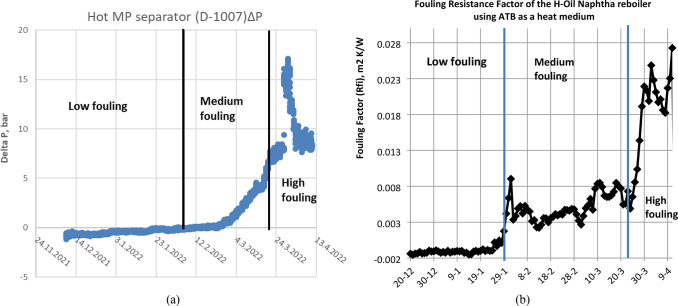
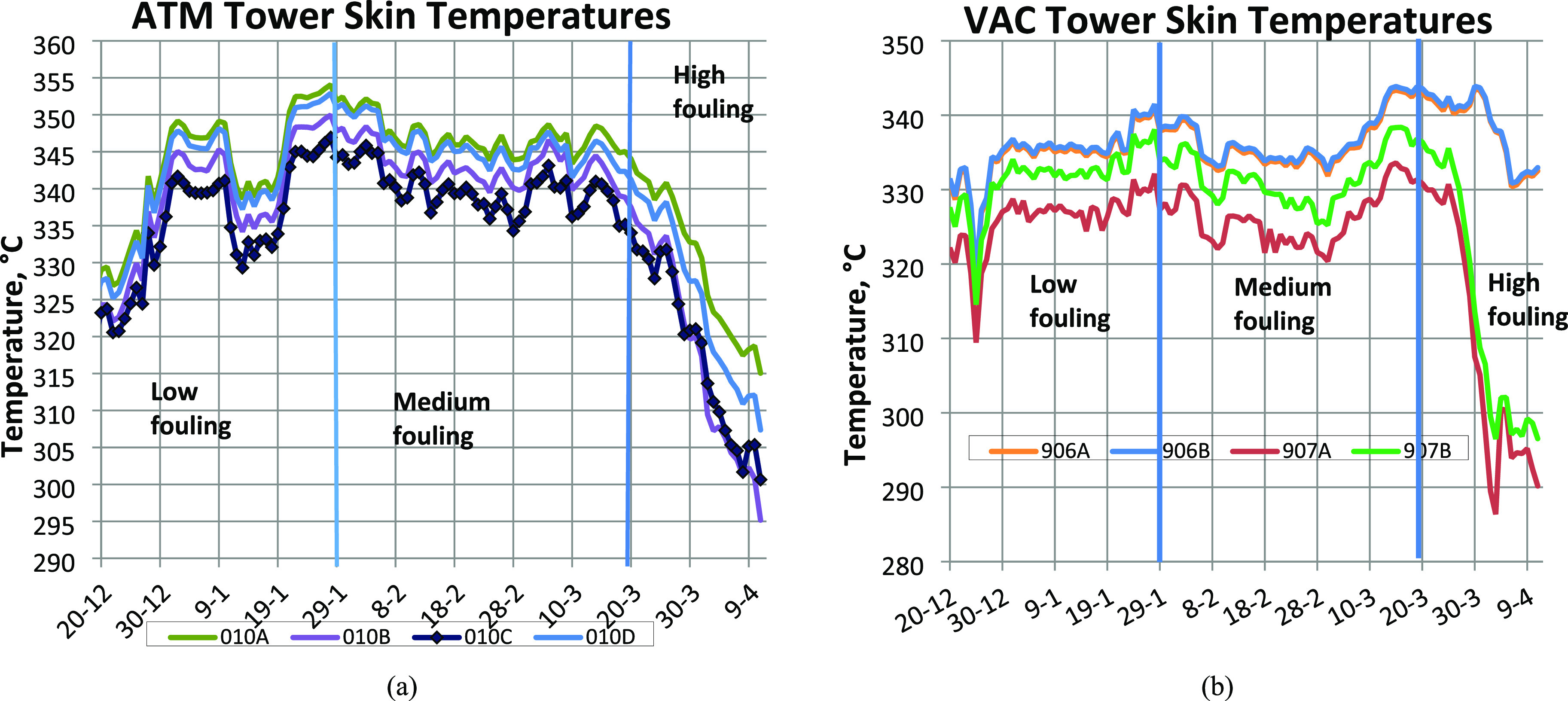


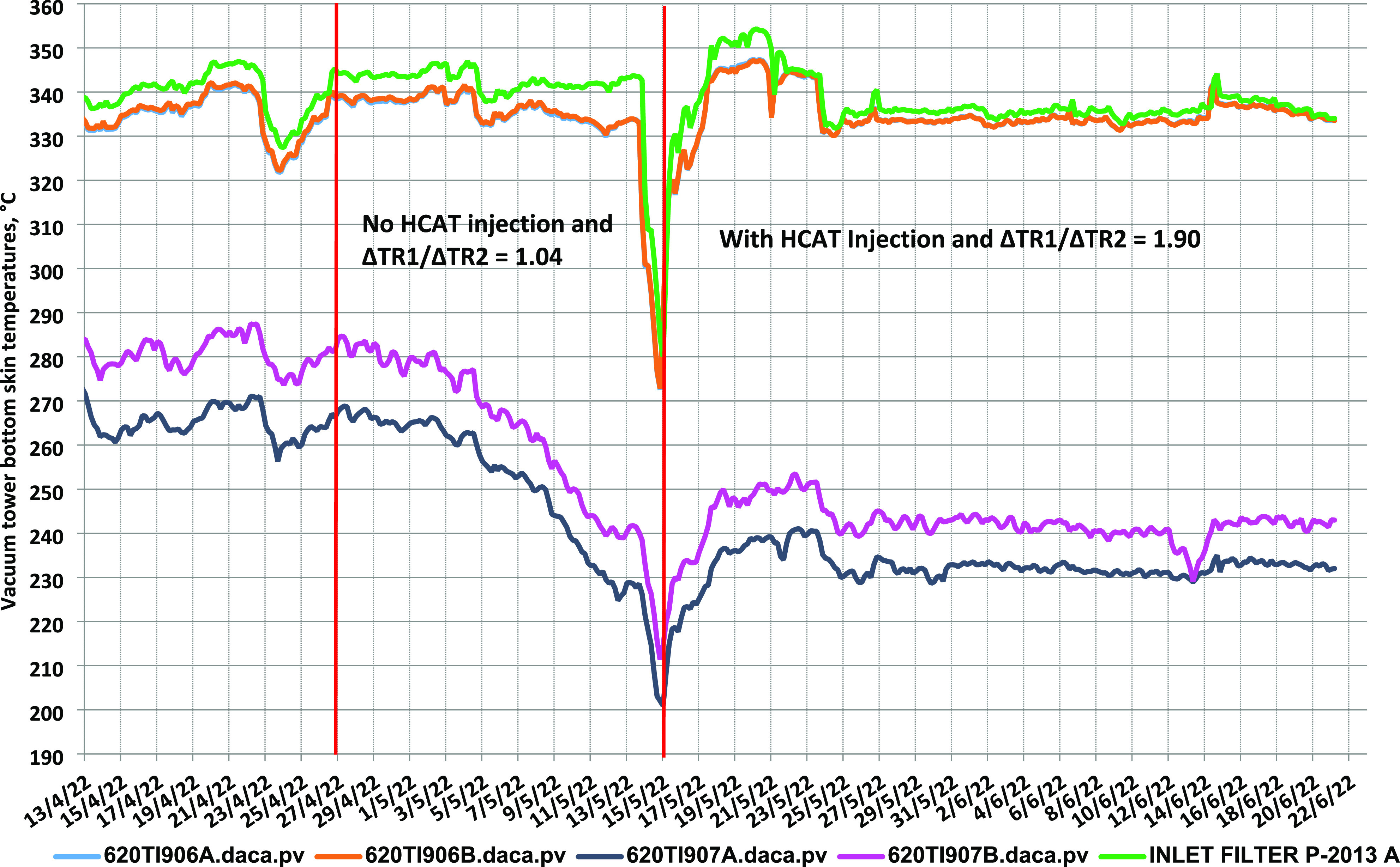
 of 1.04 and 1.90 with and without HCAT
injection.
of 1.04 and 1.90 with and without HCAT
injection.References
-
- Panariti N.; Rispoli G.. The first EST Commercial Unit:Achieving the goal of residue conversion; 13th International Bottom of the Barrel Conference: Istanbul, Turkey, 13–14 May 2015.
-
- Stratiev D.; Nenov S.; Shishkova I.; Georgiev B.; Argirov G.; Dinkov R.; Yordanov D.; Atanassova V.; Vassilev P.; Atanassov K. Commercial investigation of the ebullated-bed vacuum residue hydrocracking in the conversion range of 55–93%. ACS Omega 2020, 5, 33290–33304. 10.1021/acsomega.0c05073. - DOI - PMC - PubMed
-
- Frecon J.; Le-Bars D.; Rault J. Flexible upgrading of heavy feedstocks. Pet. Technol. Q. 2019, Q11, 11.
-
- Stanislaus A.; Hauser A.; Marafi M. Investigation of the mechanism of sediment formation in residual oil hydrocracking process through characterization of sediment deposits. Catal. Today 2005, 109, 167–177. 10.1016/j.cattod.2005.08.014. - DOI
-
- Félix G.; Ancheyta J. Comparison of hydrocracking kinetic models based on SARA fractions obtained in slurry-phase reactor. Fuel 2019, 241, 495–505. 10.1016/j.fuel.2018.11.153. - DOI
LinkOut - more resources
Full Text Sources