


Forest gaps alter the soil bacterial community of weeping cypress plantations by modulating the understory plant diversity
- PMID: 36061809
- PMCID: PMC9437579
- DOI: 10.3389/fpls.2022.920905
Forest gaps alter the soil bacterial community of weeping cypress plantations by modulating the understory plant diversity
Abstract
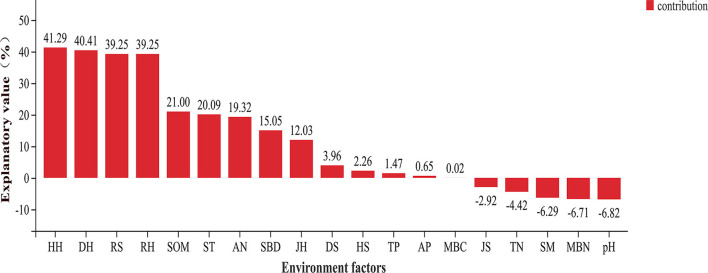
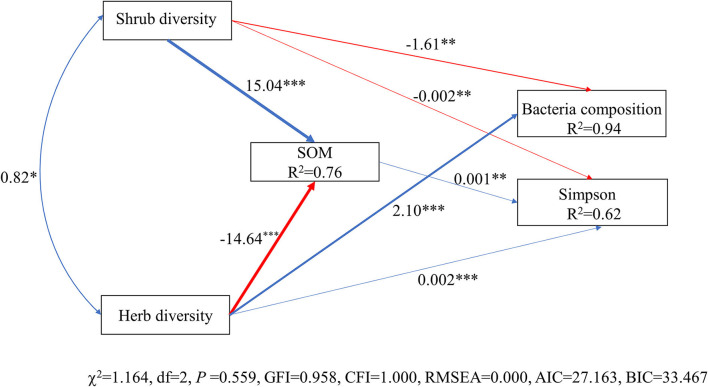
Weeping cypress is an endemic tree species that is widely planted in China, and the simple stand structure and fragile ecosystem of its plantation are common issues. Exploring the effect of different gap sizes on the soil bacterial community structure of weeping cypress plantations can provide a theoretical basis for the near-natural management of forest plantations. We, therefore, constructed three kinds of forest gaps with different sizes in weeping cypress plantations, namely, small (50-100 m2), medium (100-200 m2), and large gaps (400-667 m2), for identifying the key factors that affect soil bacterial communities following the construction of forest gaps. The results suggested that the herb layer was more sensitive than the shrub layer, while the Simpson, Shannon, and richness indices of the herb layer in plots with gaps were significantly higher than those of designated sampling plots without any gaps (CK). The presence of large gaps significantly increased the understory plant diversity and the Shannon and Simpson indices of the soil bacterial alpha diversity. There were obvious changes in the community composition of soil bacteria following the construction of forest gaps. The dominant bacterial phyla, orders, and functions were similar across the plots with different gap sizes. Of the indicator bacterial species, the abundance of the nitrogen-fixing bacteria, Lysobacter_ yangpyeongensis, and Ensifer_meliloti, was significantly different across plots with different gap sizes and accounted for a large proportion of the bacterial population of plots with medium and large gaps. The understory plant diversity was mostly related to the soil bacterial community than to other soil factors. The results of structural equation modeling indicated that the understory plant diversity was the most important environmental factor in driving the composition and diversity of bacterial communities. The construction of forest gaps significantly improved the understory plant diversity, physicochemical properties of the soil, and bacterial diversity in weeping cypress plantations, and the results of the comprehensive evaluation were in the order: large gaps > small gaps > medium gaps > CK. Our results suggested that large gaps are beneficial for the diversity of above-ground plant communities and underground soil bacterial communities.
Keywords: forest gap sizes; near-natural forest management; soil bacteria; soil properties; understory vegetation.
Copyright © 2022 Lyu, Luo, Liu, Zhang, Li, Hou, Chen, Zhao, Fan and Li.
Conflict of interest statement
The authors declare that the research was conducted in the absence of any commercial or financial relationships that could be construed as a potential conflict of interest.
Figures




References
-
- Adamo I., Castaño C., Bonet J. A., Colinas C., Martínez de Aragón J., Alday J. G. (2021). Soil physico-chemical properties have a greater effect on soil fungi than host species in Mediterranean pure and mixed pine forests. Soil Biol. Biochem. 160:1–11. 10.1016/j.soilbio.2021.108320 - DOI
-
- Catorci A., Tardella F. M., Cutini M., Luchetti L., Paura B., Vitanzi A. (2013). Reproductive traits variation in the herb layer of a submediterranean deciduous forest landscape. Plant Ecol. 214, 737–749. 10.1007/s11258-013-0203-0 - DOI
-
- Chai Y., Cao Y., Yue M., Tian T., Yin Q., Dang H., et al. (2019). Soil abiotic properties and plant functional traits mediate associations between soil microbial and plant communities during a secondary forest succession on the Loess Plateau. Front. Microbiol. 10, 1–15. 10.3389/fmicb.2019.00895 - DOI - PMC - PubMed
LinkOut - more resources
Full Text Sources
Research Materials
Miscellaneous
