


Musical abilities in children with developmental cerebellar anomalies
- PMID: 36061946
- PMCID: PMC9436271
- DOI: 10.3389/fnsys.2022.886427
Musical abilities in children with developmental cerebellar anomalies
Erratum in
-
Corrigendum: Musical abilities in children with developmental cerebellar anomalies.Front Syst Neurosci. 2022 Nov 9;16:1079004. doi: 10.3389/fnsys.2022.1079004. eCollection 2022. Front Syst Neurosci. 2022. PMID: 36438544 Free PMC article.
Abstract
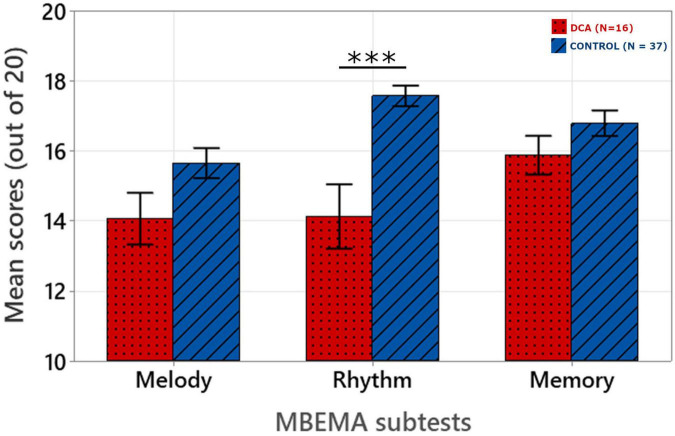
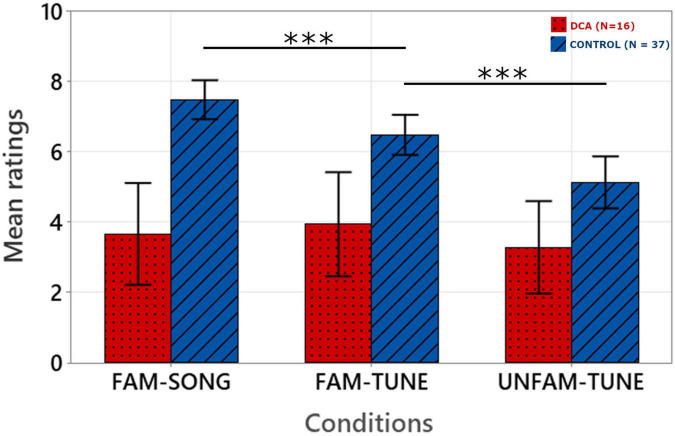
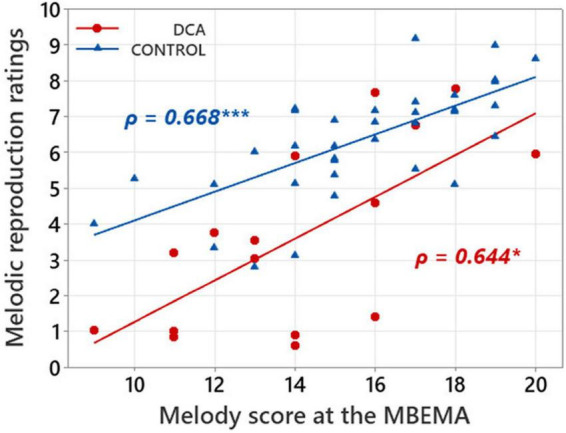
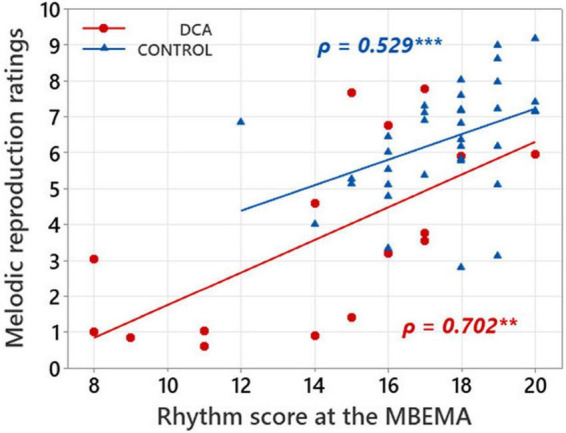
Developmental Cerebellar Anomalies (DCA) are rare diseases (e.g., Joubert syndrome) that affect various motor and non-motor functions during childhood. The present study examined whether music perception and production are affected in children with DCA. Sixteen children with DCA and 37 healthy matched control children were tested with the Montreal Battery for Evaluation of Musical Abilities (MBEMA) to assess musical perception. Musical production was assessed using two singing tasks: a pitch-matching task and a melodic reproduction task. Mixed model analyses showed that children with DCA were impaired on the MBEMA rhythm perception subtest, whereas there was no difference between the two groups on the melodic perception subtest. Children with DCA were also impaired in the melodic reproduction task. In both groups, singing performance was positively correlated with rhythmic and melodic perception scores, and a strong correlation was found between singing ability and oro-bucco-facial praxis in children with DCA. Overall, children with DCA showed impairments in both music perception and production, although heterogeneity in cerebellar patient's profiles was highlighted by individual analyses. These results confirm the role of the cerebellum in rhythm processing as well as in the vocal sensorimotor loop in a developmental perspective. Rhythmic deficits in cerebellar patients are discussed in light of recent work on predictive timing networks including the cerebellum. Our results open innovative remediation perspectives aiming at improving perceptual and/or production musical abilities while considering the heterogeneity of patients' clinical profiles to design music-based therapies.
Keywords: ataxia; cerebellum; children; developmental cerebellar anomalies; music perception; music production; rhythm; singing.
Copyright © 2022 Guinamard, Clément, Goemaere, Mary, Riquet and Dellacherie.
Conflict of interest statement
The authors declare that the research was conducted in the absence of any commercial or financial relationships that could be construed as a potential conflict of interest.
Figures
References
-
- Akaike H. (1974). A new look at the statistical model identification. IEEE Trans. Automat. Control 19 716–723. 10.1109/TAC.1974.1100705 - DOI
-
- Audacity Team (2019). Audacity(R): Free audio editor and recorder (2.2.1) [Computer software]. Available online at: https://www.audacityteam.org
LinkOut - more resources
Full Text Sources
