. 2022 Aug 17:13:986504.
doi: 10.3389/fneur.2022.986504. eCollection 2022.

Multi-type RFC1 repeat expansions as the most common cause of hereditary sensory and autonomic neuropathy

Affiliations

Multi-type RFC1 repeat expansions as the most common cause of hereditary sensory and autonomic neuropathy

Jun-Hui Yuan et al. Front Neurol. .

Abstract

Non-coding repeat expansions within RFC1 and NOTCH2NLC genes have lately been linked to multisystem neurodegenerative diseases, which also shed light on yet undiagnosed patients with inherited peripheral neuropathies. The aim of this study was to identify the genetic basis of patients with hereditary sensory and autonomic neuropathy (HSAN). We collected 79 unrelated DNA samples clinically suspected with HSAN from multiple regions of Japan. Mutation screening was first performed using gene panel sequencing and whole-exome sequencing. Pathogenic/likely pathogenic variants were identified from genes of WNK1/HSN2 (6 cases), SCN9A (3 cases), NTRK1 (3 cases), and DNMT1 (2 cases). Subsequently, long-range flanking PCR and repeat-primed PCR were applied to analyze repeat expansions in RFC1 and NOTCH2NLC. Bi-allelic RFC1 repeat expansions were detected from 20 adult-onset HSAN patients, consisting of [(AAGGG)exp/(AAGGG)exp] (8 cases), [(ACAGG)exp/(ACAGG)exp] (8 cases), and [(AAGGG)exp/(ACAGG)exp] (4 cases). GGC repeat expansion in NOTCH2NLC was found in 1 case. Single-nucleotide variant-based haplotype analysis of patients harboring disease-associated repeat expansions in RFC1 revealed distinguishable haplotypes among subgroups with different repeat genotypes. These findings substantially redefine the genetic spectrum of HSAN, where multi-type RFC1 repeat expansions account for 25.3% of all patients, highlighting the necessity of genetic screening, particularly for adult-onset patients.

Keywords: RFC1; gene panel sequencing; haplotype; non-coding repeat expansion; sensory neuropathy.


Conflict of interest statement

The authors declare that the research was conducted in the absence of any commercial or financial relationships that could be construed as a potential conflict of interest.

Figures
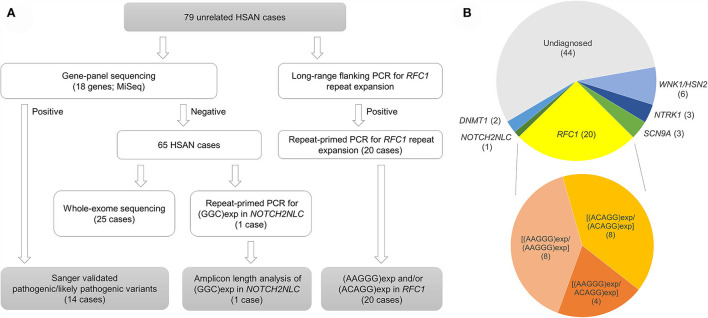
Figure 1
Figure 1
Genetic analysis workflow (A) and proportional piechart of genes with pathogenic/likely pathogenic variants from diagnosed HSAN patients (B).
Figure 2
Figure 2
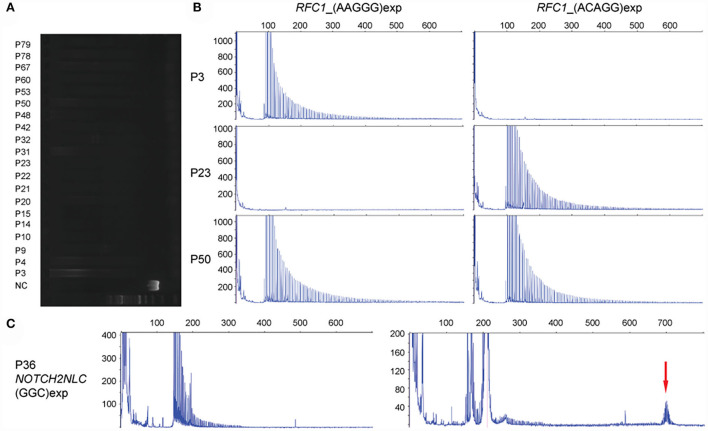
Detection of disease-associated repeat expansions in RFC1 and NOTCH2NLC genes. (A) Long-range PCR shows the absence of clear amplifiable PCR product in RFC1 from 20 cases with HSAN. NC: negative control. (B) Examples of [(AAGGG)exp/(AAGGG)exp] (P3), [(ACAGG)exp/(ACAGG)exp] (P23), and [(AAGGG)exp/(ACAGG)exp] (P50) of RFC1, in the decremental saw-tooth pattern. (C) Repeat-primed PCR reveals (GGC)exp in NOTCH2NLC (P36), and amplicon length is determined by fluorescence amplicon length analysis (red arrow).
Figure 3
Figure 3
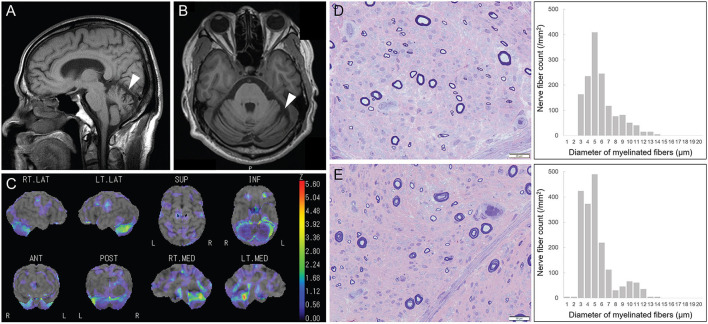
Radiological and pathological features of patients with disease-associated RFC1 repeat expansions. (A,B) Brain MRI shows cerebellar atrophy (white arrow; P10). (C) Brain single photon emission computed tomography (SPECT) reveals decreased blood flow in the cerebellar region (P21). (D,E) Marked loss of large and small myelinated fibers (large > small). Myelinated fiber densities are 1,456/mm2 and 1,880/mm2, respectively, from P31 with [(AAGGG)exp/(AAGGG)exp] and P10 with [(ACAGG)exp/(ACAGG)exp].
Figure 4
Figure 4
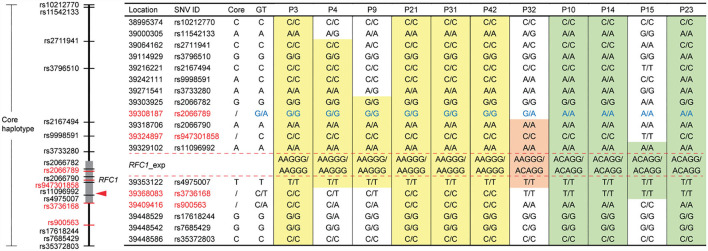
Single-nucleotide variant (SNV)-based haplotype analysis of 11 cases with different disease-associated RFC1 repeat expansions. The “core haplotype” region, spanning from chr4:38995374 (rs10212770) to chr4:39448586 (rs35372803), is covered by 14 previously applied and 4 new SNV markers (red color). GT: genotype. Respectively, 49.2 kb (chr4: 39303925~39353122) and 453.2 kb (chr4: 38995374~39448586) highly conserved homologous haplotype blocks are identified from all six cases carrying [(AAGGG)exp/(AAGGG)exp] (yellow background) and 3/4 of cases with [(ACAGG)exp/(ACAGG)exp] (green background). P32 carrying [(AAGGG)exp/(ACAGG)exp] shares an identical haplotype block (chr4: 39318706~39353122; light red background) with other repeat expansion subtypes. Genotype of rs2066789 (G/A) is haplotype specific (blue color), and the haplotype of P15 is unique.

References

    1. Davidson G, Murphy S, Polke J, Laura M, Salih M, Muntoni F, et al. . Frequency of mutations in the genes associated with hereditary sensory and autonomic neuropathy in a UK cohort. J Neurol. (2012) 259:1673–85. 10.1007/s00415-011-6397-y - DOI - PMC - PubMed
    1. Rotthier A, Baets J, De Vriendt E, Jacobs A, Auer-Grumbach M, Levy N, et al. . Genes for hereditary sensory and autonomic neuropathies: a genotype-phenotype correlation. Brain. (2009) 132:2699–711. 10.1093/brain/awp198 - DOI - PMC - PubMed
    1. Yuan JH, Hashiguchi A, Yoshimura A, Sakai N, Takahashi MP, Ueda T, et al. . WNK1/HSN2 founder mutation in patients with hereditary sensory and autonomic neuropathy: a Japanese cohort study. Clin Genet. (2017) 92:659–63. 10.1111/cge.13037 - DOI - PubMed
    1. Cortese A, Simone R, Sullivan R, Vandrovcova J, Tariq H, Yau WY, et al. . Biallelic expansion of an intronic repeat in RFC1 is a common cause of late-onset ataxia. Nat Genet. (2019) 51:649–58. 10.1038/s41588-019-0372-4 - DOI - PMC - PubMed
    1. Rafehi H, Szmulewicz DJ, Bennett MF, Sobreira NLM, Pope K, Smith KR, et al. . Bioinformatics-based identification of expanded repeats: a non-reference intronic pentamer expansion in RFC1 causes CANVAS. Am J Hum Genet. (2019) 105:151–65. - PMC - PubMed

LinkOut - more resources