


Longitudinal relations between behavioral engagement and academic achievement: The moderating roles of socio-economic status and early achievement
- PMID: 36064213
- PMCID: PMC9484542
- DOI: 10.1016/j.jsp.2022.08.001
Longitudinal relations between behavioral engagement and academic achievement: The moderating roles of socio-economic status and early achievement
Abstract
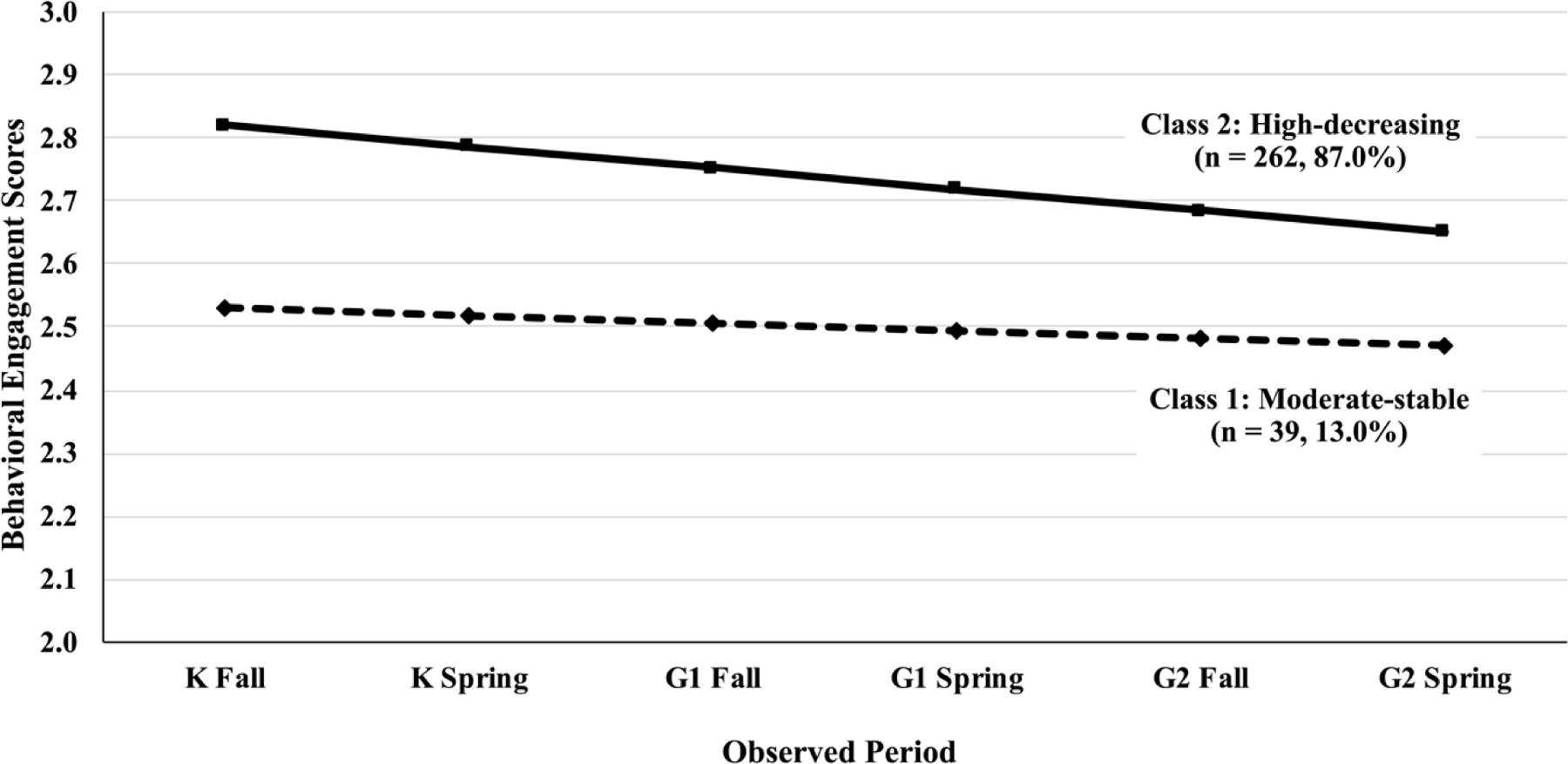
This study investigated developmental trajectories of observationally coded engagement across the early elementary years and whether these trajectories were associated with children's academic achievement. Furthermore, we evaluated if these relations varied as a function of children's family socio-economic status and early reading and math skills. Data were collected from 301 children who were studied from kindergarten (Mage = 65.74 months; 49% boys) to 2nd grade. Children's behavioral engagement was observed in kindergarten, 1st, and 2nd grade. Reading and math skills were assessed via standardized tests in kindergarten and 2nd grade. Growth mixture models identified two classes of behavioral engagement: most children (87.0%) displayed relatively high behavioral engagement in the fall of kindergarten and decreased significantly across time (referred to below as high-decreasing class), and other children (13.0%) exhibited moderate behavioral engagement in the fall of kindergarten that was stable across time (referred to below as moderate-stable class). After controlling for academic skills in kindergarten and demographic variables (i.e., child age, sex, ethnicity, and family socio-economic status), children in the high-decreasing class displayed higher reading skills, but not math skills, than children in the moderate-stable class. Additional analyses revealed that differences in reading skills between the two classes were present only for children from low socio-economic status families or for children low in kindergarten reading skills. The findings suggest that economically or academically at-risk students might benefit more than their peers from high behavioral engagement.
Keywords: Academic achievement; Behavioral engagement; Developmental trajectories; Early elementary school.
Copyright © 2022 Society for the Study of School Psychology. Published by Elsevier Ltd. All rights reserved.
Conflict of interest statement
Declaration of Competing Interest None.
Figures

References
-
- Aikens NL, & Barbarin O (2008). Socioeconomic differences in reading trajectories: The contribution of family, neighborhood, and school contexts. Journal of Educational Psychology, 100, 235–251. 10.1037/0022-0663.100.2.235 - DOI
-
- Archambault I, & Dupéré V (2017). Joint trajectories of behavioral, affective, and cognitive engagement in elementary school. The Journal of Educational Research, 110, 188–198. 10.1080/00220671.2015.1060931 - DOI
-
- Archambault I, Janosz M, Goulet M, Dupéré V, & Gilbert-Blanchard O (2019). Promoting student engagement from childhood to adolescence as a way to improve positive youth development and school completion. In Fredricks JA, Reschly AL, & Christenson SL (Eds.), Handbook of student engagement interventions: Working with disengaged students (pp. 13–29). Academic Press.
-
- Bauer DJ (2007). 2004 Cattel Award Address: Observations on the use of growth mixture models in psychological research. Multivariate Behavioral Research, 42, 757–786. 10.1080/00273170701710338 - DOI
-
- Bodovski K, & Farkas G (2007). Mathematics growth in early elementary school: The roles of beginning knowledge, student engagement, and instruction. The Elementary School Journal, 108, 115–130. 10.1086/525550 - DOI
