


Device-measured physical activity and incident affective disorders
- PMID: 36064521
- PMCID: PMC9446787
- DOI: 10.1186/s12916-022-02484-0
Device-measured physical activity and incident affective disorders
Abstract
Background: Studies on physical activity (PA) and mental health are largely limited to self-reported PA. This study aims to use prospective cohort data to investigate the association between device-measured PA and affective disorders.
Methods: A total of 37,327 participants from UK Biobank who had not had any prior affective disorder diagnoses were included in this prospective cohort study. Wrist-worn accelerometers were used to measure total, light (LPA), moderate (MPA), and vigorous (VPA) PA. Associations between PA domains and affective disorders were analysed using penalised splines in Cox proportional hazard models. Analyses were adjusted for other intensity-specific PA and sociodemographic and lifestyle factors. Sensitivity analyses were conducted adjusting for body mass index and longstanding illnesses as well as excluding events in the first 2 years of follow-up. Preventable fractions for the population were estimated for MPA and VPA.
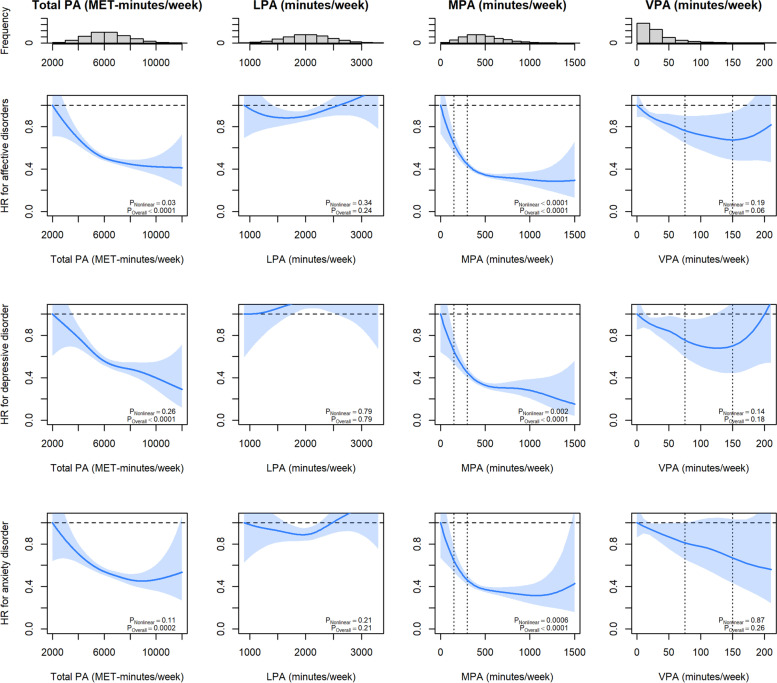
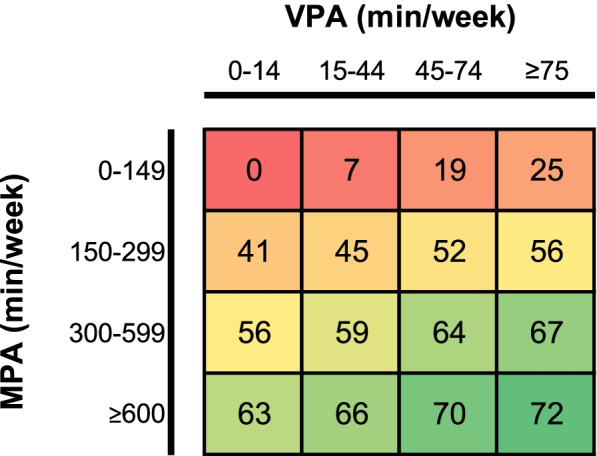
Results: Over a median follow-up of 6.8 years, 1262 (3.4%) individuals were diagnosed with affective disorders. Replacing 30 min of sedentary behaviour in a week with MPA (HR 0.95, 95% CI 0.94-0.97) or VPA (HR 0.91, 95% CI 0.85-0.98) was associated with lower risk of affective behaviours, up to 500 and 120 min of MPA and VPA. Assuming causality, 5.14% and 18.88% of affective disorders could have been prevented if MPA ≥150 min/week and VPA ≥75 min/week were achieved, respectively, across the study population.
Conclusions: Device-measured MPA and VPA were associated with lower risk of affective disorders. The potential mental health benefits of MPA continue to accrue above the current World Health Organization recommendation.
Keywords: Accelerometery; Anxiety; Depression; Mental health; Physical activity.
© 2022. The Author(s).
Conflict of interest statement
The authors declare that they have no competing interests.
Figures
References
-
- James SL, Abate D, Abate KH, Abay SM, Abbafati C, Abbasi N, et al. Global, regional, and national incidence, prevalence, and years lived with disability for 354 diseases and injuries for 195 countries and territories, 1990–2017: a systematic analysis for the Global Burden of Disease Study 2017. Lancet. 2018;392(10159):1789–1858. doi: 10.1016/S0140-6736(18)32279-7. - DOI - PMC - PubMed
-
- NICE . Physical activity: exercise referral schemes. Public health guideline [PH54] London: National Institute for Health and Care Excellence; 2014.
MeSH terms
Grants and funding
LinkOut - more resources
Full Text Sources
Medical
Miscellaneous
