


doi: 10.1038/s41467-022-32866-0.
Potential solutions for manufacture of CAR T cells in cancer immunotherapy
Affiliations
- PMID: 36064867
- PMCID: PMC9445013
- DOI: 10.1038/s41467-022-32866-0
Item in Clipboard
Potential solutions for manufacture of CAR T cells in cancer immunotherapy
Nat Commun.
.
Abstract
CAR T cell therapy is an effective cancer treatment, but biological and manufacturing hurdles hamper its broad breakthrough. Although the first step towards automated manufacture of CAR cells has been taken, new technologies are needed to enable the treatment of large patient groups.
Conflict of interest statement
U.K. is a consultant in immuno-oncology for AstraZeneca, Affimed, Glycostem, GammaDelta and Zelluna. S.F. is a consultant for Janssen-Cilag. All authors are involved in collaborations with Novartis and Miltenyi Biotec regarding the production of CAR T cells. All authors declare no other competing interests.
Figures
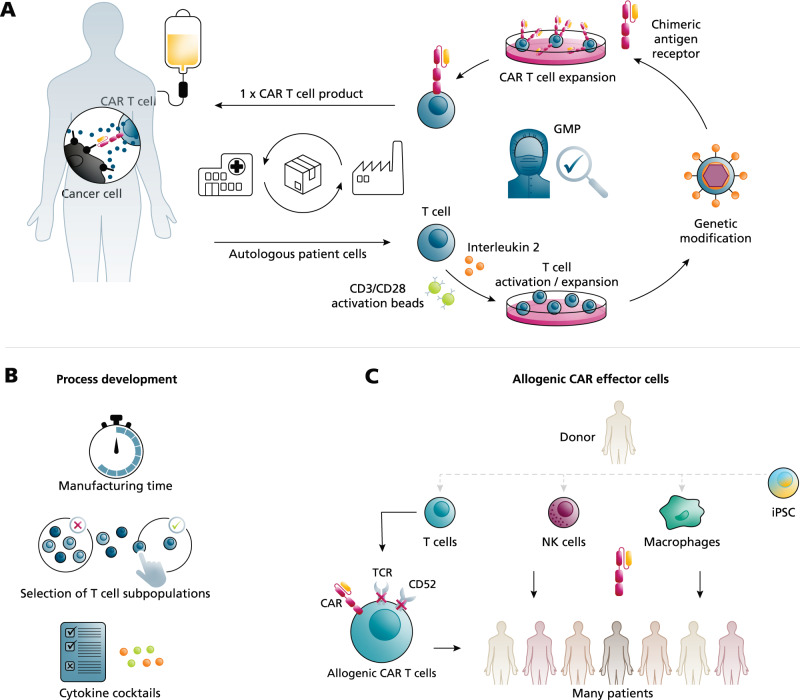
A Currently approved autologous chimeric antigen receptor (CAR) T cell immunotherapy is based on a person’s own T cells that are given back to the same patient after ex vivo modification. The production process is performed under Good Manufacturing Practice (GMP) conditions and monitored by several quality controls. B Biological approaches to increase CAR T cell quality by process development include the reduction of the manufacturing time, the selection of efficient T cell or CAR T cell subpopulations and the required cytokine combinations in order to avoid exhausted cells. C For allogenic CAR immunotherapy, different immune effector cells are obtained from healthy donors and can be given to a large cohort of patients. To enable allogenic CAR T cells, depletion of their T cell receptor (TCR) and the CD52 molecule is performed before they are further modified with the CAR. Other promising immune effector cells are natural killer (NK) cells or macrophages. To obtain cells for allogenic CAR cells, mature healthy donor cells could be derived from induced pluripotent stem cells (iPSC) in the future.
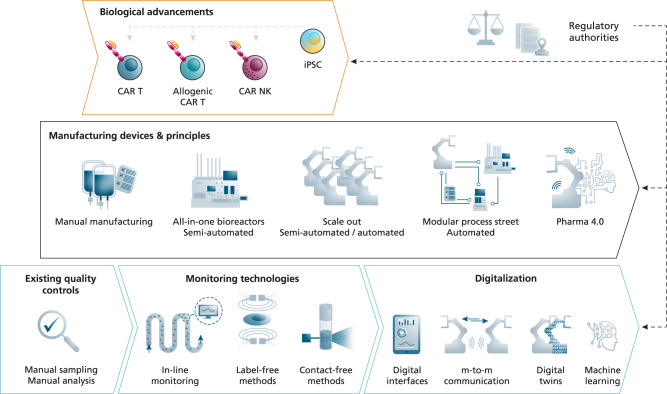
Novel manufacturing devices and principles to enable automated CAR cell production. CAR T cells are often produced manually but first semi-automated all-in-one bioreactors are available for the GMP compliant cell manufacturing. For a high-throughput production of autologous products, one solution is using parallelized manufacturing devices. Another principle is connecting different manufacturing devices performing specific sub-processes of the CAR cell manufacturing automatically in process streets. For full automation, these advancements in manufacturing require novel engineering solutions in the fields of real time monitoring and in-line quality control technologies (non-invasive, label-free, contact-free). In addition, automated high-throughput manufacturing of CAR cell products needs the implementation of real-time capable data processing systems, the digital communication of all involved devices and digital representatives of the system (digital twins). All these technical innovations must be closely co-developed and implemented with respect to the biological advancements in CAR immunotherapy and with the requirements of regulatory agencies.
References
Publication types
MeSH terms
Substances
LinkOut - more resources
Full Text Sources
Other Literature Sources
Medical
